Sunday, August 30, 2015

A New Creation


A Reflection:
“Therefore, if anyone is in Christ, he is a new creation; old things have passed away; behold, all things have become new.” 
~ 2 Corinthians 5:17
 

A Short Prayer:
Lord, as you did with Venerable Matt Talbot, help us to overcome all earthly attachments and self-destructive addictions.  Make us a new creation.  Amen.


Friday, August 21, 2015

Seek the Change That Matters

"To his friends and even his family, Matt Talbot looked like an ordinary, hard-working man with a strong religious bent. On the inside, though, he was a warrior waging a spiritual battle that lasted forty-one years and made him a hero of the faith.

His story shows us that the deepest and longest-lasting changes aren’t the showy, splashy announcements. They are the inner decisions that may only take a second to make but require a lifetime to live out."
                                       Woodeene Koenig-Bricker


Sunday, August 16, 2015

Tuesday, August 11, 2015

Paying Attention to God

The theologian, Dr. Ralph Martin (http://www.shms.edu/content/dr-ralph-martin) has stated that “prayer is, at root, simply paying attention to God.”  This definition is particularly  descriptive of Matt Talbot's focus during the last forty-one years of his life.

Sunday, August 2, 2015

Venerable Matt Talbot included in new Celtic Saints book

In his latest book, The Spirituality of Celtic Saints (2015, New Priory Press), theologian Richard J. Woods, O.P., provides a thorough survey of Celtic saints.
 
Venerable Matt Talbot is included in the section titled “Urban Sanctity,” pages 216-217 (among other pages) at the link:

Sunday, July 19, 2015

Venerable Matt Talbot, a “Missionary of Mercy”

Archbishop Eamon Martin, Archbishop of Armagh and Primate of All Ireland, celebrated Mass today at the Annual Pioneer/Matt Talbot/ Apostleship of Prayer Pilgrimage to the National Marian Shrine in Knock. In his homily below he notes Venerable Matt Talbot as a “missionary of mercy.
 
 
“I would like to thank God today for the many missionaries of mercy around this country who unselfishly reach out to help those who are addicted by offering prayer, providing counselling and therapy, recovery programmes and pathways of mentoring and support for addicts and their families … few Irish families that have not been impacted in some way by the problems of addiction, whether it be to alcohol, tablets or other drugs, online gambling, pornography or some other dependent behaviour” – Archbishop Eamon Martin

Earlier this week I had the joy of making a pilgrimage to the birthplace of one of my spiritual heroes – Pope Saint John XXIII. Standing in the humble surroundings of his family home in Sotto Il Monte, I gave thanks to God for this good shepherd who was the pope when I was born.

Angelo Roncalli was seventy six years old when he was elected as successor to Saint Peter and he lived only a further five years. At the time they said he would simply be a ‘caretaker pope’, a ‘stopgap’ until the next man – but they were wrong! Within months Pope John called the Second Vatican Council which began its work in 1962 and ended in 1965, fifty years ago this year. Pope John had the courage to call for renewal in the Church; he spoke about the importance of reading ‘the signs of the times’ and interpreting them in the light of the Gospel of Jesus Christ.

In my prayers at Sotto Il Monte this week I reflected on some of the signs of our times. I was conscious that I was coming to Knock today for the pilgrimage of the Pioneer and Total Abstinence Association, so naturally I reflected on the witness of your Association at this time in Ireland as excessive drinking and other addictions continue to cause so much hurt and destruction in many Irish homes and families.

I found myself asking God: “Why is that despite all our efforts to read ‘the signs of the times’ and spread the good news of Jesus Christ, we always seem to be fighting an uphill battle against the darkness of evil in our world? So many people are in need; so many people are searching for meaning and hope in their lives; so many seem lost or astray. What can we do to help them?”

It strikes me that that is precisely how the disciples felt in today’s Gospel reading when they returned to Jesus. Remember, in last Sunday’s Gospel, Jesus summoned the twelve and sent them out to all the towns and villages. This week they’re back and they’re exhausted! So many people are coming and looking for them that they don’t even have time to eat. Jesus invites them to come away with Him to a lonely place to rest for a while. When Jesus notices that the people have found them and keep coming, He takes pity on them, because they are “like sheep without a shepherd”.

It is a description which might apply to many Irish people today – indeed perhaps we all at times feel “like sheep without a shepherd”.

So what did Jesus do for His troubled people? The Gospel tells us He sat down and talked to them at some length, and then, as we will find out next Sunday, He fed them. He nourished them with His word; He fed their hunger; then, He sent them to seek out His others who were lost or astray, to reach out in love and mercy to those who were harassed and overwhelmed by the problems of life.

Thank God that here today in Knock, and at every celebration of the Eucharist, we are nourished at the table of His Word, and fed at the table of His Body and Blood. In sharing this ‘banquet’ we open our own lives up to His love and mercy. We come to know better that He, the Lord, is our Shepherd too; if we can only allow Him fully into our lives then there is nothing we shall want, and even if we sometimes find ourselves walking through life in the valley of darkness or the shadow of death, we need not fear because He is there with us with his staff, to bring us comfort and guide us again along the right path. At the end of Mass, we are sent out from here to touch the lives of others with the loving presence and tender mercy of Christ, particularly those who are weak and struggling.

Recently I met a man in his mid-forties who told me that a few months ago he took the Pioneer pledge on behalf of his son who is alcoholic. He said “I want my son to know I am with him in his struggle and he’s not on his own”. He went on to tell me that he used to enjoy a drink himself: “For me” he said, “this is just a little sacrifice for God; but for my son it’s a life or death issue.” I thought: What a wonderful way this man has chosen to put his faith into practice – to make a personal sacrifice which gives glory to God, which offers a powerful witness to others, and at the same time asks God’s grace and help for someone else in their struggle with addiction.

Today, my brothers and sisters in the Pioneer Total Abstinence Association of the Sacred Heart, I want to affirm the heroic self-sacrifice and offering that you and thousands of others in the Association have been making for almost one hundred and twenty years. When Father James Cullen founded your Association back in 1898, he wanted you to be ‘pioneers’ in the sense of going out and leading the way from the slavery of addiction towards the freedom of sobriety.

Father Cullen wanted the Association to be rooted in devotion to the Sacred Heart, because he knew that it is only through the unconditional love and mercy of the Heart of Jesus that we can be truly set free from selfishness and anything that is imprisoning us.

Father Cullen had no illusions about the damage that excessive drinking was doing in his time. Sadly, that remains the case today. According to the charity Alcohol Action Ireland, research tells us that half of all adults who drink in Ireland are “harmful high risk drinkers” and 15% of our 18-24 year olds who drink are already dependent. Alcohol is a factor in half of the suicides in Ireland and more people die each day from alcohol-related problems than on our roads. Increasingly nowadays more women and young people are presenting for help with alcohol dependency. I imagine there are few Irish families that have not been impacted in some way by the problems of addiction, whether it be to alcohol, tablets or other drugs, online gambling, pornography or some other dependent behaviour.

How can we read these signs of our times and interpret them in the light of the Gospel? What is it in our culture that has left us so prone to addictive behaviours? Why are so many people today being caught up in dependency on alcohol, drugs or some other compulsion? Could it be that we are trying to live our lives without a true openness to God and his loving mercy and as a result we end up like sheep without a shepherd? Have our lives become so empty of meaning or true purpose, so lacking in true love or intimacy that we feel the need to escape into the false comfort of addictive behaviours? Perhaps all of us can identify behaviours in our personal lives which we know deep down are not good for us – like overuse of alcohol, drugs or the internet, an unhealthy relationship, obsession with work, the need to gamble or risk, compulsive consumerism, or a fixation with someone or something which dominates our lives to the exclusion of those who are most dear to us.

Being honest with ourselves like this, and recognising our weaknesses, can help open us up to the unconditional love and mercy of God. It also prevents us from becoming self-righteous or ‘holier than thou’, and looking down on those who are dependent as if it was their fault, rather than recognising that they are people who have lost power and control over their lives and who simply cannot stop without humbly and honestly admitting their need for help.

I think of the Venerable Matt Talbot who recognised his weakness and then quietly undertook daily sacrifice and penance while reaching out humbly in love and charity to others. In preparation for the Jubilee Year of Mercy Pope Francis has been speaking about the need for “missionaries of mercy” in the world. Last Advent he said “there is a need for people who are witnesses of the mercy and tenderness of the Lord, which shakes up those who are resigned, revives the discouraged, (and) ignites the fire of hope.” Matt Talbot was such a “missionary of mercy”, and so also should be every member of the Pioneer Association.

I would like to thank God today for the many missionaries of mercy around this country who unselfishly reach out to help those who are addicted by offering prayer, providing counselling and therapy, recovery programmes and pathways of mentoring and support for addicts and their families.

Father Cullen genuinely believed that lives can be changed by openness to the love and mercy of the Sacred Heart and by prayer, fasting and self-denial. His secret was to encourage even those people who did not have a problem with drink to make a generous self-offering on behalf of those who could not control their addiction. Today I encourage you to continue this positive witness in Ireland which speaks with such compassion to the signs of our times in the heart of the Church and the community. May God continue to bless the Pioneer Total Abstinence Association. May our Lady of Knock, Queen of Ireland and Mother of Mercy, touch the lives of those who are struggling with addictions of any kind and point them to the tender love of her Son, Jesus Christ our Lord. Amen.

The Pioneer Prayer
For thy greater Glory and consolation, O most Sacred Heart of Jesus, for Thy sake, to give good example, to practice self-denial, to make reparation to Thee for the sins of intemperance and for the conversion of excessive drinkers, I will abstain for life from all intoxicating drinks, Amen."


http://www.catholicbishops.ie/2015/07/19/homily-of-archbishop-eamon-martin-for-3-00pm-mass-celebrating-the-pilgrimage-of-the-pioneer-total-abstinence-association-to-the-national-marian-shrine-in-knock/

Saturday, July 11, 2015

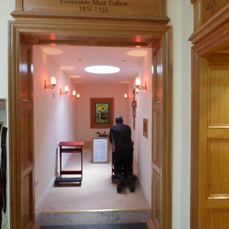
A Small Matt Talbot Shrine


A priest is praying in the small Venerable Matt Talbot Shrine at the Franciscan Church on Merchants Quay in Dublin. (Photo by Ken Johnston)

Thursday, July 9, 2015

Matt Talbot Image


Note:  This photograph was posted by Ken Johnston on 30 June 2015 at
https://www.facebook.com/ken.johnston.167/posts/1134472103236554

Wednesday, July 1, 2015

Ballad of Matt Talbot


Davey Inthevalley wrote and sings this song about "Dublin's beloved Venerable Matt Talbot," which was published on 15 June 2015.

What apparently struck Davey about Matt was that Matt was an ordinary man, a hard worker, and eventually found grace that lead him to true sobriety.

Monday, June 29, 2015

Enhancing Awareness of Venerable Matt Talbot in Lithuania

 
Our friend, Grzegorz Jakielski, is particularly passionate about spreading awareness of Venerable Matt Talbot not just in Poland but throughout the world.
 
Last week he went on a three-day journey to Lithuania where he visited and photographed many Lithuanian churches and left holy cards of Matt Talbot with the prayer for his beatification in each.
 

Thursday, June 25, 2015

On Reading the Bible


From the time of Matt Talbot’s conversion and abstaining from alcohol, he read (and marked) his Bible daily and the writings of such authors as St. Augustine. When he didn’t understand a passage, he would seek clarification from his spiritual director.

The Bible contains keys to right living that Matt applied and we can apply immediately: do unto others what you would have them do unto you, turn the other cheek, and honor your father and mother. But it’s more than just a self-help book. The most important aspect of God’s word is its ability to bring us face-to-face with Jesus, who is the living Word of God.

Augustine was raised by a Christian mother and was probably familiar with many of the stories and teachings in the Bible. But it wasn’t until he had a personal experience of God speaking to him through Scripture that his life turned around. 


What happened for Augustine can happen for us. If we spend time with the word of God every day—not just reading it but pondering it, praying through it, and listening to it—we’ll begin to find Jesus. Our hearts will be stirred by what we read, and the words will begin to come alive for us, as if they were written just for us. We’ll hear Jesus speaking them to us, showing us how they apply to our own situations and filling our hearts with freedom and hope.

Friday, June 19, 2015

1963 Documentary About Matt Talbot

This 41 minute documentary is unique in that it consists of interviews conducted in 1963 with people who were acquainted with Matt.
Along with a brief text introduction about Matt in English, Polish, and German, it may be viewed at 

Monday, June 15, 2015

Support for Venerable Matt Talbot in Poland


Grzegorz Jakielski, an active supporter of Venerable Matt Talbot in Poland, sent some photographs from the VII Meeting with Matt Talbot in Plock Trzepowo last week, which can be viewed at   http://mateusztalbot.pl/strony/7spotkanie-galeria.html or on Facebook at https://www.facebook.com/pages/Matt-Talbot/304690079653019


Sunday, June 14, 2015

Inviting God to Use Me

While this homily is addressed to all of us, it may speak especially to those who are addicted.

 If You Can Use Anything Lord, You Can Use Me - Homily for the 11th Sunday of the Year
Msgr. Charles Pope
June 14, 2015 
http://blog.adw.org/2015/06/if-you-can-use-anything-lord-you-can-use-me/

The readings today speak of God’s providence, which is often displayed in humble, hidden, and mysterious ways. While it is true that God sometimes works in overpowering ways, His more common method seems to be to use the humble and even unlikely things of the created order to accomplish His goals.

For us who are disciples, there are three related teachings that speak of how God will make use of us and of others. It will also be good to link these teaching to Father’s Day, which occurs next weekend in the U.S. These three teachings can be described as Adaptability, “Awe-Ability,” and Accountability.

I. ADAPTABILITY – In today’s first reading as well as in the gospel, we hear how God can take something humble and adapt it to be mighty and powerful.
The tender shoot of the first reading becomes a mighty oak: I, [the Lord], will take from the crest of the cedar … a tender shoot, and plant it on a high and lofty mountain; … It shall put forth branches and bear fruit, and become a majestic cedar (Ezekiel 17:22-23).

The mustard seed of the first reading becomes a great shade tree: The … kingdom of God … is like a mustard seed that, when it is sown in the ground, is the smallest of all the seeds on the earth. But once it is sown, it springs up and becomes the largest of plants and puts forth large branches, so that the birds of the sky can dwell in its shade (Mk 4:32-33).

The next time you think God can’t use you, remember

Noah was a drunk
Abraham was too old
Isaac was a daydreamer
Jacob was a liar
Leah was ugly
Joseph was abused
Moses was murderer had a stuttering problem
Gideon was afraid
Samson had long hair and was a womanizer
Rahab was a prostitute
Jeremiah and Timothy were too young
David had an affair and was a murderer
Elijah was suicidal
Isaiah preached naked
Jonah ran from God
Naomi was a widow
Job went bankrupt and was depressed
Peter denied Christ
The Disciples fell asleep while praying
Martha worried about everything
The Samaritan woman was divorced, more than once
Zacchaeus was too small
Paul was too religious
Timothy had an ulcer
Lazarus was dead!


No excuses then, God chooses the weak and makes them strong

In fact, it is often our very weakness that is the open door for God. In our strength we are usually too proud to be of any use to Him. Moses was too strong at age forty when he pridefully murdered a man, thinking he was doing both the Jews and God a favor. It was only forty years later, at the age of eighty, that was Moses weak and humble enough to depend on God. Only then could God use him.

We are invited in this principle to consider that it is not merely in the “biggie-wow” things we do that God can work. It is also in the humble and imperfect things about us, the mustard seed of faith, the tiny shoots, and the humble growth that God can magnify His power.

So the first principle is adaptability. God can take and adapt even the humblest, most ordinary, lowliest things and from them bring forth might and lasting fruit. Never despair over what is most humble about you, or that you are of little account on the world’s stage. It is precisely our humble state that God most often uses to bring forth His greatest and most lasting works.

II. “AWE-ABILITY” – This is the capacity to reverence mystery and to have wonder and awe at what God does. In today’s gospel, Jesus emphasizes that though a man plants seeds, he does not really know the deeper mysteries of life and growth:
This is how it is with the kingdom of God; it is as if a man were to scatter seed on the land and would sleep and rise night and day and through it all the seed would sprout and grow, he knows not how (Mk 4:26-27).

Despite our often self-congratulatory celebration of our scientific prowess and of how much we know, there is much more that we neither know nor understand. We do well to maintain a reverential awe of the deeper mysteries of God’s works and His ways. We are also rather poor at assessing how effective our methods are. We may come away from a project considering it to have been very effective, and yet little comes of it in the long run. Conversely, sometimes what we consider to have been an ineffective effort may bear great fruit. God works in His own ways and we do well to remember that God can surprise us, reminding us that He is able and is in charge.

Some years ago, a friend of mine had on her desk a “God can.” It was a metal cookie tin with the following saying on its cover: “He worketh in strange and mysterious ways, his wonders to perform.” Into this box she would place slips of papers on which were written the challenges, struggles, and failures of her life. When she met the limits of her strengths and abilities, she would say, “I can’t … but God can.” So into this metal “God can” went the slips of paper, placed there in the hope that God would make a way out of no way. And quite often He did.

We do well to cultivate a sense of wonder and awe at who God is and how He works. Not only does this bring us joy, but it also opens us to hope and to the possibility that God can work in hidden ways to exult what is humble and to transform those who are cast down and troubled, including us and our culture. As we saw in the “adaptability” section, it is often in the humblest things that God does His mightiest works.
 
The second reading today reminds us, For we must all appear before the judgment seat of Christ, so that each may receive recompense, according to what he did in the body, whether good or evil (2 Cor 5:9-10).

As we have seen, God is able to adapt and to work in wondrous and hidden ways to lift us up, even if we are humble and struggling. Given this capacity of God’s, we must one day render an account of how we have responded to God’s grace and His invitation to be exulted.

On the Day of Judgment, the answer “I couldn’t” will ring hollow because, as we have seen, “God can.” Today’s readings remind us to be open to what God can do, often in mysterious ways, and even with the most humble things in our lives.

As Father’s Day approaches, I am calling the men in my parish to account. I am summoning them to spend a year preparing, with prayer, Bible study, and fellowship to make the following pledge:

I DO solemnly resolve before God to take full responsibility for myself, my wife, and my children.
I WILL love them, protect them, serve them, and teach them the Word of God as the spiritual leader of my home.
I WILL be faithful to my wife, love and honor her, and be willing to lay down my life for her as Jesus Christ did for me.
I WILL bless my children and teach them to love God with all of their heart, all of their mind, and all of their strength.
I WILL train my children to honor authority and to live responsibly.
I WILL confront evil, pursue justice, and love mercy.
I WILL pray for others and treat them with kindness, respect, and compassion.
I WILL work diligently to provide for the needs of my family.
I WILL forgive those who have wronged me and reconcile with those I have wronged.
I WILL learn from my mistakes, repent of my sins, and walk with integrity as a man answerable to God.
I WILL seek to honor God, be faithful to His church, obey His Word, and do His will.
I WILL work courageously with the strength God provides to fulfill this resolution for the rest of my life and for His glory.


As for me and my house, we will serve the Lord (Joshua 24:15).
This resolution comes from a movie of a few years ago called Courageous, which I strongly recommend you see (if you have not already done so).

Indeed all of us, men and women, will be held accountable. For even if we can’t, God can. And even if we feel too humble and insignificant, God does His greatest work with humble things and humble people. For us, it is simply to say that we have an adaptability that God can use. This should inspire in us an “Awe-ability” that joyfully acknowledges God’s often secretive and hidden power. If that be the case, then, knowing our accountability, it simply remains for us to say, “If you can use anything, Lord, you can use me!”

Saturday, June 13, 2015

Cheap vs Costly Grace

This homily by Fr. Lincoln, who currently serves St. James Parish in Tupelo, Mississippi, is posted at http://peregrinolincoln.blogspot.com/search/label/homily%20-%20costly%20grace%20vs%20cheap%20grace


6/14/2015 – 11th Sunday in Ordinary Time – Matthew 4:26-34


We are back in Ordinary Time this Sunday after having many weeks of Lent and the Easter season, of the solemnities of the Most Holy Trinity and the Body and Blood of Christ.  In fact, the last time we had a Sunday in Ordinary Time was way back in February in the middle of winter.  Today, in the middle of our summer months, in the midst of our farmers trying to grow their crops and many of our parishioner trying to grow their gardens with all the rain we’ve been having, its appropriate that we hear Jesus teaching us about the Kingdom of God through parables about seeds.   


In particular, it is the parable of the mustard seed that intrigues me today.  Jesus spoke in parable in our to help us to better understand the Kingdom of God.  The parable of the mustard seed and these other parables are meant to shed light on the new reality we are to live out when we are called to a life of discipleship and when we begin to cooperate with God’s grace in our lives.

Grace – that is an interesting concept, isn’t it?  I will have to admit that perhaps we don’t here about grace enough at mass or in our preaching.  Grace is the presence of God in our lives.  Grace is our participation in the life of God – in the life of the Holy Trinity.  Grace is a supernatural gift that God gives to us, a gift that comes out of his goodness and benevolence, a gift that he bestows upon us for our eternal salvation.  Grace is given to us freely.  But we have to respond to that grace in order for it to bear fruit in our life.  We have the potential to respond to grace, just as the mustard seed had potential to grow into this amazing and wonderful plant.   

Think of how we can validly receive a sacrament, such as receiving the Holy Eucharist when we come to mass.  But there is a difference between validly receiving a sacrament and fruitfully receiving the sacramental graces that this sacrament offers us.  We cannot be passive in our faith, just as we cannot be passive in receiving a sacrament.  We receive God’s grace in the sacraments and in our lives through our personal faith, through our expectancy, through the hunger and thirst we have for God in our lives.

But the grace we are talking about is costly grace, to quote the words of Dietrich Bonhoeffer, the renowned German theologian who was put to death by the Nazis in WWII.   Jesus didn’t die for us and bring us salvation so we could stay trapped in a cycle of sin.   He died for us so that we could be transformed and receive new life.  If Jesus just had pity on us and did not challenge us to rise from our sins, to be transformed into a new creation, then his death would have been in vain.  Then the grace that Jesus offers would be cheap grace. It would be the kind of grace that does not mean anything to us because it does not require anything from us in return.  God’s grace calls us to holiness. It calls us to transformation, renewal, and conversion.   

We all know that there are certain behaviors and lifestyles that our world deems to be acceptable and even praiseworthy.  But through the lens of our faith, those behaviors and lifestyles are not part of the kingdom of God.  That is why Paul boldly asserts today that we walk by faith, not by sight, because the ways of the world can lead us astray sometimes and keep us from repentance and conversion. If we don't walk in the light of our faith, if we don’t interact with the graces we receive from God, then we remain children of the world, not children of the light of Christ...
     
...I have mentioned before that I really enjoy this daily devotional publication called Give Us This Day published by the Liturgical Press in Collegeville, Minnesota.  One of the features I like is “Blessed Among Us,” which is a short reflect on saint or a person who has lived out his faith in a meaningful way.  I think that the secular world mistakenly views a saint as a perfect person with few flaws and faults.
For us Catholics, saint include those people of faith who rose above their struggles in life, who met life in their reality and tried to infuse that reality with faith, who stand as examples of faith for all of us.   

The Blessed Among Us for Tuesday was an Irishman named Matt Talbot.  Matt Talbot was not a priest or a ground-breaking theologian, or a powerful leader of society.   He was a laborer who struggled to make a living, who had almost no formal education, who was an alcoholic since he was a teen.  Yet, at the age of 28, he had enough of his miserable existence, he walked into a church, committing himself to a path of conversion and change in his life.   He took a pledge not to drink anymore.

Nonetheless, he struggled mightily for the first year, at one point collapsing on the steps of a church, not knowing if he could go another step in life.   But daily mass and a devotion to prayer and penance kept him on the right path. He even tried to make amends to the people he had harmed or to those from whom he borrowed money to buy drink.  We think of the many who struggle in our society with addictions of many kinds.

Cheap grace would excuse those addictions and not challenge us to break out of that cycle.  Cheap grace would let us take the easy way out. But the life of Matt Talbot, an Irishman who died in 1925 and who was named Venerable by Pope Paul VI and who possibly will be canonized one day, is a witness of faith for all of us.  Grace is costly, not cheap.  It demands something for us.  It demands sacrifice and commitment and faith.  Finding a way to respond to grace in our lives is a way for us to let that little mustard seed of faith grow and develop in our lives and to bear fruit.   

And remember this – Love God.  Love your neighbor.  Be a disciple.  Make disciples.

Sunday, June 7, 2015

90th Anniversary Gathering at Granby Lane

Matt Talbot was on his way to Mass at St. Saviour’s Church, Dominick Street, Dublin on Trinity Sunday, 7 June 1925, when he collapsed and died of heart failure on Granby Lane.


Granby Lane then and now
Matt Talbot's photo.


Matt Talbot's photo.


Earlier today, there was a procession from St. Saviour’s Church to Granby Lane for laying of wreath, prayers, and blessing.


Saturday, June 6, 2015

2015 Documentary on “Matt Talbot – his life and legacy”

 
A new and important documentary on Venerable Matt Talbot, who died 90 years ago on 7 June 1925, can be viewed at http://www.icatholic.ie/matt-talbot-life-legacy/.

It was recorded at the Matt Talbot Shrine in Dublin, with Fr. Brian Lawless, Vice Postulator for the cause of Venerable Matt Talbot, as the presenter.

Thursday, June 4, 2015

Light a Candle

In solidarity with those able to attend, light a candle in memory of Venerable Matt Talbot and all our deceased family and friends.


http://www.matttalbot.ie/images/Shrine_gif.gif

Thursday, May 28, 2015

Devotees of Matt Talbot are encouraged to attend these Dublin Masses


Saturday 30th May

Fr. Michael Shields will visit the Matt Talbot Shrine, Our Lady of Lourdes Church, Sean Mac Dermott Street, Dublin 1 and celebrate Matt Talbot Vigil Mass at 7.00 pm followed by Healing Service.  Come and pray a Litany of Healing, Hope and Joy.


Sunday 31st May
Matt Talbot Novena Mass & Prayers for Healing at 3.00 pm at the Matt Talbot Shrine, Our Lady of Lourdes Church, Sean Mac Dermott Street, Dublin1. Supervised car parking.

Friday 5th June
Matt Talbot Novena Mass & Prayers for Healing at 7.30 pm. St. Agatha’s Church, North William Street, Dublin 1.
 
Saturday 6th June

Memorial Mass for Matt Talbot & our deceased loved ones at 7.00 pm. Service of Light from 8.00-11.00 pm. Matt Talbot Shrine, Our Lady of Lourdes Church, Sean Mac Dermott Street, Dublin 1


Sunday 7th June

Corpus Christi Mass at 9.30 am.  Procession to Granby Lane at 10.15 am for laying of wreath, prayers and blessing. St. Saviour’s Church, Dominick Street, Dublin 1.

Monday, May 25, 2015

Praying for Those in the Grip of Death by Addiction

Today, we pray with one voice, asking that each of those suffering from the spiritual death of addiction will be liberated from the bonds of compulsion and craving; that the hold of these harmful behaviors will be released forever.

We call to you, Lord Jesus, and to the Power upon whom you called, that like the Prodigal Son, these brothers and sisters, held in the grip of death by addiction, will be able to return to a life free from harmful dependence.

Matt Talbot was led out of the despair of dependence, by living and working in prayerful devotion. He was dedicated to helping others. Through abstinence, prayer, the Sacraments, and reading of the Word, he was saved. Today, we ask that each of the addicted be led out of the shadows and into the light of hope.

With the example of this humble servant, and all the Saints who have struggled and prevailed, we ask that our plea for sobriety be heard, and that the energy needed for recovery will be available to all who seek Your help.

Show us the way out of addiction. Lead us to a new life of Faith. Teach us, through the example of Matt Talbot, to discipline of living addiction free lives.

Send each of those who suffer from addiction behavior the strength and courage needed to overcome dependence. Inspire us to seek abstinence and sobriety in our day to day lives, to live as Matt Talbot lived, by the light of Your Holy Spirit, and the guidance of Your redeeming grace, as we seek the miracle of recovery. 

We ask this in the name of God, the Most High, Amen.