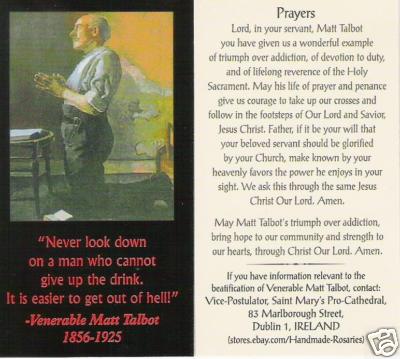
Monday, August 31, 2009

A Prayer for Temperance


Jesus, You practiced temperance; You were the Model of self-restraint, Never over-indulging in the temporal. My body being the Temple of the Lord, I must treat it with ongoing respect. Self-abuse destroys the body; Be it alcohol, drugs, or excess food. Lord Jesus, bestow fortitude upon me For my soul to control my body, To practice the virtue of temperance. Jesus, You are the source of my vigour. Through You, all is possible!


Source: http://www.catholic.org/prayers/prayer.php?p=1621

Sunday, August 30, 2009

"Prayers for Addicted Persons and Their Loved Ones" Booklet


To request a free copy of the 2009 revised edition 29 page booklet published by The National Catholic Council on Alcoholism and Related Drug Problems, Inc.( http://www.nccatoday.org/) and Guest House, send an email to NCCA@guesthouse.org.

Friday, August 28, 2009

The Power of God and Recovery


10th Week Friday …The Surpassing Power of God


Thoughts and Homilies for the Day
Mount St. Alphonsus Redemptorist Pastoral Center


The first reading from St Paul’s letter to the Corinthians begins with these words: we hold this treasure (the glory of God) in earthen vessels, so that the surpassing power may be of God and not from us. (1Cor 4, 7)


Do you remember where you heard something similar before?
Right, in the first steps of the 12 Step program…


1. The first step is to admit that our lives are unmanageable… that we can do nothing by ourselves… that the power to change does not come from us.


2. The second step is to believe that only a greater power than ourselves can restore us.


3. And the third step is to turn our lives over to God as we understand Him


Why? Because as St Paul says: HE HAS THE SURPASSING POWER. He is the only one that can free us from our addictions and make us whole.


I think I told you before that the people in Matt Talbot who come here for their retreat always pray for the canonization of Matt Talbot, the Dublin alcoholic, who conquered his addiction and went on to become a real saint. But people in Matt Talbot can never make any headway with his cause because they say that Congregation of Saints in Rome seems to only accept physical miracles… and all they have to offer as miracles is their own sobriety.


And I really think that their sobriety is not so much a proof that Matt Talbot is a saint, and I believe he is, but it is a proof that God exists and that he is alive and well and (not taking nourishment) but rather giving nourishment. God’s power is working miracles all around us and these walking miracles are enough proof for me that He who made the universe is slowly but surely bringing it to fulfillment.


I would like to paraphrase the next few verses of the first reading where Paul emphasizes what he is talking about.


“We are afflicted in every way, but by the power of God, we are not held back.
We are perplexed, but by God’s power, we are not driven to despair.
We are persecuted, but by the power of God, we are not abandoned.
We are struck down, but by God’s power, we are not destroyed.
We always carry about in our body the dying of Jesus, so that the life of Jesus (the power of God) may be manifested in us.
We sacrifice ourselves for Jesus so as to give testimony of his life in us.


Paul begins today’s reading by talking about the “power of God” and after a few sentences, he is changes and is now talking about the “life of Jesus”. For Paul they are like two sides of the same coin. And so we pray: MAY THE POWER OF GOD AND THE LIFE OF JESUS LIVE IN US ALWAYS AND GIVE US THE COURAGE TO OVERCOME ALL OUR WEAKNESSES AND SINS. AMEN!


“We hold this treasure (the glory of God) in earthen vessels, so that the surpassing power may be of God and not from us.” (1Cor 4, 7)


Note: Perhaps due to a typo, actual posting date, or our error, the apparent correct biblical reference is 2 Corinthians 4:7 for June 12, 2009 rather than June 19, 2009 if the original title link is clicked.

Thursday, August 27, 2009

"A Pint of Plain" and Matt Talbot


Bill Barich recently published his book, A PINT OF PLAIN: Tradition, Change, and the Fate of the Irish Pub (2009, Walker & Company, 242 pp).

The New York Times Sunday Book Review published an excerpt of this book on March 10, 2009 which mentions Matt Talbot and the temperance movement during "Ireland's woeful battle with alcohol that worsened during the nineteenth century."


As to the book's title, the refrain of the following poem, "A pint of plain is your only man," has become a famous quotation, meaning a pint of stout will solve all your problems.


"The Workman's Friend"
by Flann O'Brien (1911-1966)


When things go wrong and will not come right,


Though you do the best you can,


When life looks black as the hour of night -


A pint of plain is your only man.


When money's tight and hard to get


And your horse has also ran,


When all you have is a heap of debt -


A pint of plain is your only man.


When health is bad and your heart feels strange,


And your face is pale and wan,


When doctors say you need a change,


A pint of plain is your only man.


When food is scarce and your larder bare


And no rashers grease your pan,


When hunger grows as your meals are rare -


A pint of plain is your only man.


In time of trouble and lousey strife,


You have still got a darlint plan


You still can turn to a brighter life -


A pint of plain is your only man.


Source: http://www.irishcultureandcustoms.com/Poetry/FlannOBrien.html

Sunday, July 26, 2009

A Guide to Daily Prayer


By Friar Rex, Hermit
March 14, 2009
Source: http://littleportionhermitage.blogspot.com/2009/03/guide-to-daily-prayer.html

"Sought through prayer and meditation to improve our conscious contact with God, as we understood him, praying only for knowledge of his will for us and the power to carry that out." (Step 11 of the 12 Steps of Alcoholics Anonymous)


Not a few people have come to me over the years asking me about "prayer and meditation." Though I am and always will be only a beginner in the school of prayer, I share my experience, strength and hope in the power of prayer and meditation--both of which I consider a form of "Divine Therapy", to coin a phrase used by Fr. Thomas Keating--in hopes that my fellow pilgrims can indeed improve their conscious contact with God and come to know Christ Who presides over us all.


Below you will find a copy of the hand-out I give folks when they come to see me. Nothing you will read is original with me. Indeed, "there is nothing new under the sun." What I share I learned from others. If what you read proves helpful to you on your journey, take it with you and to God be all the glory. If you find some or all of it less than helpful, leave it.


Pax et Bonum,
~ Friar Rex


++++


A Guide to Daily Prayer


Preparation for Prayer


The purpose of prayer is:

1. To improve my conscious contact with God.

2. To enhance my usefulness to others.

3. To develop humility, making it possible for me to receive God's grace and guidance.


As I understand God, God is..... (Take a few moments to contemplate your developing understanding of God as you remain clean & sober one day at a time.)


++++++++++++++++++++


Prayer In The Morning

1. Today I ask God to . . .

a.) . . . direct my thinking and actions, to especially divorce my thoughts and actions from motives of:

- Selfishness

- Self-seeking

- Self-pity

- Resentment

- Fear

- Dishonesty

b.) . . . clear my thinking of wrong motives that I may better know and do God’s will.


2. I Think about the 24 hours ahead:

a.) What will I DO?

b.) Who will I BE?


3. I Ask God to clarify my vision of God’s will for me today. How can I best serve God and my fellows?


4. When I feel indecisive: I ask God to give me an inspiration, an intuitive thought, or some other way of making God’s will clear to me. I ask God to help me relax and take it easy, to trust, to stop struggling, to "let go and let God."


5. I ask God for:

a.) (Knowledge) Show me all throughout the day the next right thing to do.

b.) (Power) Give me whatever I need to take care of tasks and problems.

c.) (Freedom) Free me from self-will.

d.) (Love) Show me the way of patience, tolerance, kindness, and compassion.

e.) (Service) Allow me an opportunity to be useful and helpful to at least one other person.

+++++++++++++++++++++++

Prayer Throughout The Day

I pray for knowledge of God's will and the power to carry it out.

1. I pause when agitated or doubtful and ask for the correct thought or action.

2. Many times during the day I humbly pray, "Thy will, not mine, be done."

3. I ask God what I can do for others, especially the person who still suffers from active addiction.

++++++++++++++++++++

Prayer In The Evening

I identify and pray for the removal of character defects, internal obstacles which block God from acting in or through me.

1. I constructively review my day (without fear or favor).

a.) Was I:

- Resentful?

- Selfish?

- Dishonest?

- Afraid?

- _______?

- _______?

- _______?

b.) What motives were underneath my:

- Intentions?

- Thoughts?

- Acts?

- Efforts?

c.) Do I owe an apology?

d.) Have I kept something to myself that should be discussed with my sponsor or a trusted friend at once?

e.) Was I patient, tolerant, loving, kind, caring and compassionate toward all?

f.) What could I have done better?

g.) Was I thinking of myself most of the time?

h.) Or was I thinking of what I could do for others?


2. I ask God's forgiveness for those times when I failed to live according to God’s will.


3. I ask what corrective measures should be taken.


4. I thank God for blessings received.


5. I pray for the willingness to try again tomorrow!


Note: Matt Talbot practiced Step 11 decades before the creation of Alcoholics Anonymous. (JB)


Saturday, July 25, 2009

Pioneer and Matt Talbot Group Annual Pilgrimage to Knock


July 19th 2009

Homily by Bishop Eamonn Walsh


No one could accuse Our Lady of being anti-alcohol. She launched Jesus’ Public life at the marriage feast of Cana. The deeper message of that gospel lies in the truth; every person or thing Jesus touches he changes for the better.


Fr. James Cullen S.J., founder of the Pioneer Total Abstinence Association in 1898, had that realisation of getting God to touch the hearts of people and change the way people address alcohol and the way they see those who damage themselves and others through it.


He was a creative thinker. He started by targeting those who were not struggling with alcohol rather than those in its grip. He tapped into the tried and tested spirituality of prayer, fasting and almsgiving; he realised that the heart opens through self-giving; it opens in a new and wider way when the self-giving is rooted and modelled on the total and loving self-giving as symbolised in the heart of Jesus.


The Sacred Heart represents the unconditional love of God for each and everyone. This is at the centre of the pioneer spirituality. It enables us to first of all see ourselves as loved by God and then see each other as sisters and brothers loved by God. It also enables us to see the man or woman knocked down by alcohol or strung out on drugs as our sister and brother. We can’t turn our backs or look away; we are prompted to reach out. The reaching out with our time, prayers and love is the almsgiving.


At the root of every exploitation, fraud, scandal, is the attitude of selfishness; everyone for themselves; failure to treat people as sisters and brothers equally loved by God. The core spirituality of the Pioneer Movement could serve as a value foundation stone for today’s challenges.


Reparation is a central part of the Pioneer prayer and fasting/self-sacrifice/abstinence. We know that the power to heal comes from God’s touch. Whatever he touches he enriches. The pioneer participates and co-operates in God’s healing touch through their self-sacrifice and self-denial. We offer the spiritual richness of self-sacrifice to be used in God’s own mysterious way. We offer it for those struggling with addiction, their families and all those whose lives are adversely affected. We offer them for those on their treatment journey and those who are slipping and struggling.


In praying for sensible use of alcohol, making sacrifices for those being damaged by alcohol and other drugs can only make us more understanding and willing to help make a difference. When we meet them on the street our attitude is changed. A smile or a word can re-awaken in people their long lost self-worth and respect.


Our reparation, penance for our own or the wrong-doings of others is not an appeasement of God; no, it is God’s chosen way of releasing his gratuitous love. In spoken and unspoken ways, we petition that our sacrifices may be the instruments of guiding his healing touch of those most in need.


At a human level our prayer and abstinence changes our mindset and spirit for the better.


Matt Talbot is our inspiration that no one must ever be written off as a hopeless case. Humiliation may have brought him to his senses but his prayer and fasting gave him the self-belief that together with God’s help no hill was too high to climb.


I congratulate the Pioneer Movement on their initiative in recent times and particularly for Temperance Sunday this year of inviting people to participate in a short term pledge. It, I believe, enhances the movement and makes its spirituality available to many more people.


The Bishops’ Drugs and Alcohol Initiative continues to set up parish drug/alcohol awareness groups in the four provinces. I want to thank the various local pioneer groups who have worked alongside them. Together we can raise awareness and provide alternatives to the destructive use of drugs and alcohol.


We can campaign together, the stronger we are on the ground the greater part we can play in changing attitudes and promoting treatment and care for all affected directly and indirectly by misuse of drugs and alcohol.


You are 111 years on the go, we are only 11. But like a penny-farthing bicycle, you the big wheel, we the tiny one, we can journey and progress together as long as we are anchored in prayer and self-giving that reaches out to the most in need.


Alcohol has been a problem in post-Famine times, in Celtic Tiger times and post. It does not time out, it clings on like a barnacle.


In today’s Gospel when Jesus saw the crowd he took pity on them because they were like sheep without a shepherd and he began to teach them at length. We live in a drink culture that needs leadership. That leadership from government is hampered by its heavy dependence on revenue from its tax and excise duty on alcohol. That leadership from the Drinks industry is hampered by its financial vested interests. That leadership from sporting organisations is hampered by dependence on sponsorship. That leadership from media is hampered by its dependence on advertising. Financial neutrals like us may be the ones to provide leadership in a drinks culture in need of a good shepherd. Together we can play our part.


Source: http://www.pioneerassociation.ie/media-centre/10-news/74-knock-homily

Thursday, July 23, 2009

An interview about the P.T.A.A.


One of the organizations that Matt Talbot belonged to in recovery was the Pioneer Total Abstinence Association of the Sacred Heart based in Ireland.

In this 57 minute audio program of EWTN Live recorded on 06/24/09, the host, Fr. Mitch Pacwa, S.J., interviews Fr. Bernard McGuckian, S.J., who is the Spiritual Director of the PTAA. At 17:10 minutes into the program about PTAA history and current activities, Fr. McGuckian specifically mentions Matt Talbot and later mentions Sister Ignatia, who worked closely with Dr. Bob, co-founder of Alcoholics Anonymous, and is called the "Angel of Alcoholics Anonymous" by her biographer, Mary Darrah.

The link to download this program is el_06242009.mp3 Then left click on the link.

Sunday, July 19, 2009

There is a saint for every neurosis

10 Reasons Why Catholicism Is the Best Religion for the Mentally Ill


Therese J. Borchard

BEYOND BLUE

April 11, 2008


1. There is a saint for every neurosis.

You have a neurosis? We've got a saint! St. Joseph takes care of those prone to panic attacks while traveling. For twitching, Bartholomew the Apostle is your dude. Those roaming the house in their sleep can call on Dymphna. The Venerable Matt Talbot is "patron saint" to those struggling with alcoholism and drug addiction. And, of course, St. Jude covers the hopeless causes.


The additional nine reasons can be found at http://blog.beliefnet.com/beyondblue/2008/04/10-reasons-why-catholicism-is.html Theresa's focus on the spiritual journey to mental health is one of the most read blogs at Beliefnet.


(For one of many sites that list patron saints for chronic and incurable illnesses, see http://www.2heartsnetwork.org/patronsfortheill.htm)

Wednesday, July 15, 2009

Canonization is not a simple process


BY ROY WENZL

The Wichita Eagle

July 7, 2009

If Emil Kapaun becomes a saint of the Catholic Church, his canonization will work out according to a complex process.


Two people familiar with the process are the Rev. John Hotze, the judicial vicar of the Catholic Diocese of Wichita, and Thomas J. Craughwell, who has written several books about sainthood.


Hotze recently accompanied an investigator for the Vatican who checked out two possible miracles in the Wichita area, in which families prayed to Kapaun to intercede with God on behalf of their sick or injured children.


Hotze said the Vatican looks for four things in medical cases:


* A medical diagnosis, such as a critical head injury.


* A turning point. After prayers to the proposed saint, the patient is better.


* An immediate or speedy recovery, seemingly not possible considering the critical diagnosis.


* Whether there is a scientific explanation for the survival and fast recovery.


If there is not a scientific explanation, the investigation keeps going. Eventually, Craughwell said, the case is turned over to Vatican doctors and other investigators, including cardinals, and finally the pope.


The church does not want to get these cases wrong, Craughwell said. "There is no way to 'unsaint' someone."


Pope John Paul II canonized nearly 1,000 saints, far more than his predecessors. But proving sainthood is not easy, Craughwell said.


For example, he said, one person proposed for sainthood is Matt Talbot (1826-1925), an Irish drunkard who stole a fiddle from a poor musician. Talbot reformed, and spent the last decades of his life going to Mass every day and trying to find the musician to make restitution.


Many alcoholics and drug addicts have adopted Talbot as their patron.


Though he is hugely popular among AA members and Irish people, the church has so far refused to canonize Talbot because they don't consider his sainthood proven.


"The church really tries to get it right," Craughwell said.


SOURCE: http://www.kansas.com/local/story/882072.html

Monday, June 29, 2009

One Personal Reflection on the Venerable Matt Talbot


Venerable Matt Talbot
By Daisy Deadhead
June 18, 2009


In the Catholic calendar, today is the Feast Day of Matt Talbot. He has not been fully canonized yet, but is currently in the first stage, which gives him the title of "Venerable"; he needs to progress through the second stage (and the title of "Blessed") before he is a saint.


My late, great Alcoholics Anonymous sponsor, Kathy Anthony
, supervised the detox unit at the old Talbot Hall in Columbus, Ohio, which is now part of the Ohio State University Medical Center, but was at that time part of the St Anthony Hospital complex on the east side. At Talbot Hall, she made me stand up at an actual podium and give my AA "testimony" to about 300 people. It was the first time I had ever done it, and I was scared shitless. I remember looking at the painting of Matt Talbot hanging in the entrance hall, and asking him for a boost. I can even recall reaching out and touching the picture, whispering, "If you're listening, how about an infusion of grace?"


He got me through it, and I owe him. In fact, after the first few sentences, I relaxed completely and it was not unlike a regular conversation... or like blogging.

Friday, June 19, 2009

Novena to Venerable Matt Talbot

Matt Talbot.JPGHere is one of the Church's holy men for us to emulate. Matt Talbot was a regular guy if ever there was one, a working class alcoholic who changed and sanctified his life with the help of God. He never gave up. He even died while walking to mass. Read about his life here and here and here. This website is also dedicated to him.


Interestingly, Matt had a keen sense of justice. "He refused to return to work after a strike in 1900 and sought another job." He believed strongly in the rights and dignity of the working man. He was a very hard worker. Along these lines, it is his perseverance that Matt Talbot is most known for. "It is consistancy that God seeks," he said.


He was a great adorer of Our Lord in the Eucharist. It is written:

Young Matt Talbot, known as the "saint in overalls," also knelt outside the doors of his church for hours every morning. Once inside, he would prostrate himself on the floor in the form of a cross before entering his pew. Every Sunday, he spent seven hours in Church without moving, "his arms crossed, his elbows not resting on anything, his body from the knees up as rigid and straight as the candles on the altar," Kaczmarek writes. He did this every Sunday for 40 years.
A tremendous son of Our Blessed Mother, in addition to praying the rosary and angelus, one of his favorite little prayers, which he sometimes kept written on his hand, was, "O Virgin I ask three things from you: the grace of God, the presence of God, the blessing of God" and "O blessed Mother, obtain for me from Jesus that I may participate in His folly." I love that one.

Most notably, of course, Matt Talbot is known for his total conversion of life away from alcohol addiction, something he described as like "escaping Hell." Almost a year ago, while visiting Australia, Pope Benedict XVI visited a rehabilitation community and made the following
comments with regard to addictions and recovery, which are amazingly insightful (not surprising). Turning away from addiction and towards God is a choice for life. "I have set before you life and death, blessing and cursing. Choose therefore life, that both thou and thy seed may live: And that thou mayst love the Lord thy God, and obey his voice, and adhere to him." (Deuteronomy 30: 19-20) Here's what the pope said:

"They had to turn away from other gods and worship the true God," the pope said.

The false gods competing for people's allegiance today, he said, are associated with the worship of material things, possessive and manipulative forms of love and power.


"The cult of material possessions, the cult of possessive love and the cult of power often lead people to attempt to 'play God,' to try to seize total control with no regard for the wisdom of the commandments that God has made known to us," the pope said. "This is the path that leads toward death."

But, Pope Benedict said, worshipping the true God, recognizing him as the source of goodness, entrusting oneself to him, opening oneself to his healing power and obeying his commandments are the choices that lead to life.

Let's pray for the conviction and perseverance of Venerable Matt Talbot, may the Holy Ghost grant it! Here is a prayer that you may say for the canonization of the Irish holy man, Matt Talbot. You may also use it as a novena prayer. Begin today and say for 9 days. His feast is on June 19th!

Lord, in your servant, Matt Talbot you have given us a wonderful example of triumph over addiction, of devotion to duty, and of lifelong reverence of the Holy Sacrament. May his life of prayer and penance give us courage to take up our crosses and follow in the footsteps of Our Lord and Saviour, Jesus Christ. Father, if it be your will that your beloved servant should be glorified by your Church, make known by your heavenly favours the power he enjoys in your sight. We ask this through the same Jesus Christ Our Lord. Amen.

Thursday, June 18, 2009

Remembering Matt Talbot


For people who have an interest in recovery from alcoholism and the Venerable Matt Talbot, Matt is typically remembered in prayer daily.

There is, however, a yearly Remembrance Day for Matt, which is noted either today, June 18, or tomorrow, June 19, depending on the website.

For previous posts regarding this discrepancy of dates, see

Saturday, May 9, 2009

Devotion to Our Lady

In his sobriety Matt Talbot developed a deep and abiding devotion to Mary and exemplifies the six norms Fr. Hardon articulates in this article. JB


Fr. John A. Hardon, SJ


Devotion to the Blessed Virgin is one of the cardinal features of not only professing to be, but of being a Catholic.


Over the years in speaking on the Blessed Virgin Mary, you naturally fall into certain categories and almost routine ways of speaking about Our Lady. Yet, as with anything we love, repetition is no hindrance to the increase of our affection.


Devotion to the Blessed Virgin is one of the cardinal features of not only professing to be, but being a Catholic. You might say a Catholic is one who is devoted to Mary. What I will suggest for our reflections is that we look at and check our devotion to Mary on six norms. The one who is devoted to Mary thinks of her, reads about her, talks about her, speaks to her, invokes her and tries to imitate her.


First, if we are devoted to Our Lady we think of her. We instinctively think about and of the people that we admire, those we love. I'm not sure how we would define pleasant thoughts, but I hazard to guess that pleasant thoughts are about people we love. One reason, by the way, that some people are sad is because they may not be loving others the way they should and, as a consequence, deprive their minds of the most pleasant mental experience on earth. A fair index, therefore, of how much we admire or love a person is how much they are consciously on our minds.


In order to think of Mary, we need reminders of Mary in our lives. It may be a picture, an image, a symbol or a 3x5 card, bent in half, like the one on my desk next to the telephone with the inscription "Mary, teach me to know the Will of Jesus." We have to keep making the effort of remembrance until it becomes habitual. As we know, the formation of character is the result of consciously formed habits. Thus, the first recommendation is to cultivate by all the means at our disposal the habit of having Marian thoughts.


Secondly, a person who wishes to cultivate a strong devotion to Our Lady reads about her. There is a great deal of literature about the Blessed Virgin Mary. There are books and periodicals to such an extent that anyone who claims that they are devoted to Our Lady and never opens a book, or reads an article, or bothers to find out a little more about her can well be suspected as to the soundness and sincerity of their devotion. Read, then, about Mary in the Scriptures, in the lives of the saints, in the stream of literature about Lourdes, Fatima, Guadalupe, La Salette and Beaurang.


Third. One who is devoted to Mary talks about her. As you see, I feel perfectly safe in talking about her to you because I am confident you want to talk about her to others yourselves. What we think and read about should give us much to talk about. Or better, what is on the mind and in the heart will inevitably be on the lips. Our Lady wants to be talked about.


Fourth. One who is devoted to the Mother of God speaks to her. No speeches, just plain conversation. This is evidently very pleasing to her and honors her Son. Talking things over with her, I admit, can be easier for some than others, but this is the way great Catholics live, they talk to Our Lady. It makes sense. She is alive; she is the Mother of God and she is accessible. Speaking to God is, of course, the top priority in our prayer life. But we are human, we all know what it means to have a mother. I know that speaking to her just about anything and everything that is on our minds can take up those slack moments in our day. I hate to think of what is on the majority of people's minds most of the time. My calculated guess is that most people are talking to themselves even, as I have discovered, when they seem to be talking to you!


What does it mean to live a Marian life modeled on the simplicity of Our Lady? It means first of all no pretense.

Self-love properly controlled is the condition and norm, as God Himself tells us, for our loving others. But this self-love can become, as I am afraid it is for many people, an addiction. And one of the symptoms of this addictive self-love is an almost uninterrupted soliloquy. Talking to Mary will not only help break through the crust of the egoism to which we are all so pathetically prone. It will also keep us in contact with that person who, the infallible Church tells us, after God, is the most important mediatrix on the way to our salvation.


Fifth. The one who is devoted to Our Lady invokes her. You notice I distinguish between speaking to Mary and invoking Mary. When I speak to her, as I do in conversation with other people, I am sharing with her what is on my mind and in my heart; when I invoke, I ask. This I dare say is the most familiar and common form of Marian conversation and it is part of the daily life of every Catholic.


What bears emphasis, however, in this invoking of Mary, is that it should be done consciously. It is just plain spiritual common sense that when we begin prayer we should become consciously aware of who we are talking to and what we are saying. Every time we pray, however distractedly, we are adoring God and pleasing Him, but the more aware and conscious I am of what I am doing the better. There is all the difference in the world between two people in conversation when one is just talking, you might almost say "just to hear himself", and when one is speaking from the heart. Moreover, when we invoke Mary we should do so not only consciously and heartedly but also confidently. Mary listens to our requests, even the trifling ones, as Cana for all times symbolizes.


Finally, a person devoted to Mary strives to imitate her. This, I don't hesitate saying, is the acme of devotion to Mary; it is also the acid test of whether she means what she should in our lives.


Among the virtues that we should especially try to imitate in Our Lady, I would place her simplicity somewhere near the top. As I have mentioned more than once, the more you deal with souls, the more you learn of their struggles in life, the more evident it is that what we need in our spiritual life today is simplicity. This is partly brought on by the high complexity of modern civilization.


What does it mean to live a Marian life modeled on the simplicity of Our Lady? It means first of all no pretense.


True greatness does not have to parade itself. Pretense is pride; pretense is claiming to have or to know what I don't have or don't know in order to have people think better of me. Simplicity means I put on no airs; it is humility manifested. Just compare in your lives the difference in the way you deal with different people. How instinctively it seems, in a moment, in a split second, we can decide whether this person is my inferior or my superior. I cannot give you a more valuable formula for the practice of Christ-like charity than to say, treat everyone as your equal. God will bless you far beyond what you think. Or I would even go farther, and this is Ignatius speaking to his sons and I pass it on to you: treat others as your superiors.


The simplicity of Our Lady was that of humble service. The moment the angel informed her about Elizabeth's condition what did Mary do? She went immediately to take care of such household chores as Elizabeth needed help with. No airs. There should never be a menial task that we are unwilling to do. No vanity. No display. No artifice. Just childlike simplicity; but let it be as Mary's was -- simplicity of heart.


Saints tell us that no one devoted to Mary will be lost. This must be true. Devotion to Our Lady is a sign that we are pleasing to God, because God, you would expect, loves those who love His Mother. That is why He gave her, entrusted her, to us and we to her. So that by doing the Will of her Son we may thus enjoy His presence in her company not only on earth but in eternity. You see, heaven is possessing Jesus and Mary. Son and Mother cannot be separated; we cannot choose between them. We either love them both and are devoted to them both or we shall not possess either. But if we love them and serve them in this life we shall be with them forever in the company of all the saints who are there because they loved the Mother of God.


Source: www.catholiceducation.org/articles/religion/re0943.htm

Wednesday, May 6, 2009

Matt Talbot: Example of Sobriety

Mary D. Herald
Arlington Catholic Herald
1/1/97


Venerable Matt Talbot was an Irishman who was an alcoholic from an early age. He experienced a spiritual conversion, stopped drinking and remained free from alcohol until his death 41 years later. Matt’s example demonstrates to alcoholics that through the grace of God, a life of sobriety is possible. Although he lived and died before the development of Alcoholics Anonymous (A.A.), the basic principles Matt Talbot lived by are the same principles embodied in the twelve steps of A.A. today.


Matt was born in Dublin in 1856, and at the age of 12 began working as a messenger for a wine merchant. He began drinking wine and when he came home drunk his father made him change jobs and work at the docks. There he switched to whiskey, and by the age of 17 he was intoxicated almost daily. Matt spent all his money on drink. Although he continued to attend Sunday Mass, he refrained from receiving Communion.


His mother prayed for him, and when he was 28, Matt hit bottom. He had been drunk for a week and was broke. When he tried to get money from his friends, they all turned away, some even crossing the street to avoid him. He suddenly took an honest look at what he had become. He then took a pledge to stay sober — first for three months, then for six months, and finally for life.


On the day of his first pledge, Matt went to confession and received holy Communion for the first time in years. He resolved to put God first in his life, and he relied on God’s grace to help him stay sober each day. Daily Mass, prayer and penance became a new way of life for Matt.


The first three steps of A.A. suggest that the alcoholic of today do just what Matt Talbot did: take an honest look at yourself, admit your problem, and start living your life on a spiritual basis. The A.A. motto "First Things First" means simply that if God is your top priority, other aspects of life will naturally fall into place.


The A.A. program suggests making amends to those who have been hurt by the alcoholic’s behavior, and Matt Talbot did this also. He changed his behavior toward his family, and became the support of his mother. He searched the streets of Dublin to find and repay a musician whose violin he had stolen when drinking.


Having had a spiritual conversion, Matt tried to be of service whenever possible. He contributed to charity, prayed for others, and became a responsible and respected member of society. He was not a loner, but belonged to several groups and sought the counsel of others. He avoided controversy and generally tried to live according to spiritual principles. This is the A.A. way of life today.


Matt Talbot died on June 7, 1925. In 1975 Pope Paul Vl declared that Matt Talbot had practiced all the Christian virtues in a heroic degree. The Church gave him the title of Venerable, the first step toward sainthood and a declaration that Matt Talbot is a Christian worthy of veneration and imitation.


By honoring this humble Irish working man, our Church proclaims hope for all addicted people. She invites us all to imitate his practice of love, humility and service.

Thursday, April 30, 2009

"So Great a Cloud: A Record of Christian Witness"

So Great a Cloud
This paperback book by Fr. Stephen Redmond, SJ about saintly people, including Matt Talbot, might be of interest. It is available from Veritas Publications or through Amazon.

The following is the publisher's description:

What is a saint? Many may think of the ‘heroes of the early Church’ like St Peter and Thérèse of Lisieux, but the list extends onwards through time to contemporary saints like Matt Talbot and Edel Quinn. So Great a Cloud tells the story of these saints, old and new, be they clergy, laity, scholars, highprofile or less known, all with one thing in common – their ability to challenge and encourage us. The book can also be seen as a history of the Church in terms of outstanding Christians, illuminated by Stephen Redmond’s original poetic verses.The success stories of this ‘communion of saints’ remind us that the pilgrim Church, despite its human failings, is essentially a way to God, a God that, historically and redemptively, remains ‘one of us’.


Stephen Redmond SJ is a Jesuit priest, author and composer. Previously a history teacher, he has a great interest in the lives of saints.

Tuesday, April 28, 2009

A Documentary on the Life of the Venerable Matt Talbot


In a series of documentaries titled, "Bringing the Saints Into Focus," produced by the Focus World Wide Network (focustv.org), one sixty minute documentary features the life of Matt Talbot.

In its promotional clip lasting 1:36 minutes, which can be viewed at https://shop.focustvonline.com/p-309-bringing-the-saints-into-focusthe-venerable-matt-talbot.aspx, we see a photograph of Matt, chains that he wore and hear their purpose, his room, a street memorial where he died, and his casket being transported to its initial burial site. Apart from the narrator Fr. Brendan Quinlan, P.P. , who has served on the Dublin Diocesan Matt Talbot Committee, appears and comments on aspects of Matt's life.

After viewing the clip in its presented size, the viewer may want to replay the clip enlarged on your computer screen. It may also be worthwhile in replaying the clip to periodically stop it by clicking the screen to study and meditate on a particular photograph.

While we have not yet seen the complete DVD, we did note one error in the clip; the narrator states that Matt died in 1925 at the age of 71 rather than at the correct age of 69.

Friday, April 24, 2009

The 12 Steps and Catholic Spirituality


For those who are interested in a thirty-two page publication relating the twelve steps (originating from Alcoholics Anonymous) to Catholic spirituality, you might be interested in this pamphlet, by Rev. Leo A. Dolan, which was published in 1991 and has the Imprimatur of John R. Roach, D.D., Archbishop of St. Paul and Minneapolis.
(A brief leaflet on Matt Talbot was previously written by Fr Leo in the 1970s which bears the Imprimatur date of 1975.)

While Fr. Dolan, who has a background in chemical health education, widely praises the value of the twelve steps for a wide range of negative dependencies in human beings, he strongly argues that the twelve steps are incomplete without integrating them with the truths of the Catholic faith, thus achieving a full spirituality. He proceeds to address each of the twelve steps in light of Christ, the Church, and the Sacraments.
He concludes his reflections in The Twelve Steps and Catholic Spirituality by "describing a holy man who employed beautifully the dynamic of change found in the Twelve Steps," namely, Matt Talbot.

This very inexpensive pamphlet can be purchased from the Calix Society at http://www.calixsociety.org/store

Note: For the sake of clarity, there is another Fr. Dolan; this one is Fr. Albert H. Dolan, O.Carm., prolific author of four books on Matt Talbot and many saints. He is probably best searched on Amazon as "Albert H. Dolan."

Wednesday, April 22, 2009

Who is Matt Talbot?


Catherine Alexandria
April 14, 2009
http://therecoveringdissidentcatholic.blogspot.com/2009/04/who-is-matt-talbot.html


Photo: Venerable Matt Talbot 1856 - 1925


A few weeks ago, I was at the Catholic Parents Online retreat at the Church of St. John in St. Paul, MN.


The evening before the retreat I learned another cousin of mine was in rehab for alcohol addiction. At the same time, I had a different cousin in rehab for meth addiction. Furthermore, an uncle of mine continues to struggle with his numerous addictions.


I was wondering around the Church between sessions and I finally remembered to go visit the mysterious (to me) Shrine in the Vestibule. It is a Shrine to Matt Talbot; whom some of you who are in recovery may already know about. I'd seen the Shrine at St. John before but had no idea who it was for. My Angel smiled on me this day because there were pamphlets, written by Father Leo Dolan (former Pastor of St. John) by the Shrine. I picked one up and read about Venerable Talbot.


The presence of the Shrine and my knowledge of it could not have come at a better time. I lit a candle and prayed to Venerable Talbot to give some of his strength to my struggling family members.


As I was getting up, a lady came by and said with excitement "Is that Matt Talbot?" I nodded and she almost threw herself down in front of the Shrine. Hey, when you need it, you need it!


Father Dolan's pamphlet talks about the need for a HUMAN model of recovery. Someone who "employed the timeless dynamic of radical conversion the 12 Steps [of Alcoholics Anonymous] acknowledge-and also has integrated these with a full Catholic spirituality"


Matt Talbot was born in Dublin, Ireland in 1856. His family was poor and he was surrounded by the excessive use of alcohol. He had very little formal schooling and often skipped school when he was enrolled.


By age 12 he quit school altogether and began to work. He also began to drink. His first job was as a delivery boy for a liquor company. Before long, he was a full-fledged alcoholic.


For the next 16 years, he worked and he drank. He often sold what he had, including at times, his clothes to buy alcohol. He stole and pawned the stolen items for money to buy alcohol.


At age 28, he walked out of a pub upset that his friends would not buy him a drink. He also seemed to tire of wasting his life. That day, he went to Church and made a good Confession and promised the Lord he would abstain from alcohol for the next 6 months. With this, began a life of sobriety, sanctity, prayer and penance.


He lived out the change of the 12 Steps before they were even devised by AA. He lived them and then some as he was careful to submit the regular direction of a Spiritual Advisor, attended Daily Mass, made frequent use of the Sacrament of Confession. He even taught himself to read so he could read the Bible. He spent much time in prayer before the Blessed Sacrament. He spent the rest of his life "making amends" for his earlier dissolute life.


If there is a Catholic 12 Steps Program, Matt Talbot lived it.


He died, at the age of 68, while on his way to Mass on Trinity Sunday 1925.


There is a prayer for Canonization in the booklet written by the late Archbishop John Roach (may he rest in peace), no stranger to addiction and recovery himself:
Lord, in your servant Matt Talbot you have given us a wonderful example of triumph over addiction, of devotion to duty, and of lifelong reverence for the Most Holy Sacrament. May his life of prayer and penance give us courage to take up our crosses and follow in the footsteps of Our Lord and Savior, Jesus Christ.
Father, if it be your will that your beloved servant should be glorified by your Church, make known by your heavenly favours the power he enjoys in your sight. We ask this through the same Jesus Christ Our Lord. Amen


Deep curtsy to Father Leo Dolan for his pamphlet.


Note: Archbishop John Roach was the Imprimatur of the Matt Talbot pamphlet by Fr. Leo Dolan, not the author of the "Prayer for the Canonization of Matt Talbot."

Whether or not it is the same Matt Talbot pamphlet by Fr. Leo that is mentioned by Cathy in the above post, there is a four page card/pamphlet reprinted with the permission of Rev. Leo Dolan that is available through the Calix Society. This card is titled, "Matt Talbot" and has a picture of a statue of Matt Talbot on the cover, two pages of text, and the" Prayer for the Canonization of Matt Talbot" on the back cover. Fr. Leo Dolan also authored a 32 page pamphlet titled, "12 Steps and Catholic Spirituality" that includes a three page sketch of the life of Matt Talbot that is available from the Calix Society at http://www.calixsociety.org/literature.html


Sunday, April 19, 2009

Venerable Matt Talbot Icon (2009) by Terry Nelson


by Terry Nelson

Terry has given us permission to post this panel he painted depicting Matt Talbot. Greater detail can be viewed by double clicking the left of your mouse. More information and reactions to his icon can be found at http://abbey-roads.blogspot.com/2009/04/matt-talbot.html

Tuesday, March 31, 2009

Christian Ascetic: Matt Talbot


Alex Malina
February 9, 2009


Very rarely do we hear about modern ascetics. In fact asceticism has almost entirely disappeared as an accepted and natural practice within the Western church, and to some degree in the large population of the Eastern church as well. Most of the holy men and women that we know of ascetic experience come from the early centuries of the Church, some before the Council of Chalcedon, and others later and in the Middle Ages. Rarely are we brought face to face with a character whose devotion and selfless practice existed in more modern times. And I believe there is a special significance to the fact that there were ascetics who practiced their penance in modern times, because we can understand them better, we can understand their motivations, they do not appear like super-hero’s from the Religious Life, but in fact as human beings tormented by the world and life as many beings on Earth.


Perhaps one of the most popular Christian ascetics of modern times was Matt Talbot, who was born on May 2, 1856 in Dublin, Ireland. It is said that for the first 28 years of his life Talbot lived as a simple worker, but addicted to alcohol. He started drinking at the age of 12, when he got his first job at a brewery. Later, he worked on the docks, where he got in the habit of drinking whiskey and visiting pubs and cabarets. Almost every night Talbot returned late at night to his parents house drunk.


After a while he lost his job, and had no money. Craving alcohol he decided to stand outside a pub where most of his friends frequented. He figured that when his friends see him standing outside they would invite him in and buy him a pint. But each friend passed by without inviting him. Talbot took this to heart, offended by the cruelty of his friends, for whom he had bought many drinks himself, he went home sober for the first time in many years.


That night, while having dinner with his mother he decided to take “The Pledge.” The Pledge was a popular thing to do in Ireland at the time. When you took the pledge you took it seriously, and you stopped drinking. However like most men and women of the time, the pledge was good for only a few days for many.


Talbot took the first pledge for 3 months, which were torturous on him. He offset the mad cravings, he would attend 5am morning Mass everyday, and spent most of the day in prayer and working as a handyman. His greatest cravings for alcohol were in the evenings, after work, when most men went to the pubs. Instead Talbot took long walks through the city.


After 3 months Talbot took another pledge, this time for six months. After six months he took the final, life-long pledge to never drink again. Over the many years that he was a drunk he accumulated great depths, and throughout the remaining years of his life Talbot made sure that all of his debts were paid out completely.


He adopted the life of poverty, emulating Jesus Christ. He lived on the bare essentials he needed to survive, giving the rest to the poor.


At some time in his life he decided to pursue the act of mortification, living in “holy slavery” to the Holy Virgin. He began binding chains around his waist, chest, arms, and legs, heavy chains with religious symbols attached to them, which he wore everyday of his life under his clothing. Talbot was inspired by the writings of St. Louis de Montfort who preached “total consecration of Jesus Christ through Mary.” Montfort is considered one of the modern fathers of Christian mortification, or what is known as “Mortification through Mary.”


But this was only one aspect of his asceticism. From what we know of Talbot he practiced many forms of asceticism, reminiscent of the hermit ascetics of early Ireland.


One of the practices that he employed in his early days was sleeping for small periods of time. Deprivation of sleep is one of the most common forms of penance and ascetic practice in all cultures. To make things more difficult for himself Talbot slept on a wooden pillow for about 3 hours a day. We know that his diet was just as meager, he lived mostly on tea, cocoa and bread. Though it has been recorded that when he was invited to others homes he ate just like everyone else.


Throughout the day Talbot managed to pray every minute he got. Any time there was free time he could be seen praying, often co-workers would find him behind a large pile of lumber on his lunch break in deep prayer. His mother often noticed him waking up at 2am after a small 3 hour nap, his hands raised in the form of a cross, praying, and when he would fall back into sleep, he would be clutching the statue of the Virgin.


This type of existence might have caused him to die so young. On June 7, 1925, on his way to morning Mass Talbot collapsed and died from heart failure. There was no way of identifying him, however when his clothes were taken off the nurses where shocked to find the severe methods which Talbot employed upon his body.


It was not until the 1930s that serious interest in Talbot’s ascetics arose. In 1931 an article on Talbot “The Saintly Lumberman” was published by Time Magazine. And in 1975 the Catholic Church gave Talbot the style “Venerable.”


Note: While the author comments that "this type of existence might have caused him to die so young," one might argue that Matt lived a relatively long life considering the number of years Matt abused alcohol from a very young age, the hard labor he did throughout his life, his daily meager diet and regular fasts, and the life expectancy at that time in Dublin. (JB)