Wednesday, October 5, 2016

A Lifesaving Gift from an Unknown Addict's Death


According to reports, although the donation is “high-risk” due to the addiction, doctors tested it and it is in great condition and visually looks excellent.

Prayers requested for my niece, for her recovery from the operation and that she doesn’t reject the liver.
Also, prayers requested for the soul of the donor. May we meet in Heaven.”
 

Saturday, October 1, 2016

Pope Francis: "Overcome Desolation with Prayer, not Pills or Drink"

The Pope’s advice on how to get through hard times and help others do the same

Aleteia
September 27, 2016
VATICAN CITY — What should you do when you, or a friend or loved one, are experiencing spiritual darkness due to a family tragedy, illness, or something that is weighing you down?

Today, Pope Francis said that prayer is the way to overcome our darkest moments, rather than resorting to pills or drink to escape the reality of our troubles. His comments came during his homily at Holy Mass this morning in the chapel of his residence at Santa Marta.

Commenting on today’s first reading from the Old Testament, in which Job pours out his sorrows to God after losing everything, even his children, Pope Francis focused on the spiritual desolation that we all experience and explained how we can overcome it.

The pope pointed out that, although Job had lost everything, he did not curse God but rather poured out his troubles to him as “a son to his father.”

Sooner or later all of us experience spiritual darkness

“Spiritual desolation is something that happens to all of us: it can be stronger or weaker but that feeling of spiritual darkness, of hopelessness, mistrust, lacking the desire to live, without seeing the end of the tunnel, with so much agitation in one’s heart and in one’s ideas…Spiritual desolation makes us feel as though our souls are crushed, we can’t succeed, and we also don’t want to live: ‘Death is better!’ This was Job’s outburst. It was better to die than live like this. We need to understand that when our soul is in this state of generalized sadness we can barely breathe: this happens to all of us, whether strong or not, to all of us. We need to understand what goes on in our hearts.”

Pope Francis went on to pose the question: “What should we do when we experience these dark moments, be it a family tragedy, an illness, something that weighs us down?” Noting that some people would think of a sleeping pill to help them escape their problem, or drinking one, two, three or four glasses,” he warned that these methods “do not help.” Instead, today’s liturgy shows us how to cope with this spiritual desolation, “when we are lukewarm, depressed and without hope.”

The Pope said the way out from this situation is to pray, to pray loudly, just as Job did, day and night until God responds. “It is a prayer to knock at the door but with strength! ‘Lord, my soul is surfeited with troubles. My life draws near to Hell. I am numbered among those who go down into the pit; I am a man without strength.’ How many times have we felt like this, without strength? And here is the prayer. Our Lord himself taught us how to pray in these dreadful moments. ‘Lord, you have plunged me into the bottom of the pit. Upon me, your wrath lies heavy. Let my prayer come before you, Lord.’ This is the prayer and this is how we should pray in our darkest, most dreadful, bleakest and most crushed moments that are really crushing us. This is genuine prayer. And it’s also giving vent just like Job did with his sons. Like a son.”

Silence, closeness, and prayer: how to help those who are suffering

Silence, closeness, and prayer is the best way to be a friend to those going through times of darkness, Pope Francis said, as he warned that sometimes  words and speeches in these situations can do more harm than good.

“First of all, we must recognize in ourselves these moments of spiritual desolation, when we are in the dark, without hope and asking ourselves why. Secondly, we must pray to the Lord like today’s reading from Psalm 87 teaches us to pray during our dark moments. ‘Let my prayer come before you, Lord.’ Thirdly, when I draw close to a person who is suffering, whether from illness, or whatever other type of suffering and who is experiencing a sense of desolation, we must be silent: but a silence with much love, closeness and caresses.  And we must not make speeches that don’t help in the end and even can do harm.”

The Pope concluded his homily by asking the Lord to grant us these three graces: the grace to recognize spiritual desolation, the grace to pray when we are afflicted by this feeling of spiritual desolation, and the grace to know how to be close to people who are suffering terrible moments of sadness and spiritual desolation.”


Note: Even after his conversion and in recovery from drink at age 28, Venerable Matt Talbot had moments of spiritual darkness, yet he persevered by the grace of God. 

Also note an article titled, "Pope Francis to Addicts: You are Never Alone" at https://www.osv.com/OSVNewsweekly/InFocus/Article/TabId/721/ArtMID/13629/ArticleID/17163/Pope-Francis-to-addicts-%E2%80%98You-are-never-alone%E2%80%99.aspx

Wednesday, September 28, 2016

Reference to Matt Talbot and The Rosary

Psalter of Mary

“It used to be the practice of Pope Pius IX* to wander off by himself through the endless corridors of the Vatican Museum and Art Gallery. One day he came upon a group of tourists looking intently at some paintings by Murillo.
   
“Do you like them,” the pontiff asked. Everyone nodded, but no one spoke. “Well,” said Pio Nono, “How would you like for the Holy Father to show you the most valued of all the treasures here in the Vatican?”

To that question, they all shouted back a hearty “yes.” Then the pope slowly opened his palm to reveal a simple little black rosary, its beads worn from years of use. “There it is,” he said, “a treasure which means more to the Church than all the others combined.”

Those who look upon the Acts of the Apostles as the earliest history of the Church would surely regard the fifteen decades of Our Lady’s Rosary as the “second oldest” and most accurate record of God’s relationship with His People. 

Stamped with the seal of centuries, ladened with the richest of indulgences and recommended by all the spiritual writers, the Rosary resembles a portable chapel, wherein the  human family maintains unbroken contact with heaven – irrespective of time, place or condition.

So it is that in times of Sorrow, the distressed client of Mary counts off the beads much the same as Christ numbered the cobblestones along the way to Calvary. In times of Temptation, the besieged Christian recalls how the youthful David overcame the giant Goliath with a handmade sling and a fistful of rocks. In times of Stress, the troubled believer ponders the effects of the Rosary as it passed through the chemically-stained fingers of Louis Pasteur, the ink-darkened hands of Joyce Kilmer and the drink infested grasp of Matt Talbot.

The Rosary cuts across the whole gambit of salvation history. No other prayer in all of Christendom embraces a wider or more expressive array of God’s relation with His People.

The Joyful mysteries encompass the announcement of humankind’s salvation, the concern of Our Lady for her kinfolk, the coming of Christ to His People, the presentation of the Messias in the Temple and the appearance of the Christ-child before the Elders.

The Sorrowful mysteries recall the agony of Jesus in the Garden, the scourging of Our Lord at the pillar, the Savior’s crowning with thorns, the carrying of the burdensome Cross and the death of Christ for humankind’s salvation.

The Glorious mysteries relate the triumph of Our Lord over death, the return of the Savior to His Father, the descent of the Holy Spirit, the bodily-Assumption of Mary into heaven and her coronation as Queen.

What other devotion so graphically unfolds the drama of salvation within the framework of daily prayer? The Rosary, the culminated exclamation of belief and hope, is history and prophecy: it is history insofar as it tells what has been and it is prophecy because it foretells what will be.

The Rosary combines the story of the past, the challenge of the present and the promises of the future into a single montage of Christian life.

For every believer, the Rosary should never be further than a pocket’s length away. The Christian may go to bed hungry, cold or ill, but never before reciting the beautiful and relevant “Psalter of Mary.”    


*NOTE:  Pope Pius IX, born Giovanni Maria Mastai-Ferretti in 1792, reigned as Pope from 16 June 1846 to his death in 1878. He was the longest-reigning elected pope in the history of the Catholic Church, serving for over 31 years.

Below is a photograph of Matt Talbot's rosary beads which he wore daily.


 OLYMPUS DIGITAL CAMERA


Tuesday, September 20, 2016

A Recovery Meditation Guide

Love & Service:  A Meditation Guide for People in Recovery 
by Dave M.*
 Edited from the FORWARD:

"The purpose of this (128 page) work is to provide my fellows in recovery an effective means to deepen their relationship with a God of their understanding through prayer and meditation.

While facilitating retreats and workshops, folks have expressed to me their desire for more. They’ve been through the basics, found self-help information that garners more self-centeredness than
God-consciousness and suspect they’re ready to move on.

Love & Service provides access to God-consciousness in a spiritual rather than specifically religious format. It shares the wisdom of ages past with coaching and insight on the specifics of abandoning ones self to God. 
 
The inspiration for Love & Service came from Imitation of Christ (IOC) by Thomas A. Kempis. Love & Service continues IOC’s tradition of a candid and conversational style. This work is meant to be a liberation from worldly inclinations as well as a recollection as a preparation for prayer and the consolations of prayer.

References in this guide will appear periodically to Alcoholics Anonymous (“Big Book”) along with the page number."


*Note:  Dave describes himself as a happily married retired businessman, retreat facilitator, founder of www.spiritualretreatsteps.com, Benedictine Oblate, and trusted servant to those in AA and Al-Anon.

Wednesday, September 14, 2016

Twelve Steps to Spiritual Freedom

 
Joanna Thyer, a hospital chaplain, medical educator and counselor in Australia, has authored Twelve Steps to Spiritual Freedom: Understanding the Christian Roots of Twelve Step Programs, Loyola Press (2014).

"This book integrates the emotional and spiritual journeys of the author's and others' personal stories, with the spiritual wisdom of the Twelve Step program of Alcoholics Anonymous, and the inherent wisdom of the Christian mystical tradition, especially that of St Ignatius of Loyola. 

The insights shared will help those seeking spiritual development, whether they are in recovery programs or not; those dealing with life crises such as addiction or depression; and those with or without a faith.  Counselors, therapists, social workers, and family and friends who support their recovery efforts will also benefit from the contents of this book."

Following “My Story: In the Desert” and the Introduction, the author begins with the “Matt Talbot’s Story” in Chapter 1, titled “Moments of Truth,” which can be read at https://www.loyolapress.com/products/books/spirituality-inspiration/twelve-steps-to-spiritual-freedom
or https://www.amazon.com/Twelve-Steps-Spiritual-Freedom-Understanding/dp/0829440526

Wednesday, September 7, 2016

How Saints Found God’s Will


Regarding the book written by Julie Onderko, titled: Discover Your Next Mission from God: Saints who found God's will--and how you can too, Sophia Institute Press (2015), the publisher states in part the following:

“God created each person for a specific purpose and with a specific mission. How do I find out what that mission is?

Every saint in heaven once asked this question. Their path to discovering God’s will was often frustrating and tedious, but their reward for perseverance is eternity in heaven.

In this book the author uncovers the lives of countless saints to show how they searched for — and ultimately discovered — God’s will for their lives. By reflecting on the decisions, circumstances, and ever-guiding love of God in the saints’ lives, you’ll come to a greater knowledge of how to see and live the plan He has for your life...”

In Chapter 4 titled “Practice Humility, The Essential Ingredient,” Venerable Matt Talbot is the focus on pages 35-40, which can be read at

Thursday, September 1, 2016

Addiction: A Spiritual Problem That Needs a Spiritual Solution*

The source of this very thoughtful homily given at St. Aidan's Cathedral, Enniscorthy on 31st July 2016 is http://www.staidanscathedral.ie/reflection/sunday-31st-july-2016


Dear friends. I would like to share a few thoughts this week on addiction. I do so not only because it is topical and relevant to our society today but because it is found in the Gospel story this weekend of the man who wasn’t contented with his rich harvest but wanted an even greater return the following year – a year he would never see because of his premature death. Like many addictions, his was to ‘having more’. What he had was never enough.

Now when we talk about addictions, we might be tempted to think only of the big ones we hear about – addictions to alcohol, to smoking, drugs, gambling or pornography. If we do then we might be tempted to cod ourselves in thinking that addictions effect other people but not me. That I’m ok. The truth is that all of us are prone to any number of addictions at any time. Most of us are probably struggling with some addiction right now. It’s not a question of if we are, but more a question of ‘to what am I addicted?’ This is because the human spirit always seeks to attach itself to something greater than itself. And it is this attachment that will either destroy us or fill us with joy in this life and the next.

One man who came full circle on this journey of attachment and detachment was Matt Talbot. It is said that he was a hopeless alcoholic by the time he was 14. He was so addicted to drink that he would do anything and lose everything just to have another drink. He pawned his clothes and boots to get money for alcohol. On one occasion, he stole a fiddle from a street entertainer in Dublin and sold it to buy drink. His addiction to alcohol turned him into someone he hated to be. When he hit rock bottom, he turned to God in desperate prayer and pledged with his grace to detach himself from drink and to attach himself ever more faithfully to God. In his efforts to turn his life around, Matt Talbot was successful but credited everything to God and his mercy.

We can learn so much from his story. The most important thing to learn is how his addiction, like our addictions and every addiction, is a spiritual problem that needs a spiritual cure. Before his conversion, Matt Talbot tried to satisfy his need for God with alcohol before he realised that there is no chemical solution to a spiritual problem. We are prone to addictions when God is not in first place and what comes first instead in our lives are things that can never replace him. Matt Talbot’s detachment from drink corresponded to his attachment to God. To help him make this painful transition, we know he read the writings of St Frances de Sales who urges us not just to give up our addictions but to give up our love for them. So for Matt Talbot, it wasn’t just a question of giving up the drink. It was just as much about giving up his love for it. Since his death on 7th June 1925, Matt Talbot has been an inspiration and sign of hope to people like us who struggle with addictions. He was declared Venerable by Pope Paul VI in 1975 and how wonderful it would be if one day he is declared a saint. He once wrote: ‘Never be too hard on the person who can’t give up drink. It’s as hard to give up the drink as it is to raise the dead to life again.' But both are possible and even easy for Our Lord. We have only to depend on him.’
 
Today we pray for ourselves, that we may know our addictions and admit them. We pray that we become detached and free from whatever holds us back and kills our joy that comes from God. We pray that every day, we may attach our spirits in humble prayer to the God who made them and the God for whom they were made. We pray for all those whose lives are being destroyed by addiction here and beyond. In this year of Mercy, may this be the time when new hope is born and many souls turn back again to God.

Matt Talbot, pray for us. 


*NOTE: We created the title for posting purposes

Monday, August 29, 2016

Recovery Services This Week in Dublin

SAVE THE DATE - Matt Talbot 2016


The Venerable Matt Talbot Shrine (including his tomb) is located at Lourdes Church. More information is available at http://www.hopehandson.com/blog/press-release/save-the-date-matt-talbot-recovery-month/

First Friday Novena Mass and prayers for healing in St. Agatha’s Church, North William Street, Dublin 1 on 2nd September at 7.30 pm.  We pray especially for those suffering from any form of addiction, those in recovery, their families and the wider community affected by alcohol and drug misuse. All are welcome.  http://www.stagathasparish.ie/


Sunday, August 28, 2016

Matt Talbot Wagon Club in Cleveland (1939)


wagon


"Clarence Snyder (who got sober in 1938, was sponsored by Dr. Bob, and started AA group #3 in Cleveland, Ohio) wrote in a letter to Ruth Hock (the first secretary of A.A.) on December 12, 1939, that the “Matt Talbot Wagon Club” now had 88 members and “is doing a wonderful job.” The “wagons” were used to collect old furniture, which members reconditioned and sold. As Clarence put it, they “had caught fire from the Liberty article and the Plain Dealer.” (See http://www.barefootsworld.net/aalibertymag1939.html)


“We are working closely with them. They have no benefit of hospitalization or home setup. All are transients, stumblebums, and social outcasts. There are nine of them working now. They are using our stuff and following much the same pattern in every way that it can be applied to their needs and setup.”


Source:  http://recoveryspeakers.com/december-1939-aa-history-matt-talbot-wagon-club/


Friday, August 26, 2016

The Journey of Terry Nelson with Venerable Matt Talbot Continues

The most popular artist painting Venerable Matt Talbot today is Terry Nelson. Each year more and more websites, articles, videos, and prayer cards that feature Matt include one of his paintings.

Fortunately for us, Terry is not finished with Matt.

Terry announced a week ago that “I have to get back to painting. I'm not happy with anything I've done. So I'm going to continue to work on Matt Talbot. I'll never be finished." (https://abbey-roads.blogspot.com/2016/08/looking-at-art.html)

Needless to say, we wish him well of his continuing journey with Matt.
  
At some point in the future, perhaps Terry will bless us with an in-depth perspective on his relationship with Matt through the years in both words and paintings.


Note: Some additional links for Terry are:

Thursday, August 25, 2016

Two "Minor" Venerable Matt Talbot Images


Images of Venerable Matt Talbot continue to be created.

Of the many images of Venerable Matt Talbot we have posted over the years, some are (or appear to be) created as a commission, some because of a very personal connection between Matt and the artist, and some seemingly for commercial reasons.

The first image is a hand painted (with ink and gel pens) Cahier Journal cover that may have been created for the latter reason but at least Matt Talbot was chosen to be included with saints.. https://www.etsy.com/listing/457784360/venerable-matt-talbot?ga_order=most_relevant&ga_search_type=all&ga_view_type=gallery&ga_search_query=matt%20talbot&ref=sr_gallery_6


 Venerable Matt Talbot


The sketch below accompanied the article, "Matt Talbot, francescano secolare (1836-1925), venerabile" dated 07 Giugno 2016 at
http://bibbiafrancescana.org/santorale/matt-talbot-francescano-secolare-1836-1925-venerabile/


Sunday, August 21, 2016

Call Upon Jesus for Healing from Addiction


Rev. Msgr. Ralph Chieffo, Pastor of St. Mary Magdalen Parish in Media, PA, made the following remarks at the beginning of a homily on 02/25/2015 at
 
“One of my dear friends, Father Douglas McKay, who ministers full-time to the addicts of Grays Ferry through his OUR HOUSE MINISTRY, firmly believes that through the intercession of Matt Talbot and the Calix Program, there is a greater percentage of addicts healed by calling upon Jesus as their “Higher Power.”
 
Father encourages all of us to entrust our addictions and sinfulness to Jesus because: “Only Jesus can transform a mess into a message, a test into a testimony, a trial into a triumph, a victim into a victory and our cross into a crown”
 
If God can transform a caterpillar into a beautiful butterfly in two weeks, imagine what Jesus can do for us in these six weeks of Lent.
 
We must believe like Fr. Doug that we are more than our sins and addictions.
 
For if we repent and turn away from sin and turn to Jesus, his Holy Spirit will transform us into amazing Christian disciples...”

Wednesday, August 17, 2016

Praying for Those With Addictions


Besides being a very informative magazine that has published five Matt Talbot articles which we have posted, Word Among Us Press has published a new book that may be of interest: Praying for Those With Addictions: A Mission of Love, Mercy, and Hope.

“All know people who struggle with addictions. Sometimes they are our dearest loved ones. We often feel helpless in the face of their struggle, and yet our prayers are the best weapons we have to help them break free. Anne Costa shows us that we can cooperate with God's grace as we wait in hope for healing to come. And as we wait, our prayers will help us as well. The book features a weekly Scripture verse that readers can pray, claim, and reflect on, as well as two simple prayers to pray that same week."
 

Wednesday, August 10, 2016

Informative Programme about Venerable Matt Talbot


An informative programme (of 26 minutes) about Venerable Matt Talbot, which was first presented in 2011, is available for viewing during this month of August at http://www.tg4.ie/en/player/home/?pid=4359705028001.  It includes photos, film clips, interviews, ballads, and reenactments.


Monday, August 8, 2016

A Brief Recorded Overview of Venerable Matt Talbot's Life


Fr. Anthony Casamento, a priest of the Congregation of St Michael the Archangel and currently the Director of Identity and Mission at the Australian Catholic University, provides a two minute overview of Matt Talbot’s life, which was posted 18 June, 2016 at http://cradio.org.au/shows-and-audio/exclusive-to-cradio/saint-of-the-day/venerable-matthew-talbot/

Friday, August 5, 2016

Wooden Statue of Venerable Matt Talbot


Matt Talbot and Saint Maximilian Kolbe, O.F.M. are the patrons of the Recovery Ministry on Enders Island, Mystic, Connecticut (USA).
(http://www.endersisland.com/recovery-patrons)

Matt’s statue is located in the Enders Island Chapel of Our Lady of the Assumption. Click on the Chapel's interior photos.
 http://www.endersisland.com/photos?eventid=124%2F10977a0b-774a-9f5f-95a3-09e23447e33a


 Wooden Statue of Matt Talbot, Enders Island Chapel


Monday, August 1, 2016

2016 PTAA and Matt Talbot Pilgrimage to Knock Homily


Bishop Denis Nulty gave the homily at the Annual PTAA and Matt Talbot Pilgrimage to Knock 17th July 2016, which can be read in its entirety at http://www.kandle.ie/bishop-nultys-homily-the-annual-and-matt-talbot-pilgrimmage-to-knock-17th-july-2016/. Only a portion of this homily is posted here. 


“…Today on pilgrimage I’m going to offer you a pairing that I think gives substance and life to our two pilgrimages, traveling as one today. I speak of Fr. James Cullen and Venerable Matt Talbot. Both men I have a deep affection for – the former in more recent years, since my appointment to Kildare & Leighlin Diocese, living now in Carlow and the latter, for close to twenty-eight years when I organized the very first Matt Talbot Mission in Mullingar.

James Cullen was born in New Ross in 1841. A comfortable background, allowing the family to send young James off to boarding school at Clongowes Wood College. That was in 1856, the year when Fr. Theobald Matthew of the great Temperance Crusade died. The Father Matthew Medal is still a very much revered possession amongst Pioneers. Returning to James Cullen, he was determined not to become a Jesuit, so he signed on for his native Ferns Diocese and studied for the priesthood in Carlow College.

The story goes that two years before his ordination, while home on holidays he had a chance encounter with a priest who certainly wasn’t a teetotaler, an encounter which set his mind firmly in the direction of temperance and in the founding of the PTAA. He was ordained in the Cathedral in Carlow. His early years of parish work brought him up front with the harsh reality of poverty and homelessness and identifying alcohol as the root cause then of both. His yearning towards the Jesuits never left him and he succumbed in 1881. The rest is history.

The second part of the pairing on this double pilgrimage day is Venerable Matt Talbot. I’m not sure what sparked my initial interest in this man to begin organizing missions around promoting his cause in Mullingar. It might stem from the account of his death, found bundled in a heap on Granby Lane – June 7th 1925. On that same date, thirty-eight years later I was born. The newspaper account of Matt’s death talked of the body being taken to Jervis Street hospital. Staff at the hospital would later discover three chains on his body – a heavier one around his waist; a lighter one around his arm and another below his knee. Matt, apparently was on his way to his third Mass that day and it was still early morning. An eight year-old attended that Mass accompanying a hard of hearing aunt, who liked to get up front, in case she missed what the priest was saying, remembered well the announcement at the end of Mass: ‘A poor old man has been found dead on Granby Lane, we’ll pray for him’. That eight year-old later became a priest Fr. Dominic Crilly. I spoke with him shortly before he died – he always believed too much was made of Matt’s excessive drinking; for forty years of his life he was a fervent Pioneer.

Some people, who know my interest in Venerable Matt Talbot wonder why he hasn’t been raised to the realm of the beatified or better still canonized. The miracle of a saint must be unexplainable; the miracle of overcoming addiction, like Matt Talbot once did, is even harder to prove or classify. You can be cured of a tumor; you can be cured of cancer but an addiction can linger.

And that’s why for me the Saints are those who attend AA meetings up and down the country and overcome addiction through the step programme of prayer and mutual support. They will never be canonized on this earth; but like Venerable Matt Talbot, their behavior will be richly rewarded in eternity..."

Friday, July 29, 2016

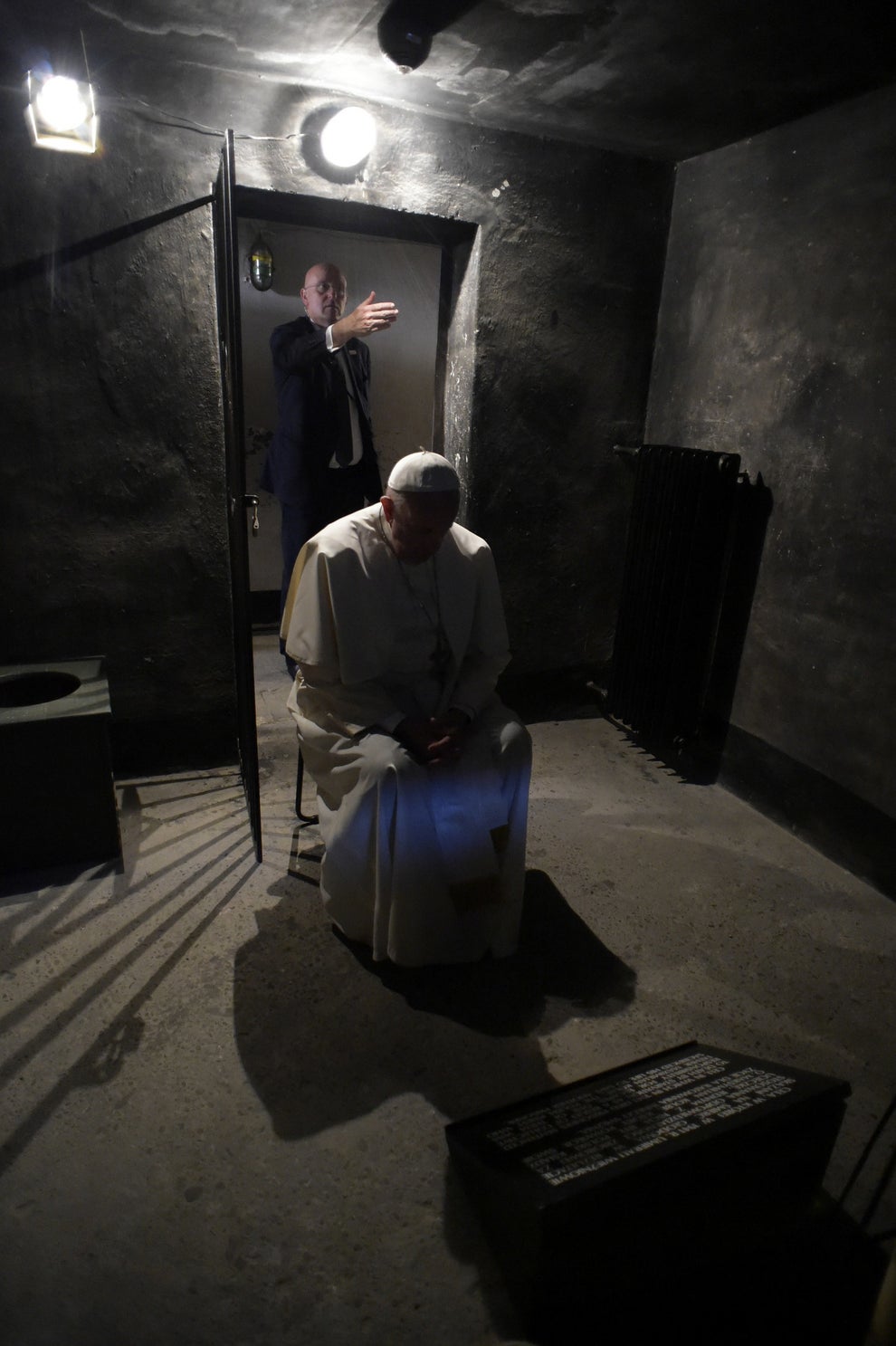
Pope Francis Prays in St. Maximilian Kolbe's Cell at Auschwitz


Pope Francis is currently in Krakow, Poland, the city of St. John Paul II, for World Youth Day 2016.

Earlier today, he visited the the Nazi concentration camp known as Auschwitz-Birkenau and walked into Auschwitz's Block 11, where St. Maximilian Kolbe spent his last days before being put to death by lethal injection in the starvation cell on the ground floor. Fr. Kolbe was a Franciscan friar who volunteered to die instead of another man when he heard him desperately cry that he was leaving a wife and children behind.

As seen in the photo Pope Francis sat in silent prayer and reflection in the cell http://en.radiovaticana.va/news/2016/07/29/pope_francis_visits_auschwitz-birkenau_museum_and_memorial/1247696

St. Maximilian Kolbe is the patron saint of drug addicts.
                                          
Image result for st koble image


Wednesday, July 27, 2016

One Church’s Post About Venerable Matt Talbot


The following was posted on FACEBOOK (06/07/16) from Saint Thomas More Catholic Church, Lynchburg, Virginia.
 
 
Venerable Matt Talbot of Dublin (1856-1925) was, sadly, the stereotype of the Irish Drunk. An unskilled labourer from a poor family, he would beg and borrow his way to the next drink. But perhaps not so sad in the end. 
 
Some years before Bill W was inspired to formulate the 12 steps of AA with Dr Bob, a man in Ireland, notoriously addicted to alcohol, began to live them. In a most grace-filled way, Matt Talbot the drunk became Matt Talbot the servant of drunks. He acknowledge his disease, recognized in God his only hope for recovery, set about making amends to those he had offended and hurt, and worked tirelessly to bring his drinking buddies to sobriety.
 
A faithful Catholic, he died on his way to church.  He is a shining example of the meaning of the Sacred Heart of Jesus (to Whom the month of June is dedicated) burning in love for all...even, well maybe especially, drunks, addicts, all those not living one day at a time in His care....
 
Years later Bill W would write, "we admitted that we were powerless over alcohol, and that our lives had become unmanageable, we came to believe that a power greater than ourselves could restore us to sanity, we made a conscious decision to turn ourselves over to the care of God, as we understood Him...." Matt Talbot knew he couldn't do it, God could, and he let Him.
 
Now on the path to canonization, he is God's shout out today to all those still in some substance's grip...be held by God instead!
 
Happy feast day Matthew! Sainthood Soon! All your fellow drunks, in and out of recovery...ask your prayers!

Tuesday, July 19, 2016

MATT TALBOT, THE COMMON MAN


In 1945 Rev. Thomas J. McCarthy, Ph.D. delivered five addresses for the nationwide Catholic Hour radio program in a series titled, SAINTS FOR THE TIMES, which were then published under the two titles:
Saints for the Times: five addresses delivered in the nationwide Catholic Hour, produced by the National Council of Catholic Men, in cooperation with the National Broadcasting Company, from October 28, 1945 through November 25, 1945. Our Sunday Visitor Press (1946) 
John Henry Newman, St. Augustine, St. Thomas Aquinas, St. Thomas More, Matt Talbot: Five Catholic hour addresses delivered by the Reverend Thomas J. McCarthy, Ph.D.  Newman Bookshop (1945)

While the three saints in this book have been deceased for centuries,  John Henry Newman (now Blessed) had died 55 years before these presentations and Matt Talbot had been deceased for only two decades and would not be declared “Venerable” for another three decades.

While we are only posting this very meaningful chapter on Matt Talbot, the entire book can be read online at https://archive.org/details/saintsfortimesfi00m.
2019 Update: This link is no longer operational but the second title will appear by posting the book title on Google for a list of universities in USA and UK that have it.


 Twenty years ago Matt Talbot was picked up dead on a Dublin Street. A simple laborer, his passing rated only the summary obituary notice that simple laborers receive — a few lines of agate type tucked away in the daily newspaper: "Matthew Francis Talbot; age, 69; died June 7th; funeral Mass, Jesuit Church, Gardiner Street; burial, Glasnevin Cemetery." That was all the press had to say of Matt Talbot at his death, and that was 20 years ago.

Today we know much more of Matt Talbot than most of the people who read that obituary notice, because today, six full-length books have appeared, not to mention hundreds of essays, articles, and pamphlets, having as their subject this lovable, thoroughly appealing, and warmly human person. The affectionate reference to him as “Matt’' rather than the more formal “Matthew" is at once the key to his hold upon the hearts of so many people. It is as though he lived just down the street from us and we had known him personally for many years.

Thousands of men and women all over the English-speaking world are praying, only 20 years after his death, that Matt Talbot will be canonized by the Catholic Church, that his name one day will be honored at the altar even as the names of Augustine, Thomas Aquinas, and Thomas More are now honored. When we speak of him today, we do in no way wish to anticipate the judgment of the Catholic Church upon his life of prayer and good works. We simply wish to hold out for consideration his life of great sanctity, hard work, and extraordinary discipline, and to indicate its significance. For Matt Talbot's story is bound to inspire, and the more it gets around, the more good it will do. He has significance, today, for two reasons. First, an America that is discouraged and disheartened at its failure to control its habit of drink can learn much from his solution; and secondly, Matt Talbot is desperately needed as a symbol by workingmen not only in America but throughout the whole world.

He was born in Dublin half way through the last century — in 1856. He was one of 12 children, of a good father and a great mother. Poverty knew his family very well. At an early age, at the age of 12 to be exact, Matt left school and went to work as a messenger boy for a wine merchant. He developed in that job a taste for wine which led to the habit of drink. And before he was 14 he was spending his weekly pay, such as it was, in the saloons instead of bringing it home to his mother. At 14 years of age, a drunkard ! Imagine, at an age when a boy should have been worrying about his athletic prowess or his skill at games, this boy was caught fast in drink, and for almost 15 years he was to remain under the tyranny of this habit. So strong was its hold over him that on one occasion he gave the very shoes off his feet in payment for a drink.

One night, though, at the age of 26, he came home to his mother and told her he was going to give up drinking. Like any mother, her heart quickened at this news; and yet she had been subjected to so many disappointments in the past that she must have wondered whether he could persevere. She sent him off to the priest, nonetheless, with the blessing of God upon him. After seeing the priest. Matt promised to abstain from intoxicating liquor for three months. That promise was not easy to keep. His whole system, so long accustomed to the stimulation of liquor, was now shocked by the lack of it. Worse still, there was a loneliness enforced upon him. — he could no longer go to the drinking places he had once frequented, he could no longer spend his evenings in the company of those with whom he had traveled for 14 years. To keep his pledge, he had to endure the bleakness of his hall bedroom during the evening hours when his day’s work was done. So desperately did he feel this sense of isolation that he grew testy, even with his mother, and threatened to go back to his drink. But she, wonderful  psychologist, sensing that no man can live in a vacuum, understanding that no man can turn from a life of sin or dissipation and have any success living virtuously unless he embrace some positive program of activity, encouraged her boy to fill up that void which the loss of drink had made in his life by taking Jesus Christ as his companion each morning in Holy Communion.

This he began to do, but his progress was discouragingly slow. The fierce temptation to drink persisted — at times agonizing in its intensity — and Matt must have wondered whether he could persevere. He must have wondered whether Christ could ever become so attractive as to counteract a habit made strong by 14 years of exercise. He stayed with his resolution, however, and for his constancy Christ rewarded him. Three months went by and he took no liquor — then a year passed. And now strength and confidence surged in his heart. He pledged himself not to touch any liquor, ever, for the remainder of his life. And he kept that pledge. And because he kept that pledge we say he is significant for America.

There is little use closing our eyes to the paralyzing effect which drink has in this country. Not drink within the limits of reason, but that habit of drink, unreasonable and excessive, which has resulted in the breaking of homes, in scalding many a mother’s, many a wife’s heart, in crushing the promise of so many business and professional careers — that habit which has become, on the testimony of expert medical men, one of America’s outstanding problems.

Now the problem of drink is mainly psychological. It involves the will. All the medical care and institutional cures in the world cannot save a man from drink if he does not sincerely will to give it up. The change has to come from within. It was so in Matt Talbot’s life. It must be so in the life of anyone thus afflicted. See what that change from within did for Matt Talbot. He still went through the simple routine of his daily round but now there was a difference. His long day at work, formally humdrum and unattractive, in itself a strong temptation to drink, was now made wonderfully attractive by the life of prayer accompanying it.

When we say a long day, think of the schedule he followed. Up at two o’clock in the morning after only three or four hours sleep on a plank bed with wooden pillow. Never mind if you can’t understand such discipline, such mortification! Never mind if you do not see the need of it! It was Matt’s way and it was a good way. He would pray for two hours in the early morning, get dressed and go off to 5:30 Mass. There he would receive Holy Communion and return to his room for a sparse breakfast. Then off to work in the lumber yards at 7:30. This was his daily routine for 41 years.

He was never late and he was not lazy — and his work was good because it was also his prayer. Thus, there was no break in his prayer from the time he rose in the morning until he slept at night. At 5:30 when his work was through at the yards, he would return home for an indifferent meal — food and drink now exerted no tyranny over him. He was above their reach, and small wonder, for his thoughts constantly were on Christ, His Blessed Mother, and the Saints. The evening hours, once so lonely and full of temptation to be out drinking, now were short enough and never lonely for Matt because of his prayer and spiritual reading.

We have said that his work was also his prayer and that is me truth. In America we have lost that notion of work as prayer, and we are the poorer for having lost it. We have forgotten that work, all work, has a dignity — and that men must see in their daily tasks, no matter how menial, how governed by routine, wonderful opportunities for improving their spiritual resources. If the American workingman will take Matt Talbot as his model, he can enrich his life immeasurably. This is not to say that he must be meek to the point of tolerating injustice and taking no steps to remedy it. Matt Talbot, for all his subdued way, went out on strike from the lumber yards when the strike was called. He did not, however, take part in recriminations and in expressions of hatred, for in the good common sense which he possessed so abundantly, he knew that nothing would be accomplished that way save the deepening of the rift between the worker and his employer.

One other thing! There is a lot of silly sentiment expressed about the common man today. The press and radio have proclaimed that the century of the common man is here. He has been rhapsodized and made a great deal of and yet very little has come of it all. For to most of us in America, the common man still has no face. We know that we are passing him every day on our streets and yet we cannot point him out. He is for all intents and purposes an abstraction, the subject of articles and talks but never a living person whom we can recognize.

If the 20th century wants an image of the common man, let it look to Matt Talbot. Was ever a man so common — broken shoes, torn trousers, odd coat, five dollars a week for wages, ill-regulated diet, cold, damp hall-bedroom, long hours at work. Why these are all the things that plague and have plagued the laboring man in our society. These are the things the laboring man has been longing to correct, and they find their complete expression in Matt. Yet for all his handicaps. Matt Talbot was patient of his lot and he achieved happiness at his work. He knew a society could have a 40 hour week, a minimum wage law, protection for the aged, good living conditions, and still be miserable and unhappy if it did not have God. He knew that many men would use their new found leisure and increased wages only to lose God and to sin more grievously than ever they had sinned in the past. He knew the weakness of the common man because he knew his own weakness. He realized that commonness is very often mediocrity and that a man cannot save his soul if he is mediocre. He saw that life could only be successful for the common man if he would be uncommonly good, uncommonly faithful in prayer, uncommonly reliant upon God. 

If Matt Talbot ever becomes canonized, it will be not only Matt, but millions of other men who in all countries of the world have chosen to follow Christ without any fanfare or publicity day in and day out at their daily tasks, providing faithfully for their families, seeking no awards or medals, caring not if the world ever sees or hears them, hoping only to merit Christ’s clasp of their hand as they go through life. If Matt Talbot is raised to the altar, the common man will be given a greater recognition in that single gesture than ever he has received since Christ walked along the roads of Judea and chose His first followers from among the ranks of those simple, nameless folk who have never since forgotten the honor He bestowed upon them; who as a consequence have treasured their anonymity, their obscurity, in the hope that He will always feel free to walk in their midst, in the hope that He will always feel free to turn to them at any time for help in accomplishing His work upon this earth.

When Christ touched the heart of Matt Talbot, He indicated once more His identity with the poor and with those whom the world has so grievously sinned against. And having touched the heart of this common man and having given it such wonderful strength, millions of hearts everywhere have begun to beat faster in the knowledge that Christ still does not forget, that He still walks among the little people of the world and in their midst He is most at home and from their midst He receives His greatest homage.

.