The Venerable Matt Talbot Resource Center exists to compile writings about the life, times, conversion, and recovery from alcoholism of Matt Talbot (1856-1925) of Dublin, Ireland. Disclaimer: The placing of information on this site from external linked sources does not necessarily imply agreement with that information. This center is independent of any other center, group, organization, website, or Facebook page. Comments are welcome at: ven.matt.talbot.resource.center@gmail.com
"People should write to Pope Francis to encourage him to visit
the tomb of Matt Talbot when he comes to Dublin next year, Archbishop Diarmuid
Martin has said. Speaking in Maynooth at a conference on priestly formation,
Archbishop Martin spoke of how priests come from the “holy people of God”, a
term the Pope regularly uses when speaking of ordinary Catholics, especially
those from marginalised communities.
“The bishop’s main point was the importance of the holy people
of God, with Matt Talbot as example,” said Fr Richard Ebejer, former
administrator of Our Lady of Lourdes Parish on Seán McDermott Street, where
Talbot’s shrine is. He added that he was delighted that the famous Dublin
ascetic had been mentioned, and so asked whether the Pontiff might be prevailed
upon to visit Talbot’s tomb, which St John Paul II was widely expected to visit
in 1979 although doing so had never been on his schedule.
Disappointed
“The local people had prepared for the visit, and had been
disappointed when the Pope did not visit,” the Maynooth-based Salesian told The
Irish Catholic, saying that this showed how it is “good not to raise
expectations.”
Fr Ebejer has previously said that the disappointment felt
locally at St John Paul’s failure to visit the tomb is still palpable today, and
that while the North inner city is a marginalised community which has a social
stigma attached to it, it has many positive aspects which the archbishop himself
has often highlighted.
“There’s a strong sense of solidarity there,” Fr Ebejer said,
describing the area as a “local community struggling to lift itself out of
poverty”. He pointed to how Dr Martin has spoken about the role of mothers and
grandmothers keeping families together when things went wrong, and noted how –
even among families where religious practice is low – there is a strong
attachment there to the local church.
Fr Eddie Conway OP of the nearby St Saviour’s Church, where
Talbot had been going when he collapsed and died in Granby Lane in 1925 agreed
it would be good if the Pope visited a community that is so often
marginalised.
Stressing that details of the papal visit have not been
confirmed, Fr Conway described the failure to visit the tomb in 1979 as “a
terrible omission” and said “It would be good for the Pope to visit him – he’s
Dublin’s holy man, the saint of the working class, known for how he fought with
the whole addiction thing, and someone people can identify with.”
Matt Talbot was declared ‘venerable’ by Pope Paul VI in October
1975."
Joseph D. recently sent us a note expressing his
appreciation “for the interesting material” about Venerable Matt Talbot on our
blog.
At our request Joseph wrote the following to
express, “as the flow came,” his gratitude for the life of Matt Talbot and gave us permission to post it.
(We have added the
title)
"My Friend, Matt Talbot" by Joseph
D.
30 January 2014
I went into Our Lady Of Lourdes Church 40 yrs. ago asking
for help from Matt . Within 6 months I had stopped drinking and have remained
alcohol free since that time. I had to return to the shrine every three days to
get a peace of mind as my thinking was in a desperate state. On one such
occasion I was not kind in my word as I said "do I have to keep coming back here
for the rest of my life, I need help". I got my peace but upon leaving the
church what I used to call the machine gun mind came back, racing thoughts that
gave no peace. I was sure I was being punished by God for talking up. I met a
friend whom that day I had arranged to play table tennis with, the mind was so
toxic I could not play. He asked if I would like to chat to a friend of his , I
agreed, the moment I went into the place he brought me to my peace came . There
was a book there that was given to me and that was my companion for many years
and educated me Spiritually. It was the start of a great adventure that is still
a work in progress. I have had to face many perils during my sobriety but the
peace remains, the education for emotional sobriety is ongoing. The story with
Matt had started many years before, he was introduced to me by my father when I
was 6 or 7. A brother of mine had died in St Canices school as a result of an
accident there, I was three years of age , this was back in 1948. The grief of
that event had a big effect on the family , I feel I am still recovering from
it. Part of the ritual every Sunday was to visit Glasnevin Cemetery, I used to
be terrified of that place. After visiting my brothers grave my father would go
to Matt's resting place where people would gather to say the Rosary around 12 oc.
He was then moved from the grave to a whitewashed tomb in the centre of the
graveyard where again the Rosary was recited . It was a scary place to get to
for the doors of other tombs would be open , showing the stacked coffins . When
I would get to Matt's place of rest I would feel the fear go . Jump on to when I
was 28 and the alcohol that was my friend and which allowed me to survive, no
longer worked. I could not trust the living to help thus I arrived at Our Lady
of Lourdes seeking solace from Matt , he did not let me down. I always say that
I saw Matt's progress in death as he was promoted from the grave to the tomb then
from the tomb to his now resting place in the church. God promoted him as he
promises to do to the meek and Matt is a great example of the meek who even in
death progressed. I am a regular visitor at his tomb to this day for the love
that flows there is a river of peace that comes from his heavenly abode in the
company of his great love , Christ Jesus.
John, thank you for the opportunity to write of my friend
to whom I owe my life. Joe .
“On Saturday 27th November, as the Matt Talbot Novena concludes, some parishioners from St.Senan's Parish, Shannon, Co. Clare made a pilgrimage of Matt Talbot in Sean McDermott Street, Dublin. Fr. Brian Lawless, the vice postulator for the cause of Venerable Matt Talbot, celebrated Mass for the pilgrims at the tomb. He also spoke about the life of Matt and shared the relics with those who had come on pilgrimage...Our thanks to Pat Grue for the photographs.” [Triple-click each photograph to enlarge]
Born in Dublin. He was an alcoholic who turned to religion. He was
originally
buried in a poorer part of Glasnevin Cemetery before being moved to the vault where Fr.Gentili was buried. The coffin was moved in 1972 and the remains now rest in Our Lady of Lourdes Church,
Sean MacDermott St., Dublin. The coffin is enclosed behind glass.
Matt's current tomb above. Below left was his first grave marker. Below right was his second tomb. The bottom picture was when his coffin was opened before he was reburied above.
At last! After a nonstop week in Dublin, Ireland at the World Meeting of
Families, I've finally had a moment to share this picture of the Matt Talbot
Hope Book at the shrine of Matt Talbot. All of the names you've sent were
carefully written on these pages of this little book, which I placed with love
and tears (quite a few!) on Matt's tomb just hours after Pope Francis had
briefly stopped by on August 25. Security restrictions
on the papal route through Dublin prevented me from being there when the Pope
was (believe me, I tried and I cried!), but I did make it to the shrine that
evening, and I spent quiet time in prayer for these precious souls in the
notebook.
Now, this journey is far from over. The Matt Talbot Hope Book
is back in the US for now, where it will be lifted up at a monthly Mass
celebrated by Father Douglas McKay of Our House Ministries. We will continue to
add names and print a second notebook if needed before we return to Ireland
within the next 12 to 18 months ("please God," as our Irish friends would say).
At that time, the book will be entrusted to Father Brian Lawless, the vice
postulator of Matt's cause for canonization.
While kneeling before Matt's
tomb, I discerned that our work here -- like the cause for Matt's canonization
-- is still very much in process. We have much to do: names to add, sacrifices
to make, prayers (many prayers) to lift up, and more souls to reach with the
good news that Christ can and will heal addiction, if we will entrust ourselves
and our loved ones fully to Him and do as He asks. We need to let those in
bondage to addiction know that they are not worthless or hopeless; we need to
fight for greater mental health treatment and insurance coverage; we need to
stand up to corrupt pharmaceutical companies and transnational criminal networks
that flood our nation with narcotics; we need to minister to families utterly
brokenhearted and disillusioned by the cycle of addiction.
Please, my
friends -- let's continue this journey together, and may Matt Talbot and all the
saints and angels, guided by the Blessed Mother (to whom Matt had an intense
devotion) intercede for us.
People have multiple reasons
for visiting the tomb of Venerable Matt Talbot. For this daughter it
was to fulfill a
request of her father with 40 years of sobriety.
“For now, I’ll simply mention that when we returned to
Dublin on August 29, Barb satisfied a request of her father and sought out the
church (Our Lady of Lourds) that contains the crypt of Matt Talbot, 1856-1925.
Although not a formal saint, he is known as the patron saint of alcoholics.
After 16 years of alcoholism he maintained 40 years of
sobriety. Barb arrived just as the priest was locking the doors of the church
but he was more than willing to keep it open to show her around and to share
with her information about Matt Talbot. The priest said that many people from
overseas stop in because of Matt Talbot but most are from the USA and Canada.
He brought out a chain that Talbot wore as a symbol of his devotion to the
Church and had Barb put her hand on the box containing the chain while he said a
prayer for her family. Her father should be pleased.”
Earlier this month Gerry Mc
Donnell, a poet and author living in Dublin, informed us that he had
recently written a radio play based on the life of Matt Talbot and was seeking someone who would be willing to produce it. This is an unique opportunity to help expand awareness of Matt Talbot. We are,
therefore, inviting everyone who might be interested to contact Gerry at gerrypoet@gmail.com.
This is a radio play which is approximately a half
hour long. It is essentially about the journey and how people return changed
from happenings on the journey.
Dan travels from Boston to Dublin to visit the
shrine of Matt Talbot. He had promised his dying mother, who believed that he
had been cured of alcoholism because of her prayers to Matt, that he would do
so. He is skeptical and is on a dutiful visit to hand in notification of Matt’s
intercession in his recovery from alcohol addiction. On the plane he meets Al a
nervous, talkative traveller and a priest who has coincidentally written a
pamphlet on Matt Talbot having been cured by praying to him. They talk about
this patron protector of the alcoholic; their beliefs and
doubts.
Dan arrives at the church where Matt’s tomb is. He
stands at the back of the church in the gloom. The sacristan explains that he
could talk to the priest after Mass. Soon after, the sacristan is back at his
shoulder more loquacious than before. Dan gets a smell of drink off him. The
Mass is long and after it is over the priest speaks to each parishioner in turn,
giving them a blessing. Dan is waiting impatiently. He has to catch a flight
back to Boston that afternoon. He explains his predicament to the sacristan who
agrees to give the envelope to the priest. Once more the sacristan approaches
Dan saying the priest would see him now. Dan asks the sacristan for the envelope
which he doesn’t have. It transpires that the sacristan’s brother, who hangs
around the church begging, has the envelope. Dan failed to distinguish between
the two, in the shadows.
The priest assures him that his visit will not be
wasted. He urges Dan to pray at Matt’s tomb. Dan is having compulsions to drink.
He hears the voice of Matt encouraging him to stay sober. It is a transformative
experience and he leaves the church with a blessing from the priest. His grimy
surroundings look pristine. As he walks through the streets it is as if he is in
love with everybody and everything. Feeling a little bit ungrateful he wonders
is he having a flash-back to his drinking and drug taking days. He gets a taxi
to the airport and boards his plane. He reaches into his pocket to read some of
the literature on Matt which he got in the church. He takes out an envelope. It
is the one given to him by his mother. The sacristan’s brother has the other
envelope. He reflects on all that has happened. A fellow passenger engages him
in small talk. He says, “I’m returning home, or am I?”
Some background
information about Gerry Mc Donnell:
GERRY MC DONNELL was born and lives in Dublin. He was educated
in Trinity College,
Dublin where he edited ICARUS, the
college literary magazine; and at Dublin
City University.
He has had six collections of poetry published. He has also written for stage, radio
and the television series Fair City.
His play Making It Home,a two-hander
father and son relationship, was first performed at the Crypt Theatre at Dublin Castle
in 2001. A radio adaptation of this play was broadcast on RTE Radio 1 in 2008
starring the acclaimed Irish actor David Kelly as the father and Mark Lambert
as the son. It has been translated into Breton and has been published. A stage production
will happen in July 2014. He has written a radio play, a stage play and a
libretto based on the life and work of the Irish poet James Clarence Mangan
(1803 – 1849).
His stage play Song of
Solomon, set on a canal in Dublin, has a Jewish
theme. His interest in Irish Jewry has resulted in the chapbook Jewish Influences in Ulysses; a collection of monologues
called Mud Island Elegy, in which Jews of 19th
century Ireland speak about
their lives from beyond the grave; Lost and Found
concerning a homeless Jewish man living in the Phoenix
Park in Dublin. Mud Island Anthology, concerning ‘ordinary’ Dublin
gentiles who lived in the latter half of the 20th centurywas published in 2009 and is a
companion collection to the ‘Elegy’ poems.
His latest collection of poetry, Ragged Star,
was published in 2011 by Lapwing Publications, Belfast. His novella called Martin Incidentally was published in January 2013. I Heard An Irish Jew, selected poems and prose, will
be published in 2014.
He is a member of the Writers
Guildof Ireland and the Irish Writers’ Union.
When
asked as to what led Gerry to write this play, he responded with the following very personal reflection:
THE CAUSE OF MATT TALBOT
Gerry Mc Donnell
December
2014
I grew up close to
where Matt Talbot lived. I had heard him spoken of fondly by ordinary working
class people. I also heard that he passed the picket on a strike. So I had
conflicting ideas about him. Anyway he was a figure of the past and had little
impact on my life, I thought; that is until I followed in his footsteps down the
dark tunnel of alcoholism. At this time I was rebellious and had little time for
religion or things spiritual. It was to be some years before the figure of Matt
re-emerged in my thoughts. The intervening years had brought the tragedy of the
untimely deaths of my parents. So I was ripe for resentment and blame which
started with God and moved down to mankind.
Matt Talbot was in
my consciousness during my recovery from alcoholism. I wondered how he could
have stayed sober in a city awash with alcohol and poverty. The fact that he had
lain down the drink at twenty-eight and remained sober for the rest of his life
puzzled me. How could a man, on his own, beat the demon drink? Of course he
wasn’t on his own. He turned to his religion and devoted himself to Our Lady. I
too turned to religion in the battle to stay sober. But I also had the
fellowship of Alcoholics Anonymous for support.
I still had
ambivalent feelings about Matt and his fervour. Was he a religious maniac or a
holy man? The chains he wore pointed to the former, yet the man I got to know in
my reading about him bore testimony to the latter. In a secular world it is easy
to interpret his life in a negative way and dismiss his self-denial- the block
of wood for a pillow and the tear at the knee of his trousers so he could better
feel the discomfort of his flesh on the granite steps of the church where he
went to Mass before a hard day’s work in a timber yard- as the actions of a
fanatic.
However, as I
matured in my sobriety I began to see him as a holy man. I read that he shared
what little lunch he had with his fellow workers. He was kind and happy in
himself although no doubt he had his demons to wrestle with. This was not the
portrait of a deranged man. Nobody suffering from a mental illness could
accomplish what he did as a life-long diligent worker and a daily Mass goer.
What led me to
write my play, The Cause of Matt Talbot, was my identification with his
Catholic, working class life and his recovery from alcoholism. I hope I have
given a true picture of him in the play or at least have not besmirched his
memory in any way.
He was born on 2nd May 1856 in humble circumstance in Dublin’s inner city, the son of Charles and Elizabeth Talbot. In post-famine years Dublin and the rest of Ireland was in distressed state: an era of grinding poverty and appalling living conditions. Yet it was also a time when the Faith was strong and prayer and the practice of their religion were the channels of hope and optimism for the masses of people.
Hard-drinking was, however, a problem, a feature of Dublin life: all the attendant miseries of excess drinking, the hardship of broken families and unfulfilled hopes were only too evident in the city. From his early teens up to the age of twenty-eight Matt Talbot was a hard drinking man, never a day idle but enduring a source of distress to those who loved him. In 1884, however, Matt stopped drinking and made a three month pledge to God he would refrain from the habit. Despite great temptations in the early stages of his conversions he never took a drink again. The remaining forty-one years of his life were lived heroically by Matt in attending daily Mass, in constant prayer, in helping the poor and indeed in the ascetic life-style of Celtic spirituality.
The chains found on his body at death were not some extreme penitential regime but a symbol of his devotion to Mary, Mother of God that he wished to give himself to her totally as a slave. This life was his prayer to God and his defence against a reversion to alcoholism. He died on Trinity Sunday, 7th June 1925, in Granby Lane on his way to Mass in the Dominican Church nearby. Within a few short years of his death his reputation as a saintly man and especially as a patron protector of those suffering from all forms of addiction, and their families, was being established. He was buried in Glasnevin Cemetery and then in 1972 his remains were removed to a tomb in Our Lady of Lourdes Church in Sean McDermott Street, Dublin, in the area where Matt spent his life. Every day pilgrims come to pray at his tomb, many come in organised pilgrimages from overseas as well as Ireland.
Matt has a tremendous following in North America and there is particular devotion to him there. The pilgrims pray to Matt asking him in turn to pray for them and their loved ones and they also pray for him that he may soon be raised to the company of the Saints in Heaven.
Prayer for the Canonisation of Venerable Matt Talbot
Lord, in your servant, Matt Talbot
you have given us a wonderful example
of triumph over addiction, of devotion to duty,
and of lifelong reverence for the Most Holy Sacrament.
May his life of prayer and penance
give us courage to take up our crosses
and follow in the footsteps
of Our Lord and Saviour, Jesus Christ.
Father,
if it be your will that your beloved servant
should be glorified by your Church,
make known by your heavenly favours
the power he enjoys in your sight.
We ask this through the same
Jesus Christ Our Lord.
Amen.
Favours received through the intercession of the Venerable Matt Talbot should be notified as soon as possible to the Vice Postulator:
Pope John Paul II waves to
cheering crowds from his Popemobile. Running behind schedule, his planned stop
on Séan McDermott Street never happened.
Pope Francis is to visit Seán McDermott Street in
Dublin’s city centre briefly on Saturday, August 25th,
2018.
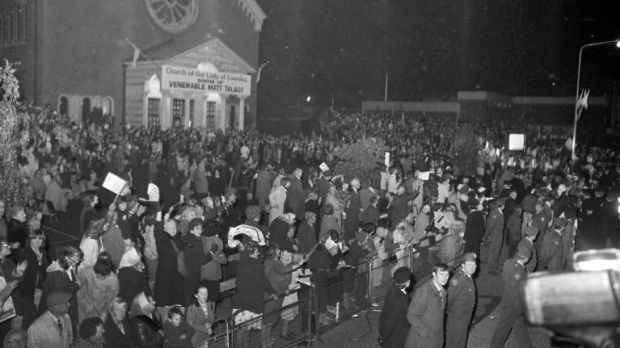
During his 1979 visit to
Ireland, Pope John Paul II had planned to stop on the street to
visit Matt Talbot’s tomb in Our Lady of Lourdes church. However, the Popemobile was
running behind schedule and drove on, much to the disappointment of many local
people. Some said afterwards joyriders did not go down Seán McDermott Street as
fast.
Crowds outside Our Lady of
Lourdes, Seán McDermott Street in 1979 waiting for Pope John Paul II.
“The story still persists, of course,
of how people were waiting for Pope John Paul to stop,” said Fr Hugh O’Donnell
at the church on Sunday. “The significance of a stop, no
matter how brief, is very important. In some ways it’s a corrective, almost. The
expectation was there in ’79, that he would stop,” he said.
Fr O’Donnell said Pope
Francis’s visit, which would follow his meeting at Dublin Castle with Taoiseach
Leo Varadkar and other members of the Government,
was not an official stop. “He won’t be saying anything. He won’t even come into
the church. So, I would say it’s more a symbolic gesture, a very reassuring
gesture for the people of the area.
“Also we have the tomb of
Matt Talbot here who is a real symbol of, an
exemplar of, someone who dealt with addiction in a particular way. He’s well
known all over the world, even more so I think than locally.”
Inter Parish Pilgrimage Mass at the Tomb of the Venerable Matt Talbot (“Friend of Addicts”) in Church of Our Lady of Lourdes, Sean Mc Dermott Street, Dublin 1 on Sunday the 10th of April 2011 from 3.00-5.00pm. Petitions (or notes on favours received) can be brought to the mass or sent to Fr. Brian Lawless, Parish Office, St Agatha’s North William Street, Dublin 1.
After 30 years of drug and alcohol abuse, Pat — a Philadelphia native with
tattooed arms and a Rocky Balboa accent — made an unlikely new friend: Matt
Talbot, an Irish laborer who’d been dead for about a century.
“I’d never heard of him until I got sober,” said Pat, now a member
of the Calix Society, a Catholic support group for those in addiction recovery.
During a Calix meeting that Pat attended after getting clean, the
group’s national chaplain, Father Douglas McKay, showed a film on Talbot, who
had battled the bottle throughout adolescence and early adulthood.
After taking an abstinence pledge at age 28, Talbot remained sober
for decades until his death in 1925, living a quiet, ascetic life that included
daily Mass, prayer, Scripture reading and charitable works.
Collapsing on a Dublin
street en route to Mass, Talbot was discovered to have regularly worn
penitential chains. Declared “venerable” by Pope Paul VI in 1975, Talbot is now
invoked as an intercessor by a number of groups that minister to those
suffering from addiction, including the Calix Society, which was founded in the
U.S.
some 20 years after Talbot’s death.
During his August 2018 visit to Ireland,
Pope Francis stopped at Our Lady of Lourdes Church in Dublin to pray before several relics of
Talbot, whose tomb is just feet from the church’s altar.
For Pat, learning about Talbot was life-changing, and he began
praying to the would-be saint, whose intercession he also credits for his
healing from an intestinal rupture that required 14 hours of emergency surgery.
After his hospitalization, Pat attended a Matt Talbot-themed
retreat, where he was able to release many of the resentments that had fueled
his addiction.
“I found forgiveness not only for myself, but for the people who
had molested me as a child, and for anybody that had ever hurt me,” he said. “I
finally saw everyone as being worthy of God’s love.”
Longtime Calix member Kathy Diering said that Talbot, in his
resolute example of holiness, “speaks volumes without even speaking.”
“When you look at his hiddenness, his spirituality, you see that
he really knew that the body and blood of Christ were his true source of life,”
she said. “He was steadfast, and that’s been an inspiration for me, because he
shows what is possible.”
Talbot’s conversion from sot to saint, made all the more dramatic
by the severity of his alcoholism, resonates with those looking to free
themselves from addiction. In fact, many of those devoted to Matt Talbot say
that his sanctity was the real key to his sobriety.“He knew that everyone else might leave him, but God wouldn’t,”
said Diering. “And that’s where his strength was.
”
Holiness is a sign of authentic recovery from addiction, said
Father McKay, who is looking to create a national shrine to Matt Talbot in Philadelphia. While
addiction is a complex disease of body, mind and spirit, he said, too often
treatment only focuses on the first two, without addressing the soul’s deep
hunger for connection with the divine.
Globally, some 35 million people now struggle with drug addiction,
according to the United Nations. A separate study projects that alcohol
consumption (which rose 10% between 1990 and 2017) will increase by another 17%
worldwide over the next decade.
In the face of such daunting statistics, Talbot’s appeal as a role
model and intercessor continues to grow internationally, thanks to the
dedicated efforts of those who work to share, online and in person, the
Irishman’s message of hope.
From his native Poland, Gregory Jakielski has been diligently
spreading devotion to this saint-in-the-making for the past seven years,
maintaining both a website and Facebook page that feature a number of Matt
Talbot resources. In August 2018, he collected hundreds of names that were
placed by a pilgrim on Matt Talbot’s tomb in Dublin.
For Pat, Matt Talbot's simplicity makes clear the path to both sobriety and sanctity. "He had no real possessions, he said. He didn't need anything but God's love, and he wanted to make others feel that too."
[In a recent posting (http://venerablematttalbotresourcecenter.blogspot.com/2011/11/programme-about-life-of-matt-talbot-on.html), we noted a televised documentary about Matt Talbot. The program listing at the time stated, “Scéalta Átha Cliath-Matt Talbot (OS) 20:00. Born in 1856 on the North Strand into abject poverty, Matt Talbot grew up to become a chronic alcoholic, unable to hold down a job, resorting to petty crime to feed his addiction. Around his 30th birthday, he renounced alcohol and became a devout Catholic. He donated some of his paltry wages to those who needed money and he helped others turn away from their addiction to alcohol.”
The following is a columnist’s reflection on that program.]
“THERE should be more to Christmas than television, especially now that the difficulties of the times we live in are being reflected as never before in the paucity of this season’s Christmas fare across all channels. That said, some television is necessary for the enjoyment of the modern Christmas and, when television is indulged in with discernment and discretion, it can add to the festive spirit.
The departing year will not be remembered for vintage television and, behind the festive hype, what’s on offer for Christmas is more of the same. That’s why my plan for this coming weekend is to record a half-hour from here, another from there, and so on in the hope of building a refuge of sorts from the festive television fizz. Finding worthwhile half-hours is the catch, but I’m hopeful. Because I gave the plan a trial run last week and here’s a taste of what I caught.
The best was the documentary on Matt Talbot from the excellent TG4 series Scéalta Átha Cliath on Thursday evening and it was so worthwhile that if I come up short this week I might include it again. In life, the Venerable Matt Talbot was a quintessential Dub who seemed destined never to be known outside the mean streets he worked and lived in. Following his death in 1925, however, his fame spread not only around this country but across the Catholic world. As yet no miracle can be attributed directly to him, which is why he has not yet been canonised, but I’ve always thought it close enough to miraculous that Matt has ever been heard of at all.
The documentary was made on the streets around the North Strand area of Dublin where Matt had lived all of his 69 years and the makers talked to people who knew people who knew him. As a definitive profile of Matt Talbot, it was especially effective when it included old footage of interviews with some of his contemporaries and I’ve never seen him so well portrayed. All who know of him know of his spiritual heroism but what was new here was his portrayal as the most ordinary of men. He could neither read nor write, was hopelessly alcoholic before he was 20, and yet …
In my schooldays in the 40s and 50s I heard the story of Matt Talbot over and over again. In the 60s as a young teacher in a posh Dublin school only a few miles from the North Strand, I told my students about Matt Talbot and always found a positive and welcoming attitude towards him. Now I wonder if there’s an Irish student who knows anything about him because so much about Irish life has changed since the old days, and not all for the better.
Matt Talbot was born into a very different Ireland but down the years there has been an unchanging feature, the high levels of alcohol, and now drug, addiction amongst all age groups, just as when Matt was growing up.
He was born into the grinding poverty of the years following the Famine, only in his case his plight was aggravated by his alcoholic, good-for-nothing father and by being one of a family of 12. As illustrated on the documentary, his school record contains only his name and the peculiarly Irish word “mitcher” written after it. He had dropped out of school by the age of 13 and embarked with his brothers on what seemed would be a life of drinking.
It didn’t help that he got work in a wine merchant’s store and was known to be adept at procuring some of the merchandise for his own use. From there he got work with the Dublin Port & Docks Board in the whiskey stores and his descent into alcoholism was the consequence. To matters worse, his brothers were alcoholics and they are remembered as being particularly difficult when they were drunk, roaring around the streets and obnoxious to all.
One way they acquired alcohol was in a shebeen (an unlicensed drinking establishment) run by a Maggie Kavanagh on what is now Parnell Street. Apart from the sale of drink, Maggie’s stock-in-trade was pig’s cheek by the barrel and the Talbot brothers might buy a drink, if they had the money, and depart with a pig’s cheek or two stolen from the barrels. These they’d sell elsewhere and return to drink the money in Maggie’s. Seemingly, that went on for years.
I had never heard of Maggie or her pig’s cheek but the famous story of how Matt gave up the drink was recalled. It happened on an evening in the early 1880s when Matt and his brothers were hanging around outside their local, flat broke. The hope was that some of their drinking pals might invite them in for a drink but there was nothing doing. What really annoyed Matt was that he had often bought drink for others when they were broke and he went home that evening and announced to his mother that he was going up to the Clonliffe College to tell a priest that he was taking the pledge. And so he did, for three months and, eventually, for life.
For the following 40 years he lived a quiet life of work and prayer, becoming known for his generosity to those less well off than himself. He was on his way to Mass one Sunday morning in 1925 when he collapsed and died. A paragraph in The Irish Independent of the following day stated, “An elderly man collapsed in Granby Lane yesterday and, on being taken to Jervis Street Hospital, was found to be dead. He was wearing a tweed suit, but there was nothing to indicate who he was."
It wasn’t mentioned that at the hospital it was discovered that he had heavy chains wrapped around his body as his way of doing penance for the sins of his early life. His story spread, first around his own place, and then across Ireland and the world.
He was buried in Glasnevin Cemetery but in later years when pilgrims from around the world began to visit his grave his remains were removed to the Church of Our Lady of Lourdes in Sean McDermott Street and placed in a tomb with a glass panel through which his coffin can now be seen.
On a disappointing note, the locals around Sean McDermott Street had become convinced that Pope John Paul II would visit the tomb during his visit to this country in 1979 and the pubs were empty for weeks with all who had volunteered to paint the church and get the whole place ready. But on the day “no joyrider ever came down Sean McDermott Street as fast” was how one local put it and the Pope passed by without giving the church as much as a look, to the bitter disappointment of all.”
"I recently talked to a drug addict, and, point blank, he asked me why Catholics go to Confession. Here's an answer from St. Faustina and her "Diary of Divine Mercy": "When I left the confessional, ineffable joy filled my soul so that I withdrew to a secluded spot in the garden to hide myself from the sisters to allow my heart to pour itself out to God. God's presence penetrated me and, in an instant, all my nothingness was drowned in God, and at the same moment I felt, or rather, discerned the Three Divine Persons dwelling in me. And I had such great peace in my soul that I myself was surprised that I could have had so many misgivings." Why do we celebrate Divine Mercy Sunday immediately after Easter? Because the Church wants Catholics to realize God is calling us to many graces thru the Sacrament of Reconciliation/Confession; that this Sacrament is a beautiful liberation from sin; it promotes the practicing of virtues, and it engenders a concrete entrustment to His Mercy. God says: "I have blotted out thy iniquities as a cloud, and thy sins as a mist: return to me, for I have redeemed thee" ( Is.44:22). Now: Jesus came for three kinds of people- sinners, the sick and simple poor. Are you one of these or "outside Jesus' grasp"? My friend the drug addict, himself detecting the "inner truth" of confession--we read St. Jas. 5:16: "Confess yours sins to one another and you will be healed"-- described the process of Confession: It's like getting garbage out of your body and soul. That's right. So, make a confession to a priest soon! Here are five good reasons: 1.It's a Gift from Jesus: "He breathed on them and said, "receive the Holy Spirit. Whose sins you forgive are forgiven, whose sins you retain are retained" (Jn. 20:22-23). 2. Saints like Mother Teresa and her Missionary of Charity of Sisters went regularly. She said: "Confession is humility in action. We call it penance but is really a sacrament of love." So: shine like the saints. 3. Get the garbage out. 4. Practice the Latin maxim: Bonum diffisum est-Good is diffusive of itself. When you are clean and free you help others be the same. 5. More graces can adhere in your soul if you are more sanctified. One of the saddest things in our Catholic Church these last few decades is the rejection of Confession. This "spiritual staple" of the spiritual life is so grace-filled and yet so neglected today. Always remember, as complicated as life can sometimes be, The Three C's of The Spiritual Life: frequent Confession, Communion and Communication (prayer). Don't let your past mistakes be a present problem: entrust yourself to Jesus and his Church appointed priest-minister, the priest (cf. also Mt. 16:18), and Reconcile. You may still be granted an indulgence, which is a release of the punishments of sin in the afterlife … granted by Pope John Paul II for the devout observance of the Second Sunday of Easter (Divine Mercy Sunday). The Decree of the Holy See offers: "a plenary indulgence, granted under the usual conditions (sacramental confession, -Eucharistic communion and prayer for the intentions of the Pope) to the faithful who, on the Second Sunday of Easter or Divine Mercy Sunday, in any church or chapel, in a spirit that is completely detached from the affection for a sin, even a venial sin, take part in the prayers and devotions held in honor of Divine Mercy, or who, in the presence of the Blessed Sacrament exposed or reserved in the tabernacle, recite the Our Father and the Creed, adding a devout prayer to the merciful Lord Jesus (e.g. 'Merciful Jesus, I trust in you!')." (Source:Marians of the Immaculate Conception Website.) **************************************************** The Bodily Resurrection of Jesus Christ is vitally important -"The Resurrection of Jesus is the crowning truth of our faith in Christ" (# 638). Many today want to deny the bodily resurrection. The "Catechism of the Catholic Church" emphasizes the bodily Resurrection, this way, in paragraphs # 638-655: "Historical and Transcendent event"; "The empty Tomb"; "The Appearances of the Risen One," "Christ's Risen Humanity" …Given all these testimonies, Christ's resurrection cannot be interpreted as something outside the physical order, and it is impossible not to acknowledge it as an historical fact…Therefore the hypothesis that the Resurrection was produced by the Apostles' faith will not hold up. On the contrary their faith in the Resurrection was born, under the action of divine grace. From their direct experience of the reality of the risen Jesus" (#643-44). Jesus Christ, in His Bodily Resurrection, triumphs over … Sin: If Jesus didn't bodily rise from the dead, sin would have the last word of destroying the God-Man, and us. "If Christ has not been raised then your faith would be in vain" (I Cor. 15:14). Sin deforms, Christ's Resurrection transforms. A few years ago a pilgrim was driving by the Grotto on Rt. 15, headed for Washington. All of a sudden he looked up and saw the golden Mary statue-glistening-- and decided to stop. Driving up he wondered if a priest was around. After seeing the beauty of the belltower statue he realized a desire to make a confession. Sure enough, yes: the man found a priest, made a Confession and continued his trip. He was a changed man. Because Jesus rose from the dead in a glorified body, He gave the Apostles the ability to forgive sins. Simple spirits or "good causes" alone don't do this. Jesus' Resurrected body triumphs over sin: There is a holiness to beauty and beauty to holiness-it radiates. Corruption-our bodies decay, but Jesus' didn't. Impassiblitiy is an attribute of Christ's glorified body. It means suffering no longer-in body or spirit. He gives us hints of re-vivified bodies here on earth thru "tastes of the resurrection". I recently witnessed one of God's miracles in life. Last Fall I went to see a lady in the hospital, who is a wife and mother, and in just giving birth was possibly dying. I didn't recognize her: she was sedated, medical tubes all over her, beeping monitors, purplish-colored skin, and covered by so much medical technology I could barely see her. I tried talking to her without a response, so I simply blessed her, leaving, thinking a worst-case-scenario. I left a note to her and her husband. A few months later I got a call from her friend: she was recovering and back home. Recently she came to the Grotto and with her large family, she received Holy Communion. "Lazarus revisited"! I was astonished by this "resurrection hint": no traces of suffering, but, oppositely, a serene face and courtly walk, no wounds or scars, a kind of gentle radiance about her-- she overcame all to live…How can you feed off of Jesus thru thanking Him at Mass, Holy Communion, prayer? Death. "The wages of sin is death" (Rm. 6: 23). Lazarus was risen from the dead but, unlike Jesus, he died again. Jesus definitively overcomes death's power by His physical Resurrection. Death, which is a result of sin, has no ultimate power over Jesus, or us. Last Winter a pilgrim's husband died suddenly. She was grieving one morning when she heard the nearby Church bells ringing. Immediately she forgot her troubles and heard Jesus-she went to Mass and encountered the Crucified and Risen One. Death was transformed and her whole day changed. Likewise, another widow heard her husband say, just before his death-"You can always find me at the altar." Jesus Christ Risen transforms death. Don't stop celebrating: Easter is not only an event, it is a Season, a state of mind and soul-by "knowing the power" of the Resurrection, St Paul says (Phil. 3:10). For Fifty Days, until the Ascension, we celebrate Jesus' Easter-saving-power and his promise. So: recall the saying, "Out of the tomb and into my heart." Catholics not only think about this, but concretely act upon it by the Five S's of the Spiritual Life: -Sacraments, Scriptures, Silence (prayer), Service, Saintly inspiration. These are ways to invite, embrace and immerse yourself in the Resurrected Jesus. Meister Eckhart, a medieval German Dominican, lover of creation and the Creator, once described a kind of resurrection process: "Out of the ground the rod grows which is the soul in her purest and highest. It shoots out of this primal ground at the breaking forth of the Son from the Father. Upon the rod opens a flower. The flower is the Holy Ghost Who will rest and repose there." … Jesus hints of this indwelling Trinity in Jn 14:26, and St Paul hints it in Rm. 8:11. God desires a dwelling within us. As we know the Resurrection was historical-it happened way back then, and physical--disciples touched His wounds. But: this does not negate His resurrection power affecting us today--internally, metaphysically. Resurrection can also be a state of mind and ongoing conversion: endless Love generated within us. After all, St Paul himself wanted to know the power of the resurrection even though he didn't experience it historically, physically. Are you allowing God's "Primal Ground" and Life to be the foundation of all your thoughts, words, deeds? St Paul intimates an Eckhartian conversion by giving up selfish self to gain the "rod" of his soul in God, as he says: "With Christ I am nailed to the cross. I no longer live, I, but Christ within me" (Gal 2:19-20). Allow Christ and the Whole Divine Trinity to flower forth and live within you. Rest and repose there. (cf. Mk. 6:31). Become part of the Resurrection. St Gregory of Nyssa counsels: "If by a diligent life of virtue, you wash away the film of dirt that covers your heart, then the divine beauty will shine forth in you." -May the Divine and Beautiful One, the Resurrected Jesus Christ, shine in and thru you to others."