Showing posts sorted by date for query tomb. Sort by relevance Show all posts

Monday, September 30, 2019

Matt Talbot: An old friend on the modern journey to recovery

Gina is quite active in speaking and writing about Matt Talbot.

Matt Talbot: An old friend on the modern journey to recovery
By Gina Christian
Catholic News Service
September 16, 2019

After 30 years of drug and alcohol abuse, Pat — a Philadelphia native with tattooed arms and a Rocky Balboa accent — made an unlikely new friend: Matt Talbot, an Irish laborer who’d been dead for about a century.

“I’d never heard of him until I got sober,” said Pat, now a member of the Calix Society, a Catholic support group for those in addiction recovery.

During a Calix meeting that Pat attended after getting clean, the group’s national chaplain, Father Douglas McKay, showed a film on Talbot, who had battled the bottle throughout adolescence and early adulthood.

After taking an abstinence pledge at age 28, Talbot remained sober for decades until his death in 1925, living a quiet, ascetic life that included daily Mass, prayer, Scripture reading and charitable works.

Collapsing on a Dublin street en route to Mass, Talbot was discovered to have regularly worn penitential chains. Declared “venerable” by Pope Paul VI in 1975, Talbot is now invoked as an intercessor by a number of groups that minister to those suffering from addiction, including the Calix Society, which was founded in the U.S. some 20 years after Talbot’s death.

During his August 2018 visit to Ireland, Pope Francis stopped at Our Lady of Lourdes Church in Dublin to pray before several relics of Talbot, whose tomb is just feet from the church’s altar.

For Pat, learning about Talbot was life-changing, and he began praying to the would-be saint, whose intercession he also credits for his healing from an intestinal rupture that required 14 hours of emergency surgery.

After his hospitalization, Pat attended a Matt Talbot-themed retreat, where he was able to release many of the resentments that had fueled his addiction.

“I found forgiveness not only for myself, but for the people who had molested me as a child, and for anybody that had ever hurt me,” he said. “I finally saw everyone as being worthy of God’s love.”

Longtime Calix member Kathy Diering said that Talbot, in his resolute example of holiness, “speaks volumes without even speaking.”

“When you look at his hiddenness, his spirituality, you see that he really knew that the body and blood of Christ were his true source of life,” she said. “He was steadfast, and that’s been an inspiration for me, because he shows what is possible.”

Talbot’s conversion from sot to saint, made all the more dramatic by the severity of his alcoholism, resonates with those looking to free themselves from addiction. In fact, many of those devoted to Matt Talbot say that his sanctity was the real key to his sobriety. “He knew that everyone else might leave him, but God wouldn’t,” said Diering. “And that’s where his strength was.
”
Holiness is a sign of authentic recovery from addiction, said Father McKay, who is looking to create a national shrine to Matt Talbot in Philadelphia. While addiction is a complex disease of body, mind and spirit, he said, too often treatment only focuses on the first two, without addressing the soul’s deep hunger for connection with the divine.

Globally, some 35 million people now struggle with drug addiction, according to the United Nations. A separate study projects that alcohol consumption (which rose 10% between 1990 and 2017) will increase by another 17% worldwide over the next decade.

In the face of such daunting statistics, Talbot’s appeal as a role model and intercessor continues to grow internationally, thanks to the dedicated efforts of those who work to share, online and in person, the Irishman’s message of hope.

From his native Poland, Gregory Jakielski has been diligently spreading devotion to this saint-in-the-making for the past seven years, maintaining both a website and Facebook page that feature a number of Matt Talbot resources. In August 2018, he collected hundreds of names that were placed by a pilgrim on Matt Talbot’s tomb in Dublin.

For Pat, Matt Talbot's simplicity makes clear the path to both sobriety and sanctity. "He had no real possessions, he said. He didn't need anything but God's love, and he wanted to make others feel that too."


Saturday, September 1, 2018

The “Matt Talbot Hope Book” Journey Continues

Image may contain: 1 person, sitting

Gina Christian updates us at
At last! After a nonstop week in Dublin, Ireland at the World Meeting of Families, I've finally had a moment to share this picture of the Matt Talbot Hope Book at the shrine of Matt Talbot. All of the names you've sent were carefully written on these pages of this little book, which I placed with love and tears (quite a few!) on Matt's tomb just hours after Pope Francis had briefly stopped by on August 25. Security restrictions on the papal route through Dublin prevented me from being there when the Pope was (believe me, I tried and I cried!), but I did make it to the shrine that evening, and I spent quiet time in prayer for these precious souls in the notebook.

Now, this journey is far from over. The Matt Talbot Hope Book is back in the US for now, where it will be lifted up at a monthly Mass celebrated by Father Douglas McKay of Our House Ministries. We will continue to add names and print a second notebook if needed before we return to Ireland within the next 12 to 18 months ("please God," as our Irish friends would say). At that time, the book will be entrusted to Father Brian Lawless, the vice postulator of Matt's cause for canonization.

While kneeling before Matt's tomb, I discerned that our work here -- like the cause for Matt's canonization -- is still very much in process. We have much to do: names to add, sacrifices to make, prayers (many prayers) to lift up, and more souls to reach with the good news that Christ can and will heal addiction, if we will entrust ourselves and our loved ones fully to Him and do as He asks. We need to let those in bondage to addiction know that they are not worthless or hopeless; we need to fight for greater mental health treatment and insurance coverage; we need to stand up to corrupt pharmaceutical companies and transnational criminal networks that flood our nation with narcotics; we need to minister to families utterly brokenhearted and disillusioned by the cycle of addiction.

Please, my friends -- let's continue this journey together, and may Matt Talbot and all the saints and angels, guided by the Blessed Mother (to whom Matt had an intense devotion) intercede for us.


Note: To add your message in this book, go to 
matttalbothopebook@gmail.com or the Facebook link above.

Sunday, August 26, 2018

A Dublin Interview About Pope Francis’ Visit and Venerable Matt Talbot


DUBLIN INTERVIEW: From Alcoholic to Future Canonized Saint
25.08.2018 ZENIT
 

Dublin’s Sean McDermott Street is the address where one finds the Parish of our Lady of Lourdes. It is not a popular district for tourists, so here there are no bars recommended by guidebooks where one goes to drink a Guinness, or a precious local whiskey. But for those who have the habit of raising their elbow a little too much, perhaps it would be a good idea to come here.

Even the Venerable Matt Talbot, buried here, was an alcoholic. Now there is a process of beatification going on for him, and soon, who knows? He very well may be proclaimed “saint.” 

Nevertheless he may already be considered a patron of men and women struggling with alcoholism. He was born in Dublin in 1856, second of twelve children. Alcoholism then was a scourge in Ireland among poor families like the Talbot's. And working as early as 12 years before bottling beer, then downloading whiskey in the port, certainly did not help him. At 27, impoverished and brutalized by vice, he vowed not to drink for three months. Since then he no longer touched on alcohol for the rest of his life, dedicated to prayer, to charity, in the third Franciscan order, and to social commitment as the founder of the Christian Workers’ Movement.
 
In 1972 his remains were removed from a tomb in Our Lady of Lourdes Church in Sean McDermott Street, Dublin, in the area where Matt spent his life. In 3 October 1975 Pope Paul VI declared him “venerable”, with a decree on his “heroic virtues”. Now the news is that Pope Francis, arriving in Dublin on Saturday 25 August, will stop here to venerate at least the chain found under the clothes of Talbot when he suddenly died of a heart attack, at 69, on his way to Mass on Trinity Sunday, 7 June 1925. The chain was a sign of devotion and penance.

While the Pope’s pause was to be brief and only outside the Church, organizers warned, the Pope decided to quickly enter and pray before the relics anyway. Pope John Paul II was supposed to stop over during his 1979 visit, but he ran out of time. Here is our conversation with Salesian Parish Priest, Father Michael Casey:
***
How well known is the place where we find ourselves now, the Shrine of Matt Talbot?

It is really well-known in the [United] States, England, and in some parts of Australia. Saint John Paul II had great devotion to the venerable Matt Talbot, and he wrote a little booklet on the life of Matt Talbot and he had great hopes that he would be able to canonize him.

Also Pope Paul VI, when he was a cardinal, he came to Dublin and he visited the grave of Matt Talbot. He was actually the Pope who made him venerable.

At that time, alcohol was the drug of “choice” of Matt. And that has been part of our history. Some have taken to alcohol to deal with life’s challenges and deal with life’s pain. It still is a challenge for us, our Irish society, but unfortunately there is not only alcohol; there are many other drugs on the market at the choice of many people.

So addiction is certainly a symptom of a deeper yearning and hunger, not only for spirits. And that is why the life of Matt Talbot gives us a lot of encouragement and hope tor people. His life teaches us that when we have a hunger and a thirst, we need to understand what we are really searching for, what can satisfy it.  And that is not alcohol or drugs. And Matt’s thirst was for the Living God.

Is faith enough to overcome addictions like alcoholism?

I think in fairness to Irish society and the government, I think they are trying to implement different laws to curb excesses of alcohol and help to have a different attitude towards it. We often say that we don’t see people drunk or overly intoxicated in other European countries, whereas here in Ireland we tend to binge drink, that has destructive effects on families and relationships.

So it is a problem, an issue that we are very aware that in Irish society. But it is a challenge, an open battle, an education, targeting young people, to help them to make more positive choices.

What do you do to promote the knowledge and the devotion to the Venerable Matt Talbot? Are there any special activities?

Our team here, we are the custodian of this church where his relics are. We are here mainly here  mainly to welcome people, pilgrimages, give talks, promote through the web site, and so on.
One of the priest, Father Brian Lawless, is the Vice-Postulator. He, at a national level and the international level, is trying to promote the cause in different ways.

What is the significance of Pope Francis’ visiting here?

A visit here wasn’t part of the original plan, but I think the Archbishop of Dublin Martin, and Pope Francis himself feel very much at home in this community, for it is one that has had its struggles, its own challenges, and has people of great faith. So I think they feel very much at home here. I think it has been a very symbolic gesture of him putting his feet on this sacred soil that is our home. It is something very special for us. We feel blessed by his presence and encouraged.

According to the program, the Pope was supposed to remain outside the Church, but given that Francis usually does not follow programs, were you happy that he came in to pray before the relics?

We know, Pope Francis often surprises people. It was wonderful he decided to enter! Aware his time was very very tight, we were planning to bring the relics of Matt Talbot to him, to show him. They are very special relics: one is the chain that Matt Talbot used as part of a devotion to Mary. It became important because when he died and when he went to the hospital, the nurses saw the chain and they wondered who this man was. The other was the lovely cross which Matt used in his room. His room for him was a kind of monastic cell. Therefore, we were glad Pope Francis saw these, and that he found the wings to come and pray here!

Thursday, August 16, 2018

"Pope Francis to visit the Dublin street where John Paul failed to stop"


Pope Francis is to visit Seán McDermott Street in Dublin’s city centre briefly on Saturday, August 25th, 2018.

During his 1979 visit to Ireland, Pope John Paul II had planned to stop on the street to visit Matt Talbot’s tomb in Our Lady of Lourdes church. However, the Popemobile was running behind schedule and drove on, much to the disappointment of many local people. Some said afterwards joyriders did not go down Seán McDermott Street as fast.
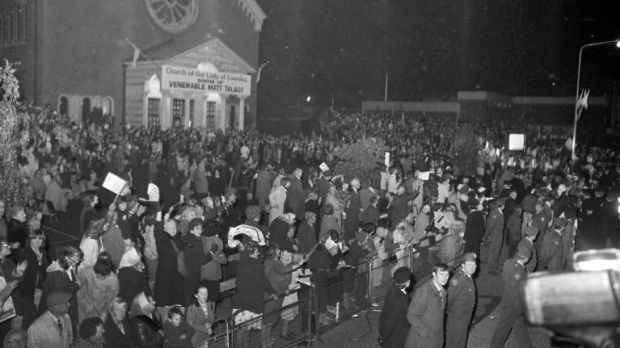
  Crowds outside Our Lady of Lourdes, Seán McDermott Street in 1979 waiting for Pope John Paul II. Photograph: Dublin City Council photographic collection 
Crowds outside Our Lady of Lourdes, Seán McDermott Street in 1979 waiting for Pope John Paul II. 
 
“The story still persists, of course, of how people were waiting for Pope John Paul to stop,” said Fr Hugh O’Donnell at the church on Sunday. “The significance of a stop, no matter how brief, is very important. In some ways it’s a corrective, almost. The expectation was there in ’79, that he would stop,” he said.
 
Fr O’Donnell said Pope Francis’s visit, which would follow his meeting at Dublin Castle with Taoiseach Leo Varadkar and other members of the Government, was not an official stop. “He won’t be saying anything. He won’t even come into the church. So, I would say it’s more a symbolic gesture, a very reassuring gesture for the people of the area.

“Also we have the tomb of Matt Talbot here who is a real symbol of, an exemplar of, someone who dealt with addiction in a particular way. He’s well known all over the world, even more so I think than locally.”

Saturday, July 14, 2018

"Matt Talbot Hope Book": An Important Time-Sensitive Invitation


“One of my parishioners told me he’s deleted 40 contacts from his cell phone since February,” my priest friend said. “All of them died from drug overdoses in the last six months.”

Sorrow and weariness dulled my friend’s gentle voice. As a priest assigned to a particularly troubled neighborhood, he has ministered over the years to hundreds of people suffering from addiction — counseling, blessing, burying them. He has prayed, wept, waited for them. Some have seized the hand of support he always extends; others have stolen from him to feed their gnawing habit. Many have simply died, either suddenly or with agonizing slowness, losing teeth and hair and flesh itself.

And my friend has loved them all, never giving up hope that in this life or the next, they will find the healing that only Christ can give.

Whenever he’s discouraged in his mission, my friend points to a painting that hangs in his office — a portrait of a gray-haired man with a push-broom mustache, dressed in an old-fashioned suit, clasping a rosary.“At least we’ve got an insider working for us in heaven,”  friend will say. “And he knows all about addiction.”

Although the man’s serene expression would suggest otherwise, my friend couldn’t be more correct: the image is that of Matt Talbot, a Irish laborer who successfully battled severe alcoholism through a life of prayer and penance. 

Declared venerable in 1975 by Pope Paul VI, Matt Talbot has become a beloved patron of those struggling with substance abuse.

He’s well qualified for the job. Born in Dublin in 1856, he began drinking heavily at age 12, capping his long workdays with fellow laborers in the pubs. He washed down his wages in countless pints, and once pawned his boots for a drink.

In 1884, unemployed and at odds with his pub pals, he took a pledge to stop drinking. He fought the urge to return to his old life through daily Mass, weekly confession, penance and constant prayer. He eventually became a Third Order Franciscan, and died while on his way to Mass in 1925. Matt Talbot’s remains are now enshrined at Our Lady of Lourdes Church in his native Dublin, where his remarkable journey from sot to saint had taken place.

The streets of 19th-century Dublin aren’t far from those of our own city today. The current opioid crisis marks another agonized spasm in the heartbreaking cycle of addiction throughout human history. Whether the substance comes in a needle or in a glass, whether the problem is in the headlines or out of the news cycle, the core issue remains the same: the one suffering from addiction is enslaved to an idol that destroys everyone and everything within its reach.

Yet under the haze of drugs, drinks and disordered thoughts, the soul seeks a God who alone can satisfy its deepest longings. All of the tools the Lord uses to heal addiction — modern medicine, psychology, support groups, sacraments — ultimately attest to that truth.

By the grace of God, Matt Talbot came to know the source of real joy, and he exchanged the bottle for the only cup that fully refreshes: the merciful love of Christ. And having drunk of it, he now intercedes for those who desperately thirst for the same.

I know a lot of people who need that cup, but whose hands are too bound by addiction to grasp it. In fact, I’ve been keeping a list of their names in a notebook that my priest friend has blessed.

I’m going to bring that notebook with me when I travel to Dublin for next month’s World Meeting of Families, and I’m going to lay it before the tomb of Matt Talbot. And I will ask this humble saint in the making to take these names to the crucified Christ, whose wounds can heal the many scars of addiction.

I’ll bring your list as well if you’ll share it with me. I don’t need full names; just a first, or a nickname, or even initials. God knows exactly who they are.

Send your names to me at matttalbothopebook@gmail.com , or via Facebook message at "Matt Talbot Hope Book." I will add them with mine, and together we will ask Matt Talbot to intercede for each.

If you or a loved one suffer from addiction, take courage. We serve a God who raises the dead and who dries all tears — and we’ve got an insider, an Irishman, working for us in heaven.
***
Gina Christian is a senior content producer at CatholicPhilly.com

Friday, April 13, 2018

Matt Talbot Prayer Cards Sent to Pope Francis


A few months ago Archbishop Diarmuid Martin invited people to write Pope Francis to encourage him to visit the tomb of Venerable Matt Talbot while visiting Dublin in August of this year http://venerablematttalbotresourcecenter.blogspot.com/2017/06/world-meeting-of-families-21-26-august.html and http://venerablematttalbotresourcecenter.blogspot.com/2017/12/personally-invite-pope-francis-to-visit.html

Gregory (Grzegorz Jakielski) did so last week and enclosed prayer cards with three new images of Matt 
(https://www.facebook.com/VenerableMattTalbot/photos/a.305602539561773.67924.304690079653019/1577210962400918/?type=3&theater).

“Yesterday I sent a letter to the Holy Father Francis inviting him to visit Shrine of Venerable Matt Talbot during the August pilgrimage to Dublin. I also included several cards with the image of Venerable Matt.”

 Image may contain: 3 people


Monday, December 4, 2017

Personally Invite Pope Francis to Visit Matt Talbot's Tomb in 2018


Ask Pope to visit Matt Talbot, Archbishop Martin says
"People should write to Pope Francis to encourage him to visit the tomb of Matt Talbot when he comes to Dublin next year, Archbishop Diarmuid Martin has said. Speaking in Maynooth at a conference on priestly formation, Archbishop Martin spoke of how priests come from the “holy people of God”, a term the Pope regularly uses when speaking of ordinary Catholics, especially those from marginalised communities.

“The bishop’s main point was the importance of the holy people of God, with Matt Talbot as example,” said Fr Richard Ebejer, former administrator of Our Lady of Lourdes Parish on Seán McDermott Street, where Talbot’s shrine is. He added that he was delighted that the famous Dublin ascetic had been mentioned, and so asked whether the Pontiff might be prevailed upon to visit Talbot’s tomb, which St John Paul II was widely expected to visit in 1979 although doing so had never been on his schedule.
Disappointed
“The local people had prepared for the visit, and had been disappointed when the Pope did not visit,” the Maynooth-based Salesian told The Irish Catholic, saying that this showed how it is “good not to raise expectations.”

Fr Ebejer has previously said that the disappointment felt locally at St John Paul’s failure to visit the tomb is still palpable today, and that while the North inner city is a marginalised community which has a social stigma attached to it, it has many positive aspects which the archbishop himself has often highlighted.

“There’s a strong sense of solidarity there,” Fr Ebejer said, describing the area as a “local community struggling to lift itself out of poverty”. He pointed to how Dr Martin has spoken about the role of mothers and grandmothers keeping families together when things went wrong, and noted how – even among families where religious practice is low – there is a strong attachment there to the local church.

Fr Eddie Conway OP of the nearby St Saviour’s Church, where Talbot had been going when he collapsed and died in Granby Lane in 1925 agreed it would be good if the Pope visited a community that is so often marginalised.

Stressing that details of the papal visit have not been confirmed, Fr Conway described the failure to visit the tomb in 1979 as “a terrible omission” and said “It would be good for the Pope to visit him – he’s Dublin’s holy man, the saint of the working class, known for how he fought with the whole addiction thing, and someone people can identify with.”

Matt Talbot was declared ‘venerable’ by Pope Paul VI in October 1975."

Monday, April 24, 2017

Visiting Matt Talbot’s Shrine in Dublin

The following is one visitor’s reaction to visiting Matt Talbot’s Shrine in  March 2016.
 
“Matt Talbot Shrine -- an inner city surprise”
Reviewed June 13, 2016
 
“Matt Talbot had a drinking problem in whiskey-loving Dublin, and so did his brothers. His life was going nowhere. He still lived with his mother. Nobody really knew him, except for the latter part of his life, when he seemed to stay clear of the drink, and tried to get others to do the same. But when he dropped dead on a Dublin street in 1925, and his body was found to have chains and cords wrapped tightly around his waist and arms, the entire city took notice.

Get the rest of the story from the internet. But if you know of someone with a drinking problem, and you know the power of prayer, stop into this church, visit the glass-covered tomb of this saint-in-process, and light a candle.

Make sure you realize that this shrine is actually the left-hand chapel inside of Our Lady of Lourdes church. The right-hand side is another grotto-style depiction of our Lady of Lourdes (now THERE is another great place to visit, in Lourdes, France!) There is some history written on the walls (eg. explaining the story of a certain rather small statue of the Sacred Heart of Jesus). I just found that sitting down to spend some quiet time after the bustle of Dublin's O'Connell street was great!

On my particular visit, I happened to stumble upon a 3:00 p.m. recitation (to video and music) of the Divine Mercy chaplet, which it appears is said daily, in addition to regular church services.”
 

Monday, August 29, 2016

Recovery Services This Week in Dublin

SAVE THE DATE - Matt Talbot 2016


The Venerable Matt Talbot Shrine (including his tomb) is located at Lourdes Church. More information is available at http://www.hopehandson.com/blog/press-release/save-the-date-matt-talbot-recovery-month/

First Friday Novena Mass and prayers for healing in St. Agatha’s Church, North William Street, Dublin 1 on 2nd September at 7.30 pm.  We pray especially for those suffering from any form of addiction, those in recovery, their families and the wider community affected by alcohol and drug misuse. All are welcome.  http://www.stagathasparish.ie/


Thursday, December 25, 2014

An Opportunity to Produce a Venerable Matt Talbot Radio Play

Earlier this month Gerry Mc Donnell, a poet and author living in Dublin, informed us that he had recently written a radio play based on the life of Matt Talbot and was seeking someone who would be willing to produce it. This is an unique opportunity to help expand awareness of Matt Talbot.
We are, therefore, inviting everyone who might be interested to contact Gerry at gerrypoet@gmail.com.

A copy of the play, The Cause of Matt Talbot, is available to anyone upon request to Gerry (or us at ven.matt.talbot.resource.center@gmail.com).


Gerry wrote this synopsis of his play:

Synopsis of
THE CAUSE OF MATT TALBOT
This is a radio play which is approximately a half hour long. It is essentially about the journey and how people return changed from happenings on the journey.
Dan travels from Boston to Dublin to visit the shrine of Matt Talbot. He had promised his dying mother, who believed that he had been cured of alcoholism because of her prayers to Matt, that he would do so. He is skeptical and is on a dutiful visit to hand in notification of Matt’s intercession in his recovery from alcohol addiction. On the plane he meets Al a nervous, talkative traveller and a priest who has coincidentally written a pamphlet on Matt Talbot having been cured by praying to him. They talk about this patron protector of the alcoholic; their beliefs and doubts.
Dan arrives at the church where Matt’s tomb is. He stands at the back of the church in the gloom. The sacristan explains that he could talk to the priest after Mass. Soon after, the sacristan is back at his shoulder more loquacious than before. Dan gets a smell of drink off him. The Mass is long and after it is over the priest speaks to each parishioner in turn, giving them a blessing. Dan is waiting impatiently. He has to catch a flight back to Boston that afternoon. He explains his predicament to the sacristan who agrees to give the envelope to the priest. Once more the sacristan approaches Dan saying the priest would see him now. Dan asks the sacristan for the envelope which he doesn’t have. It transpires that the sacristan’s brother, who hangs around the church begging, has the envelope. Dan failed to distinguish between the two, in the shadows.
The priest assures him that his visit will not be wasted. He urges Dan to pray at Matt’s tomb. Dan is having compulsions to drink. He hears the voice of Matt encouraging him to stay sober. It is a transformative experience and he leaves the church with a blessing from the priest. His grimy surroundings look pristine. As he walks through the streets it is as if he is in love with everybody and everything. Feeling a little bit ungrateful he wonders is he having a flash-back to his drinking and drug taking days. He gets a taxi to the airport and boards his plane. He reaches into his pocket to read some of the literature on Matt which he got in the church. He takes out an envelope. It is the one given to him by his mother. The sacristan’s brother has the other envelope. He reflects on all that has happened. A fellow passenger engages him in small talk. He says, “I’m returning home, or am I?”


Some background information about Gerry Mc Donnell:


GERRY MC DONNELL was born and lives in Dublin. He was educated in Trinity College, Dublin where he edited  ICARUS, the college literary magazine; and at Dublin City University. He has had six collections of poetry published. He has also written for stage, radio and the television series Fair City. His play Making It Home, a two-hander father and son relationship, was first performed at the Crypt Theatre at Dublin Castle in 2001. A radio adaptation of this play was broadcast on RTE Radio 1 in 2008 starring the acclaimed Irish actor David Kelly as the father and Mark Lambert as the son. It has been translated into Breton and has been published. A stage production will happen in July 2014. He has written a radio play, a stage play and a libretto based on the life and work of the Irish poet James Clarence Mangan (1803 – 1849).

His stage play Song of Solomon, set on a canal in Dublin, has a Jewish theme. His interest in Irish Jewry has resulted in the chapbook Jewish Influences in Ulysses; a collection of monologues called Mud Island Elegy, in which Jews of 19th century Ireland speak about their lives from beyond the grave; Lost and Found concerning a homeless Jewish man living in the Phoenix Park in Dublin. Mud Island Anthology, concerning ‘ordinary’ Dublin gentiles who lived in the latter half of the 20th century was published in 2009 and is a companion collection to the ‘Elegy’ poems. His latest collection of poetry, Ragged Star, was published in 2011 by Lapwing Publications, Belfast. His novella called Martin Incidentally was published in January 2013. I Heard An Irish Jew, selected poems and prose, will be published in 2014.

He is a member of the Writers Guild of Ireland and the Irish Writers’ Union.
CONTACT: gerrypoet@gmail.com  0876119002


When asked as to what led Gerry to write this play, he responded with the following very personal reflection:


THE CAUSE OF MATT TALBOT
Gerry Mc Donnell
December 2014

I grew up close to where Matt Talbot lived. I had heard him spoken of fondly by ordinary working class people. I also heard that he passed the picket on a strike. So I had conflicting ideas about him. Anyway he was a figure of the past and had little impact on my life, I thought; that is until I followed in his footsteps down the dark tunnel of alcoholism. At this time I was rebellious and had little time for religion or things spiritual. It was to be some years before the figure of Matt re-emerged in my thoughts. The intervening years had brought the tragedy of the untimely deaths of my parents. So I was ripe for resentment and blame which started with God and moved down to mankind. 


Matt Talbot was in my consciousness during my recovery from alcoholism. I wondered how he could have stayed sober in a city awash with alcohol and poverty. The fact that he had lain down the drink at twenty-eight and remained sober for the rest of his life puzzled me. How could a man, on his own, beat the demon drink? Of course he wasn’t on his own. He turned to his religion and devoted himself to Our Lady. I too turned to religion in the battle to stay sober. But I also had the fellowship of Alcoholics Anonymous for support. 

I still had ambivalent feelings about Matt and his fervour. Was he a religious maniac or a holy man? The chains he wore pointed to the former, yet the man I got to know in my reading about him bore testimony to the latter. In a secular world it is easy to interpret his life in a negative way and dismiss his self-denial- the block of wood for a pillow and the tear at the knee of his trousers so he could better feel the discomfort of his flesh on the granite steps of the church where he went to Mass before a hard day’s work in a timber yard- as the actions of a fanatic.

However, as I matured in my sobriety I began to see him as a holy man. I read that he shared what little lunch he had with his fellow workers. He was kind and happy in himself although no doubt he had his demons to wrestle with. This was not the portrait of a deranged man. Nobody suffering from a mental illness could accomplish what he did as a life-long diligent worker and a daily Mass goer. 

 What led me to write my play, The Cause of Matt Talbot, was my identification with his Catholic, working class life and his recovery from alcoholism. I hope I have given a true picture of him in the play or at least have not besmirched his memory in any way.

Tuesday, December 2, 2014

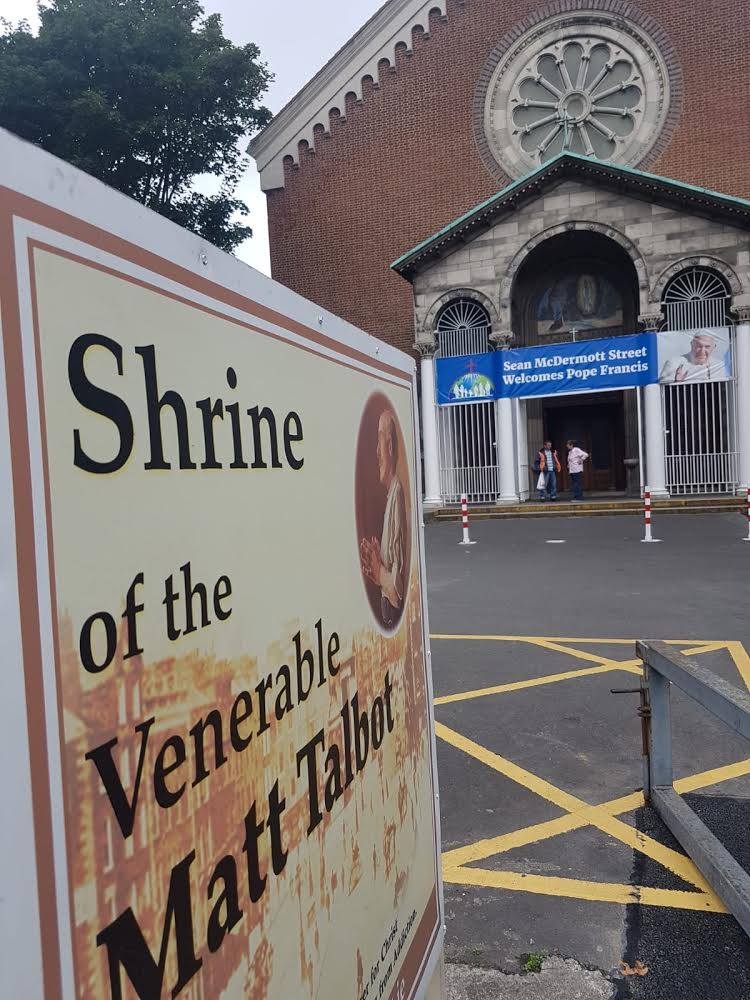
Venerable Matt Talbot Shrine Sign


The mortal remains of Matt Talbot rest in Our Lady of Lourdes Church, Sean MacDermott St., Dublin.  
Photos within the shrine and church are posted at 
http://venerablematttalbotresourcecenter.blogspot.com/search?q=tomb. The shrine is on Facebook at https://www.facebook.com/pages/Matt-Talbot-Shrine/263868810479483?ref=stream

Matt Talbot Shrine's photo.

Saturday, August 16, 2014

Wooden sculpture of Venerable Matt Talbot


Grzegorz Jakielski, at https://www.facebook.com/pages/Matt-Talbot/304690079653019, has posted this photograph of a 2 ft. wooden sculpture of Matt Talbot. It was carved by the grandmother of a recovering alcoholic as a parish gift for a priest in Poland who is very interested in Matt Talbot.
 
Grzegorz has also posted 12 photographs taken at the tomb of Matt Talbot, Our Lady of Lourdes Church, Seán McDermott Street, Dublin, at https://www.facebook.com/media/set/?set=a.559750170813674.1073741826.304690079653019&type=1


Sunday, June 1, 2014

Parish newsletter item about Venerable Matt Talbot


The following item appeared in a parish newsletter. Perhaps we can suggest that such an item about Matt Talbot be included in our parish newsletter/bulletin.


Venerable Matt Talbot

By Fr John
Newsletter for 5th June 2011- St Agnes’ Parish
Crumlin, Dublin 12


Last Sunday morning a woman who was attending Mass here in St Agnes approached me after one of morning Masses. She was from Donegal and was visiting family in the area. She asked about Matt Talbot and she expressed a wish to visit his tomb. I directed her to Sean McDermott Street.


I feel that he seems to be remembered more in other parts of the country and in the USA especially, then in his native city. On Tuesday next {7th June} we will be recalling the anniversary of his death. He died suddenly on this date in 1925 in Granby Lane on his way to Mass in Dominick St Church. Within a few short years of his death his reputation as a saintly man and especially as a patron and protector of those suffering from all forms of addiction, and their families was established.


From his early teens until the age of 28, Matt was a hard drinker. Perhaps if he was living in our age his problem would have been hard drugs. After his conversion, he led a life of prayer, devotion to the Mass and the Blessed Virgin and he gave away all he had to help the poor. He never wrote a religious book or founded a Religious Congregation. He was devoted to prayer and penance, and his little room at 18 Rutland St was his monastic cell.


Pope John Paul II had a great interest in Matt Talbot and said he would like to come to Ireland to beatify him. In a strange twist, John Paul II was himself beatified after Easter a few years after his death. However Matt Talbot, that saintly man, who died 86 years ago this week still awaits that deserved honour.

Tuesday, April 22, 2014

Learning about Venerable Matt Talbot in Utah

We greatly appreciate those who spread the word about Venerable Matt Talbot. Yet, at times, one might be somewhat surprised by the geographical location of the writer and most likely readers.

Such might be the case with this article for those living in the U.S. state of Utah, where less than 10 percent of the state’s population are Roman Catholics and the overwhelming religious body is The Church of Jesus Christ of Latter-day Saints. Based on “The Word of Wisdom,” a health code Joseph Smith promulgated in 1833, Mormons are to abstain from tobacco, alcoholic beverages, tea and coffee and general physical and spiritual fitness is encouraged.

A patron saint for those suffering from alcoholism?

By Msgr. M. Francis Mannion*
Pastor emeritus of St. Vincent de Paul Parish
The Diocese of Salt Lake City.
Friday, Apr. 18, 2014
The name of Matt Talbot is not well known outside of Ireland, but Talbot will likely be canonized in the not-too-distant future and become the patron saint of alcoholics. He was declared Venerable by Pope Paul VI in 1975.

Matt Talbot was born in humble circumstances in Dublin in May 1856. At that time, Ireland was recovering from the devastating famine of the mid-1840s. This was an era of grinding poverty and appalling living conditions, especially in the larger cities. 

Heavy drinking and alcoholism were very severe problems in those years, and a deep-seated feature of Dublin life. Talbot’s father and older brothers were heavy drinkers. Alcohol provided one of the few means of escape from the harsh conditions of Dublin life, and it brought with it all the miseries of broken families and unfulfilled hopes.

From his early years up to the age of 24, Matt Talbot was a very heavy drinker, and clearly an alcoholic. This was a source of great distress to his mother. His paycheck each week went primarily for alcohol. He frequented pubs every night, and when he ran out of money, he borrowed and scrounged among his fellow drinkers. To sustain his habit, he pawned his clothes and boots to get money for alcohol. On one occasion, he stole a violin from a street musician and sold it to buy drink. Most of his jobs in that early period were deliberately with liquor merchants, where he had easy access to alcohol. 

In 1884, however, Talbot stopped drinking and made a three-month pledge to refrain from alcohol. Having been successful in that attempt, he made a year-long and then a life-long pledge. Despite great temptations, he never took a drink again. For the rest of his life, however, abstinence was for him a fierce spiritual and psychological struggle.

The remaining 41 years were lived heroically with Matt attending daily Mass, praying fervently, helping the poor, and living out a strict spiritual life. He modeled himself on the early Irish monks, whose lives were extremely severe. He constantly read Scripture, the lives of the saints, the writings of St. Francis de Sales, and works like the Confessions of St. Augustine. His spiritual director was a priest at the diocesan seminary, who gave him a chain to wear permanently around his waist as a sign of penance.

Talbot dropped dead of a heart attack on a Dublin street on Trinity Sunday, June 7, 1925 on his way to Mass, and he was buried in Glasnevin Cemetery.

News of Talbot’s death, of his severe penitential life, the discovery of the chains he wore, and, not least, his triumph over alcohol spread rapidly among Dublin Catholics. He was popularly hailed as a saint.

Within a few years of his death, Talbot was regarded as a patron and protector of those suffering from alcoholism. In 1972, his remains were exhumed and taken to Dublin’s Our Lady of Lourdes Church, in the area where Matt had spent his life. Every day pilgrims came to pray at his tomb, and organized pilgrimages from all over Ireland became frequent.

Since then, devotion to Talbot has spread among alcoholics and their families beyond Ireland, and many devotees look forward to his canonization.

Not a lot has been published about Matt Talbot. Two of the books I would recommend are: Eddie Doherty, Matt Talbot (Combermere, Ontario: Madonna House Publications, 2001); and Tom Ryan, Comfort My People: Prayers and Reflections Inspired by the Venerable Matt Talbot (Dublin: Veritas, 2001).


*Msgr. Mannion is pastor emeritus of St. Vincent de Paul parish in Salt Lake City. He holds a Ph.D in sacramental theology from The Catholic University of America. He was founding president of The Society for Catholic Liturgy in 1995 and the founding editor of the Societys journal, Antiphon. At the invitation of Cardinal Francis George of Chicago he founded the Mundelein Liturgical Institute in 2000.

Monday, February 10, 2014

"My Friend, Matt Talbot"

Joseph D. recently sent us a note expressing his appreciation “for the interesting material” about Venerable Matt Talbot on our blog.
At our request Joseph wrote the following to express, “as the flow came,” his gratitude for the life of Matt Talbot and gave us permission to post it. 
(We have added the title)

 
"My Friend, Matt Talbot"
by Joseph D.
30 January 2014

I went into Our Lady Of Lourdes Church 40 yrs. ago asking for help from Matt . Within 6 months I had stopped drinking and have remained alcohol free since that time. I had to return to the shrine every three days to get a peace of mind as my thinking was in a desperate state. On one such occasion I was not kind in my word as I said "do I have to keep coming back here for the rest of my life, I need help".  I got my peace but upon leaving the church what I used to call the machine gun mind came back, racing thoughts that gave no peace. I was sure I was being punished by God for talking up. I met a friend whom that day I had arranged to play table tennis with, the mind was so toxic I could not play. He asked if I would like to chat to a friend of his , I agreed, the moment I went into the place he brought me to my peace came . There was a book there that was given to me and that was my companion for many years and educated me Spiritually. It was the start of a great adventure that is still a work in progress. I have had to face many perils during my sobriety but the peace remains, the education for emotional sobriety is ongoing. The story with Matt had started many years before, he was introduced to me by my father when I was 6 or 7. A brother of mine had died in St Canices  school as a result of an accident  there, I was three years of age , this was back in 1948. The grief of that event had a big effect on the family , I feel I am still recovering from it. Part of the ritual every Sunday was to visit Glasnevin Cemetery, I used to be terrified of that place. After visiting my brothers grave my father would go to Matt's resting place where people would gather to say the Rosary around 12 oc. He was then moved from the grave to a whitewashed tomb in the centre of the graveyard where again the Rosary was recited . It was a scary place to get to for the doors of other tombs would be open , showing the stacked coffins . When I would get to Matt's place of rest I would feel the fear go . Jump on to when I was 28 and the alcohol that was my friend and which allowed me to survive, no longer worked. I could not trust the living to help thus I arrived at Our Lady of Lourdes seeking solace from Matt , he did not let me down. I always say that I saw Matt's progress in death as he was promoted from the grave to the tomb then from the tomb to his now resting place in the church. God promoted him as he promises to do to the meek and Matt is a great example of the meek who even in death progressed.  I am a regular visitor at his tomb to this day for the love that flows there is a river of peace that comes from his heavenly abode in the company of his great love , Christ Jesus.  
John, thank you for the opportunity to write of my friend to whom I owe my life. Joe .

Saturday, January 18, 2014

One visitation to Matt Talbot's tomb

People have multiple reasons for visiting the tomb of Venerable Matt Talbot. For this daughter it was to fulfill a request of her father with 40 years of sobriety.


“For now, I’ll simply mention that when we returned to Dublin on August 29, Barb satisfied a request of her father and sought out the church (Our Lady of Lourds) that contains the crypt of Matt Talbot, 1856-1925.  Although not a formal saint, he is known as the patron saint of alcoholics. After 16 years of alcoholism he maintained 40 years of sobriety. Barb arrived just as the priest was locking the doors of the church but he was more than willing to keep it open to show her around and to share with her information about Matt Talbot. The priest said that many people from overseas stop in because of Matt Talbot but most are from the USA and Canada.  He brought out a chain that Talbot wore as a symbol of his devotion to the Church and had Barb put her hand on the box containing the chain while he said a prayer for her family.  Her father should be pleased.”


Source: http://tusentakk2.com/wordpress/2013/09/dublin-ireland-august-23-24-29-2013/# for text and 3 Matt Talbot related photographs.

Thursday, August 30, 2012

For International Guests Visiting Dublin This Weekend...

Dublin recently had an influx of guests from around the world in June of this year for the International Eucharist Conference.

This weekend, Dublin will host an even larger group of international guests for events surrounding and including the University of Notre vs. Navy (US) college football game in the Emerald Isle Classic at Aviva Stadium on Saturday.
 
While not on the listed itinerary (http://newsinfo.nd.edu/news/32735-notre-dame-to-celebrate-academics-faith-and-tradition-during-dublin-game/?utm_source=Daily+Newswire&utm_campaign=a735764861-Daily_Newswire7_2_2012&utm_medium=email), it is our hope that some will take this opportunity to visit the tomb of Venerable Matt Talbot. 

Tuesday, June 19, 2012

Matt Talbot Day of Remembrance


[For Roman Catholic websites that post a brief biography of a saint or holy person for a particular day of the year, we may find Venerable Matt Talbot listed for June 18 or June 19, such as the one below. (For a comment about these two dates, see Matt Talbot Remembrance Day Discrepancy)


The following narrative about Matt Talbot is from the Ministry with Persons with Disabilities at the Archdiocese of Atlanta, Georgia at http://www.archatl.com/ministries/disabilities/saints/saint_info.php?0=June+19&feast_date=June+19&1=Venerable+Matt+Talbot&full_nam e=Venerable+Matt+Talbot&2=Alcoholics&patronage=Alcoholics. Its writer, Mr, McCoy, states that “a Jesuit Father, Father Edward Dowling helped A.A. to formulate this 12 step program in 1935.” Please note that while Alcoholics Anonymous was founded in 1935 by Bill Wilson and Dr. Bob Smith and the book, Alcoholics Anonymous, was published in 1939, Bill Wilson, its anonymous author, did not meet Fr. Dowling until 1940 when Bill learned of the similarity between the 12 steps of AA and the Spiritual Exercises of St. Ignatius. One source, among many, about this meeting can be found at http://www.barefootsworld.net/askbillw.html#24 and http://www.barefootsworld.net/askbillw.html#23]


“Venerable Matt Talbot
Feast day: June 19
(Patron of Struggling and Recovering Addicts and Alcoholics)
 
Matthew Talbot (1856 - 1925) was born in the poverty of Dublin's inner city. He took to drink when still a child, and was considered a hopeless alcoholic by age thirteen. When his wages were spent, he borrowed and scrounged for money. He pawned his clothes and boots to get money for alcohol. He became a thief, once even stealing the violin from a blind street entertainer. The violin was sold to pay for a "Drinks are on me!" pub bill. 

Sixteen years later at age 28, he decided to "kick the habit". His remaining forty-one dry years were lived heroically, attending daily Mass, praying constantly, helping the poor and living the ascetic life-style of Celtic spirituality. A Jesuit priest helped him, giving him a rehabilitation program, which providentially incorporated what was to become the Twelve Steps of Alcoholics Anonymous. This is not really surprising when one remembers that a Jesuit Father, Father Edward Dowling helped A.A. to formulate this program in 1935. The steps have basis in the Spiritual Exercises of St. Ignatius, the founder of the Jesuits. The priest also gave him a chain to wear wrapped around his waist beneath his clothing. It was a very light but somewhat long chain, much like a clock chain. He wore it as a self-reminder of the fact that he was once enslaved by alcohol, and of his pledge to the Sacred Heart to keep on fighting "the demon". 

Matt also became a Third Order Franciscan in 1890. "Never be too hard on the man who can't give up drink." He told his sister. "It's as hard to give up the drink as it is to raise the dead to life again. But... both are possible and even easy for Our Lord. We have only to depend on him."
Matt Talbot worked in the lumber yards on the docks of Dublin. He was always very poor, partly because he was so generous to people in need. To his neighbors and his fellow workers, he was a cheerful, happy friend. He gave away most of his wages every week to the poor at home and in the Catholic missions abroad. He lived a life of prayer, fasting, and service, trying to model himself on the sixth century Irish Monks. He read Scripture, lives of saints, and -considering his meager schooling- an astounding assortment of books: The Confessions of St. Augustine; writings of St. Francis de Sales, St. Teresa of Avila, and Blessed John Cardinal Newman; papal encyclicals, world history, and social policy. Word by word, he deciphered what they said. What he couldn't understand, Matt laboriously copied onto scraps of paper, and then handed it to a sometimes astonished priest for explanation the next time he went to Confession.

After a life of heroic perseverance, Matt died suddenly while walking to Mass, June 7, 1925. Venerable Matt Talbot's remains were moved to Our Lady of Lourdes church on Sean McDermott Street, Dublin, Ireland in 1972. The tomb has glass panels through which the coffin may be seen. He was declared Venerable by Pope Paul VI in 1975. Addiction treatment programs, retreats, and centers throughout the world now bear his name.

Saint's Prayer

Gentle Matt, I turn to you in my present needs and ask for the help of your prayers. Trusting in you, I am confident your charitable and understanding heart will make my petitions your own. I believe that you are truly powerful in the presence of Divine Mercy. If it be for the glory of the Sacred Heart of Jesus, the honor of Mary, our Mother and Queen and the deepening of my relationship with them, show that your goodness towards me, in my daily struggles, equals your influence with the Holy Spirit, who is hidden and at home in my Heart. Friend of pity, friend of power, hear, oh hear me in this hour. Gentle Matt, please pray for me. Amen
Special Thanks to: Thanks to The Life of Matt Talbot: A Dublin Laborer by Sir Joseph Glynn and Book of Saints by the Monks of Ramsgate for the basis of this narrative. 

The national Matt Talbot Shrine for the United States is located in Manorville, Long Island.

Data entered by: Ed McCoy on 2011-12-14”

Thursday, June 7, 2012

This day in 1925 Irish History


[This article is copied as it appears at http://www.politics.ie/forum/history/190234-day-irish-history-1925-ad-death-venerable-matt-talbot.html.  From the published comments at this link, there are those who do not view Matt as a saintly person.]


“7 June 1925: The death of the Venerable Matt Talbot on this day.  


Matt Talbot was on his way to Mass on Sunday, 7 June 1925, when he collapsed and died of heart failure on Granby Lane in Dublin. Nobody at the scene was able to identify him. His body was taken to Jervis Street Hospital, where he was undressed, revealing the extent of his austerities. A heavy chain had been wound around his waist, with more chains around an arm and a leg, and cords around the other arm and leg.


He was a reformed alcoholic who turned from a life consumed by Drink to one of physical hardship and mortification devoted to religious worship. Matt was born into a large family in Dublin City in 1856. When he was just 12 years old he started to drink and became addicted. He tried numerous times to give it up but met with only temporary success. When he was 28 years old he took the Pledge and kept it until his death 41 years later. A Priest advised him to follow the ways of the early Monks & Holy Men of Ireland in avoiding the Temptations of the Flesh. He henceforth lived a Life of rigorous Work and Prayer.


He fasted constantly. His breakfast consisted of cocoa prepared the previous evening by his sister, which he often drank cold. With this he ate some dry bread. For his midday meal he had cocoa to which he would add a pinch of tea, and again drank cold. With this he took a slice of bread. His sister would bring him a small evening meal. If she brought fish he would insist that she take it home with her and would make do with bread soaked in the fish juice.


On Sundays he remained in the church for every Mass. Only on returning to his room at about 2 p.m. would he break his fast for the first time since 6.30 p.m. the previous day. The remainder of the day was spent in prayer, reading the Scriptures and the lives of the saints. He gave all his money to neighbours in need and to the missions. 


Matt Talbot mortified himself rigorously. He slept on a plank bed with a piece of timber for a pillow. This left his face numb in later years. He slept in chains, which he wore for 14 years before his death, round his leg and on his body. Reality (July/August 1999), a Redemptorist Publication  


On 6 November 1931, Archbishop Byrne of Dublin opened a sworn inquiry into the alleged claims to holiness of the former dock worker. The Apostolic Process, the official sworn inquiry at the Vatican, began in 1947.


On 3 October 1975 Pope Paul VI declared him to be Venerable Matt Talbot, which is a step on the road to his canonisation, a process which needs evidence of a physical miracle in order to be successful.His story soon became known to the large Irish émigré communities. Countless addiction clinics, youth hostels, statues and more have been named after him throughout the world from Nebraska to Warsaw to Sydney. One of Dublin's main bridges is also named after him. Pope John Paul II, as a young man, wrote a paper on him.


Talbot's remains were removed from Glasnevin Cemetery to Our Lady of Lourdes church on Seán McDermott Street, Dublin, in 1972. The tomb has a glass panel through which the coffin may be seen.On his coffin is inscribed the following words: 'The Servant of God, Matthew Talbot.' 


There is a small plaque in Granby Lane at the site of Matt Talbot's death.”