Friday, June 19, 2009

Novena to Venerable Matt Talbot

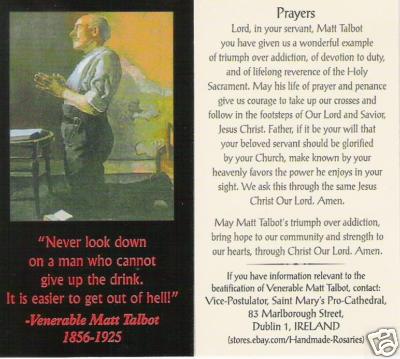
Matt Talbot.JPGHere is one of the Church's holy men for us to emulate. Matt Talbot was a regular guy if ever there was one, a working class alcoholic who changed and sanctified his life with the help of God. He never gave up. He even died while walking to mass. Read about his life here and here and here. This website is also dedicated to him.


Interestingly, Matt had a keen sense of justice. "He refused to return to work after a strike in 1900 and sought another job." He believed strongly in the rights and dignity of the working man. He was a very hard worker. Along these lines, it is his perseverance that Matt Talbot is most known for. "It is consistancy that God seeks," he said.


He was a great adorer of Our Lord in the Eucharist. It is written:

Young Matt Talbot, known as the "saint in overalls," also knelt outside the doors of his church for hours every morning. Once inside, he would prostrate himself on the floor in the form of a cross before entering his pew. Every Sunday, he spent seven hours in Church without moving, "his arms crossed, his elbows not resting on anything, his body from the knees up as rigid and straight as the candles on the altar," Kaczmarek writes. He did this every Sunday for 40 years.
A tremendous son of Our Blessed Mother, in addition to praying the rosary and angelus, one of his favorite little prayers, which he sometimes kept written on his hand, was, "O Virgin I ask three things from you: the grace of God, the presence of God, the blessing of God" and "O blessed Mother, obtain for me from Jesus that I may participate in His folly." I love that one.

Most notably, of course, Matt Talbot is known for his total conversion of life away from alcohol addiction, something he described as like "escaping Hell." Almost a year ago, while visiting Australia, Pope Benedict XVI visited a rehabilitation community and made the following
comments with regard to addictions and recovery, which are amazingly insightful (not surprising). Turning away from addiction and towards God is a choice for life. "I have set before you life and death, blessing and cursing. Choose therefore life, that both thou and thy seed may live: And that thou mayst love the Lord thy God, and obey his voice, and adhere to him." (Deuteronomy 30: 19-20) Here's what the pope said:

"They had to turn away from other gods and worship the true God," the pope said.

The false gods competing for people's allegiance today, he said, are associated with the worship of material things, possessive and manipulative forms of love and power.


"The cult of material possessions, the cult of possessive love and the cult of power often lead people to attempt to 'play God,' to try to seize total control with no regard for the wisdom of the commandments that God has made known to us," the pope said. "This is the path that leads toward death."

But, Pope Benedict said, worshipping the true God, recognizing him as the source of goodness, entrusting oneself to him, opening oneself to his healing power and obeying his commandments are the choices that lead to life.

Let's pray for the conviction and perseverance of Venerable Matt Talbot, may the Holy Ghost grant it! Here is a prayer that you may say for the canonization of the Irish holy man, Matt Talbot. You may also use it as a novena prayer. Begin today and say for 9 days. His feast is on June 19th!

Lord, in your servant, Matt Talbot you have given us a wonderful example of triumph over addiction, of devotion to duty, and of lifelong reverence of the Holy Sacrament. May his life of prayer and penance give us courage to take up our crosses and follow in the footsteps of Our Lord and Saviour, Jesus Christ. Father, if it be your will that your beloved servant should be glorified by your Church, make known by your heavenly favours the power he enjoys in your sight. We ask this through the same Jesus Christ Our Lord. Amen.

Thursday, June 18, 2009

Remembering Matt Talbot


For people who have an interest in recovery from alcoholism and the Venerable Matt Talbot, Matt is typically remembered in prayer daily.

There is, however, a yearly Remembrance Day for Matt, which is noted either today, June 18, or tomorrow, June 19, depending on the website.

For previous posts regarding this discrepancy of dates, see

Saturday, May 9, 2009

Devotion to Our Lady

In his sobriety Matt Talbot developed a deep and abiding devotion to Mary and exemplifies the six norms Fr. Hardon articulates in this article. JB


Fr. John A. Hardon, SJ


Devotion to the Blessed Virgin is one of the cardinal features of not only professing to be, but of being a Catholic.


Over the years in speaking on the Blessed Virgin Mary, you naturally fall into certain categories and almost routine ways of speaking about Our Lady. Yet, as with anything we love, repetition is no hindrance to the increase of our affection.


Devotion to the Blessed Virgin is one of the cardinal features of not only professing to be, but being a Catholic. You might say a Catholic is one who is devoted to Mary. What I will suggest for our reflections is that we look at and check our devotion to Mary on six norms. The one who is devoted to Mary thinks of her, reads about her, talks about her, speaks to her, invokes her and tries to imitate her.


First, if we are devoted to Our Lady we think of her. We instinctively think about and of the people that we admire, those we love. I'm not sure how we would define pleasant thoughts, but I hazard to guess that pleasant thoughts are about people we love. One reason, by the way, that some people are sad is because they may not be loving others the way they should and, as a consequence, deprive their minds of the most pleasant mental experience on earth. A fair index, therefore, of how much we admire or love a person is how much they are consciously on our minds.


In order to think of Mary, we need reminders of Mary in our lives. It may be a picture, an image, a symbol or a 3x5 card, bent in half, like the one on my desk next to the telephone with the inscription "Mary, teach me to know the Will of Jesus." We have to keep making the effort of remembrance until it becomes habitual. As we know, the formation of character is the result of consciously formed habits. Thus, the first recommendation is to cultivate by all the means at our disposal the habit of having Marian thoughts.


Secondly, a person who wishes to cultivate a strong devotion to Our Lady reads about her. There is a great deal of literature about the Blessed Virgin Mary. There are books and periodicals to such an extent that anyone who claims that they are devoted to Our Lady and never opens a book, or reads an article, or bothers to find out a little more about her can well be suspected as to the soundness and sincerity of their devotion. Read, then, about Mary in the Scriptures, in the lives of the saints, in the stream of literature about Lourdes, Fatima, Guadalupe, La Salette and Beaurang.


Third. One who is devoted to Mary talks about her. As you see, I feel perfectly safe in talking about her to you because I am confident you want to talk about her to others yourselves. What we think and read about should give us much to talk about. Or better, what is on the mind and in the heart will inevitably be on the lips. Our Lady wants to be talked about.


Fourth. One who is devoted to the Mother of God speaks to her. No speeches, just plain conversation. This is evidently very pleasing to her and honors her Son. Talking things over with her, I admit, can be easier for some than others, but this is the way great Catholics live, they talk to Our Lady. It makes sense. She is alive; she is the Mother of God and she is accessible. Speaking to God is, of course, the top priority in our prayer life. But we are human, we all know what it means to have a mother. I know that speaking to her just about anything and everything that is on our minds can take up those slack moments in our day. I hate to think of what is on the majority of people's minds most of the time. My calculated guess is that most people are talking to themselves even, as I have discovered, when they seem to be talking to you!


What does it mean to live a Marian life modeled on the simplicity of Our Lady? It means first of all no pretense.

Self-love properly controlled is the condition and norm, as God Himself tells us, for our loving others. But this self-love can become, as I am afraid it is for many people, an addiction. And one of the symptoms of this addictive self-love is an almost uninterrupted soliloquy. Talking to Mary will not only help break through the crust of the egoism to which we are all so pathetically prone. It will also keep us in contact with that person who, the infallible Church tells us, after God, is the most important mediatrix on the way to our salvation.


Fifth. The one who is devoted to Our Lady invokes her. You notice I distinguish between speaking to Mary and invoking Mary. When I speak to her, as I do in conversation with other people, I am sharing with her what is on my mind and in my heart; when I invoke, I ask. This I dare say is the most familiar and common form of Marian conversation and it is part of the daily life of every Catholic.


What bears emphasis, however, in this invoking of Mary, is that it should be done consciously. It is just plain spiritual common sense that when we begin prayer we should become consciously aware of who we are talking to and what we are saying. Every time we pray, however distractedly, we are adoring God and pleasing Him, but the more aware and conscious I am of what I am doing the better. There is all the difference in the world between two people in conversation when one is just talking, you might almost say "just to hear himself", and when one is speaking from the heart. Moreover, when we invoke Mary we should do so not only consciously and heartedly but also confidently. Mary listens to our requests, even the trifling ones, as Cana for all times symbolizes.


Finally, a person devoted to Mary strives to imitate her. This, I don't hesitate saying, is the acme of devotion to Mary; it is also the acid test of whether she means what she should in our lives.


Among the virtues that we should especially try to imitate in Our Lady, I would place her simplicity somewhere near the top. As I have mentioned more than once, the more you deal with souls, the more you learn of their struggles in life, the more evident it is that what we need in our spiritual life today is simplicity. This is partly brought on by the high complexity of modern civilization.


What does it mean to live a Marian life modeled on the simplicity of Our Lady? It means first of all no pretense.


True greatness does not have to parade itself. Pretense is pride; pretense is claiming to have or to know what I don't have or don't know in order to have people think better of me. Simplicity means I put on no airs; it is humility manifested. Just compare in your lives the difference in the way you deal with different people. How instinctively it seems, in a moment, in a split second, we can decide whether this person is my inferior or my superior. I cannot give you a more valuable formula for the practice of Christ-like charity than to say, treat everyone as your equal. God will bless you far beyond what you think. Or I would even go farther, and this is Ignatius speaking to his sons and I pass it on to you: treat others as your superiors.


The simplicity of Our Lady was that of humble service. The moment the angel informed her about Elizabeth's condition what did Mary do? She went immediately to take care of such household chores as Elizabeth needed help with. No airs. There should never be a menial task that we are unwilling to do. No vanity. No display. No artifice. Just childlike simplicity; but let it be as Mary's was -- simplicity of heart.


Saints tell us that no one devoted to Mary will be lost. This must be true. Devotion to Our Lady is a sign that we are pleasing to God, because God, you would expect, loves those who love His Mother. That is why He gave her, entrusted her, to us and we to her. So that by doing the Will of her Son we may thus enjoy His presence in her company not only on earth but in eternity. You see, heaven is possessing Jesus and Mary. Son and Mother cannot be separated; we cannot choose between them. We either love them both and are devoted to them both or we shall not possess either. But if we love them and serve them in this life we shall be with them forever in the company of all the saints who are there because they loved the Mother of God.


Source: www.catholiceducation.org/articles/religion/re0943.htm

Wednesday, May 6, 2009

Matt Talbot: Example of Sobriety

Mary D. Herald
Arlington Catholic Herald
1/1/97


Venerable Matt Talbot was an Irishman who was an alcoholic from an early age. He experienced a spiritual conversion, stopped drinking and remained free from alcohol until his death 41 years later. Matt’s example demonstrates to alcoholics that through the grace of God, a life of sobriety is possible. Although he lived and died before the development of Alcoholics Anonymous (A.A.), the basic principles Matt Talbot lived by are the same principles embodied in the twelve steps of A.A. today.


Matt was born in Dublin in 1856, and at the age of 12 began working as a messenger for a wine merchant. He began drinking wine and when he came home drunk his father made him change jobs and work at the docks. There he switched to whiskey, and by the age of 17 he was intoxicated almost daily. Matt spent all his money on drink. Although he continued to attend Sunday Mass, he refrained from receiving Communion.


His mother prayed for him, and when he was 28, Matt hit bottom. He had been drunk for a week and was broke. When he tried to get money from his friends, they all turned away, some even crossing the street to avoid him. He suddenly took an honest look at what he had become. He then took a pledge to stay sober — first for three months, then for six months, and finally for life.


On the day of his first pledge, Matt went to confession and received holy Communion for the first time in years. He resolved to put God first in his life, and he relied on God’s grace to help him stay sober each day. Daily Mass, prayer and penance became a new way of life for Matt.


The first three steps of A.A. suggest that the alcoholic of today do just what Matt Talbot did: take an honest look at yourself, admit your problem, and start living your life on a spiritual basis. The A.A. motto "First Things First" means simply that if God is your top priority, other aspects of life will naturally fall into place.


The A.A. program suggests making amends to those who have been hurt by the alcoholic’s behavior, and Matt Talbot did this also. He changed his behavior toward his family, and became the support of his mother. He searched the streets of Dublin to find and repay a musician whose violin he had stolen when drinking.


Having had a spiritual conversion, Matt tried to be of service whenever possible. He contributed to charity, prayed for others, and became a responsible and respected member of society. He was not a loner, but belonged to several groups and sought the counsel of others. He avoided controversy and generally tried to live according to spiritual principles. This is the A.A. way of life today.


Matt Talbot died on June 7, 1925. In 1975 Pope Paul Vl declared that Matt Talbot had practiced all the Christian virtues in a heroic degree. The Church gave him the title of Venerable, the first step toward sainthood and a declaration that Matt Talbot is a Christian worthy of veneration and imitation.


By honoring this humble Irish working man, our Church proclaims hope for all addicted people. She invites us all to imitate his practice of love, humility and service.

Thursday, April 30, 2009

"So Great a Cloud: A Record of Christian Witness"

So Great a Cloud
This paperback book by Fr. Stephen Redmond, SJ about saintly people, including Matt Talbot, might be of interest. It is available from Veritas Publications or through Amazon.

The following is the publisher's description:

What is a saint? Many may think of the ‘heroes of the early Church’ like St Peter and Thérèse of Lisieux, but the list extends onwards through time to contemporary saints like Matt Talbot and Edel Quinn. So Great a Cloud tells the story of these saints, old and new, be they clergy, laity, scholars, highprofile or less known, all with one thing in common – their ability to challenge and encourage us. The book can also be seen as a history of the Church in terms of outstanding Christians, illuminated by Stephen Redmond’s original poetic verses.The success stories of this ‘communion of saints’ remind us that the pilgrim Church, despite its human failings, is essentially a way to God, a God that, historically and redemptively, remains ‘one of us’.


Stephen Redmond SJ is a Jesuit priest, author and composer. Previously a history teacher, he has a great interest in the lives of saints.

Tuesday, April 28, 2009

A Documentary on the Life of the Venerable Matt Talbot


In a series of documentaries titled, "Bringing the Saints Into Focus," produced by the Focus World Wide Network (focustv.org), one sixty minute documentary features the life of Matt Talbot.

In its promotional clip lasting 1:36 minutes, which can be viewed at https://shop.focustvonline.com/p-309-bringing-the-saints-into-focusthe-venerable-matt-talbot.aspx, we see a photograph of Matt, chains that he wore and hear their purpose, his room, a street memorial where he died, and his casket being transported to its initial burial site. Apart from the narrator Fr. Brendan Quinlan, P.P. , who has served on the Dublin Diocesan Matt Talbot Committee, appears and comments on aspects of Matt's life.

After viewing the clip in its presented size, the viewer may want to replay the clip enlarged on your computer screen. It may also be worthwhile in replaying the clip to periodically stop it by clicking the screen to study and meditate on a particular photograph.

While we have not yet seen the complete DVD, we did note one error in the clip; the narrator states that Matt died in 1925 at the age of 71 rather than at the correct age of 69.

Friday, April 24, 2009

The 12 Steps and Catholic Spirituality


For those who are interested in a thirty-two page publication relating the twelve steps (originating from Alcoholics Anonymous) to Catholic spirituality, you might be interested in this pamphlet, by Rev. Leo A. Dolan, which was published in 1991 and has the Imprimatur of John R. Roach, D.D., Archbishop of St. Paul and Minneapolis.
(A brief leaflet on Matt Talbot was previously written by Fr Leo in the 1970s which bears the Imprimatur date of 1975.)

While Fr. Dolan, who has a background in chemical health education, widely praises the value of the twelve steps for a wide range of negative dependencies in human beings, he strongly argues that the twelve steps are incomplete without integrating them with the truths of the Catholic faith, thus achieving a full spirituality. He proceeds to address each of the twelve steps in light of Christ, the Church, and the Sacraments.
He concludes his reflections in The Twelve Steps and Catholic Spirituality by "describing a holy man who employed beautifully the dynamic of change found in the Twelve Steps," namely, Matt Talbot.

This very inexpensive pamphlet can be purchased from the Calix Society at http://www.calixsociety.org/store

Note: For the sake of clarity, there is another Fr. Dolan; this one is Fr. Albert H. Dolan, O.Carm., prolific author of four books on Matt Talbot and many saints. He is probably best searched on Amazon as "Albert H. Dolan."

Wednesday, April 22, 2009

Who is Matt Talbot?


Catherine Alexandria
April 14, 2009
http://therecoveringdissidentcatholic.blogspot.com/2009/04/who-is-matt-talbot.html


Photo: Venerable Matt Talbot 1856 - 1925


A few weeks ago, I was at the Catholic Parents Online retreat at the Church of St. John in St. Paul, MN.


The evening before the retreat I learned another cousin of mine was in rehab for alcohol addiction. At the same time, I had a different cousin in rehab for meth addiction. Furthermore, an uncle of mine continues to struggle with his numerous addictions.


I was wondering around the Church between sessions and I finally remembered to go visit the mysterious (to me) Shrine in the Vestibule. It is a Shrine to Matt Talbot; whom some of you who are in recovery may already know about. I'd seen the Shrine at St. John before but had no idea who it was for. My Angel smiled on me this day because there were pamphlets, written by Father Leo Dolan (former Pastor of St. John) by the Shrine. I picked one up and read about Venerable Talbot.


The presence of the Shrine and my knowledge of it could not have come at a better time. I lit a candle and prayed to Venerable Talbot to give some of his strength to my struggling family members.


As I was getting up, a lady came by and said with excitement "Is that Matt Talbot?" I nodded and she almost threw herself down in front of the Shrine. Hey, when you need it, you need it!


Father Dolan's pamphlet talks about the need for a HUMAN model of recovery. Someone who "employed the timeless dynamic of radical conversion the 12 Steps [of Alcoholics Anonymous] acknowledge-and also has integrated these with a full Catholic spirituality"


Matt Talbot was born in Dublin, Ireland in 1856. His family was poor and he was surrounded by the excessive use of alcohol. He had very little formal schooling and often skipped school when he was enrolled.


By age 12 he quit school altogether and began to work. He also began to drink. His first job was as a delivery boy for a liquor company. Before long, he was a full-fledged alcoholic.


For the next 16 years, he worked and he drank. He often sold what he had, including at times, his clothes to buy alcohol. He stole and pawned the stolen items for money to buy alcohol.


At age 28, he walked out of a pub upset that his friends would not buy him a drink. He also seemed to tire of wasting his life. That day, he went to Church and made a good Confession and promised the Lord he would abstain from alcohol for the next 6 months. With this, began a life of sobriety, sanctity, prayer and penance.


He lived out the change of the 12 Steps before they were even devised by AA. He lived them and then some as he was careful to submit the regular direction of a Spiritual Advisor, attended Daily Mass, made frequent use of the Sacrament of Confession. He even taught himself to read so he could read the Bible. He spent much time in prayer before the Blessed Sacrament. He spent the rest of his life "making amends" for his earlier dissolute life.


If there is a Catholic 12 Steps Program, Matt Talbot lived it.


He died, at the age of 68, while on his way to Mass on Trinity Sunday 1925.


There is a prayer for Canonization in the booklet written by the late Archbishop John Roach (may he rest in peace), no stranger to addiction and recovery himself:
Lord, in your servant Matt Talbot you have given us a wonderful example of triumph over addiction, of devotion to duty, and of lifelong reverence for the Most Holy Sacrament. May his life of prayer and penance give us courage to take up our crosses and follow in the footsteps of Our Lord and Savior, Jesus Christ.
Father, if it be your will that your beloved servant should be glorified by your Church, make known by your heavenly favours the power he enjoys in your sight. We ask this through the same Jesus Christ Our Lord. Amen


Deep curtsy to Father Leo Dolan for his pamphlet.


Note: Archbishop John Roach was the Imprimatur of the Matt Talbot pamphlet by Fr. Leo Dolan, not the author of the "Prayer for the Canonization of Matt Talbot."

Whether or not it is the same Matt Talbot pamphlet by Fr. Leo that is mentioned by Cathy in the above post, there is a four page card/pamphlet reprinted with the permission of Rev. Leo Dolan that is available through the Calix Society. This card is titled, "Matt Talbot" and has a picture of a statue of Matt Talbot on the cover, two pages of text, and the" Prayer for the Canonization of Matt Talbot" on the back cover. Fr. Leo Dolan also authored a 32 page pamphlet titled, "12 Steps and Catholic Spirituality" that includes a three page sketch of the life of Matt Talbot that is available from the Calix Society at http://www.calixsociety.org/literature.html


Sunday, April 19, 2009

Venerable Matt Talbot Icon (2009) by Terry Nelson


by Terry Nelson

Terry has given us permission to post this panel he painted depicting Matt Talbot. Greater detail can be viewed by double clicking the left of your mouse. More information and reactions to his icon can be found at http://abbey-roads.blogspot.com/2009/04/matt-talbot.html

Tuesday, March 31, 2009

Christian Ascetic: Matt Talbot


Alex Malina
February 9, 2009


Very rarely do we hear about modern ascetics. In fact asceticism has almost entirely disappeared as an accepted and natural practice within the Western church, and to some degree in the large population of the Eastern church as well. Most of the holy men and women that we know of ascetic experience come from the early centuries of the Church, some before the Council of Chalcedon, and others later and in the Middle Ages. Rarely are we brought face to face with a character whose devotion and selfless practice existed in more modern times. And I believe there is a special significance to the fact that there were ascetics who practiced their penance in modern times, because we can understand them better, we can understand their motivations, they do not appear like super-hero’s from the Religious Life, but in fact as human beings tormented by the world and life as many beings on Earth.


Perhaps one of the most popular Christian ascetics of modern times was Matt Talbot, who was born on May 2, 1856 in Dublin, Ireland. It is said that for the first 28 years of his life Talbot lived as a simple worker, but addicted to alcohol. He started drinking at the age of 12, when he got his first job at a brewery. Later, he worked on the docks, where he got in the habit of drinking whiskey and visiting pubs and cabarets. Almost every night Talbot returned late at night to his parents house drunk.


After a while he lost his job, and had no money. Craving alcohol he decided to stand outside a pub where most of his friends frequented. He figured that when his friends see him standing outside they would invite him in and buy him a pint. But each friend passed by without inviting him. Talbot took this to heart, offended by the cruelty of his friends, for whom he had bought many drinks himself, he went home sober for the first time in many years.


That night, while having dinner with his mother he decided to take “The Pledge.” The Pledge was a popular thing to do in Ireland at the time. When you took the pledge you took it seriously, and you stopped drinking. However like most men and women of the time, the pledge was good for only a few days for many.


Talbot took the first pledge for 3 months, which were torturous on him. He offset the mad cravings, he would attend 5am morning Mass everyday, and spent most of the day in prayer and working as a handyman. His greatest cravings for alcohol were in the evenings, after work, when most men went to the pubs. Instead Talbot took long walks through the city.


After 3 months Talbot took another pledge, this time for six months. After six months he took the final, life-long pledge to never drink again. Over the many years that he was a drunk he accumulated great depths, and throughout the remaining years of his life Talbot made sure that all of his debts were paid out completely.


He adopted the life of poverty, emulating Jesus Christ. He lived on the bare essentials he needed to survive, giving the rest to the poor.


At some time in his life he decided to pursue the act of mortification, living in “holy slavery” to the Holy Virgin. He began binding chains around his waist, chest, arms, and legs, heavy chains with religious symbols attached to them, which he wore everyday of his life under his clothing. Talbot was inspired by the writings of St. Louis de Montfort who preached “total consecration of Jesus Christ through Mary.” Montfort is considered one of the modern fathers of Christian mortification, or what is known as “Mortification through Mary.”


But this was only one aspect of his asceticism. From what we know of Talbot he practiced many forms of asceticism, reminiscent of the hermit ascetics of early Ireland.


One of the practices that he employed in his early days was sleeping for small periods of time. Deprivation of sleep is one of the most common forms of penance and ascetic practice in all cultures. To make things more difficult for himself Talbot slept on a wooden pillow for about 3 hours a day. We know that his diet was just as meager, he lived mostly on tea, cocoa and bread. Though it has been recorded that when he was invited to others homes he ate just like everyone else.


Throughout the day Talbot managed to pray every minute he got. Any time there was free time he could be seen praying, often co-workers would find him behind a large pile of lumber on his lunch break in deep prayer. His mother often noticed him waking up at 2am after a small 3 hour nap, his hands raised in the form of a cross, praying, and when he would fall back into sleep, he would be clutching the statue of the Virgin.


This type of existence might have caused him to die so young. On June 7, 1925, on his way to morning Mass Talbot collapsed and died from heart failure. There was no way of identifying him, however when his clothes were taken off the nurses where shocked to find the severe methods which Talbot employed upon his body.


It was not until the 1930s that serious interest in Talbot’s ascetics arose. In 1931 an article on Talbot “The Saintly Lumberman” was published by Time Magazine. And in 1975 the Catholic Church gave Talbot the style “Venerable.”


Note: While the author comments that "this type of existence might have caused him to die so young," one might argue that Matt lived a relatively long life considering the number of years Matt abused alcohol from a very young age, the hard labor he did throughout his life, his daily meager diet and regular fasts, and the life expectancy at that time in Dublin. (JB)

Sunday, March 29, 2009

The Pioneer Challenge for Lent 2009

Feature 2 March 2009 | The Pioneer Challenge for Lent
pioneer_title_image
Bishop Éamonn Walsh introduces a special Lenten edition of The Pioneer magazine and reminds us that "there is always someone for whom this is the year that will make the difference in their relationship with alcohol".

Bishop Éamonn Walsh
Vice Chair, Irish Bishops’ Drugs Initiative (IBDI)

bishopeamonnwalsh_webThis special edition of the Pioneer magazine to mark Temperance Sunday encourages us all to address our relationship with alcohol. Ireland will forever be indebted to Fr. Theobald Mathew, founder of the Temperance Movement. We are also indebted to Fr. James Cullen, founder of the Pioneer Association 111 years ago. Fr Cullen, in expressing appreciation of Fr. Mathew, described him as the ‘giant at his shoulder’. Matt Talbot is an inspiration, a sign of hope to those who can only safely relate to alcohol through abstinence. The abstinence of the Pioneer Association is positive in the way it converts the sacrifice involved into reparation for the suffering caused through the misuse of alcohol.

I welcome the Pioneer Association’s extended outreach to those who wish to enjoy the use of alcohol. A temporary pledge for Lent or a significant reduction in the consumption of alcohol is proposed. Temperance Sunday provides an opportunity to discuss honestly with family and friends the way we use alcohol. Minimising, denial and mistakes can be addressed in a friendly environment. Goals can be set and agreement made, to help one another in setting targets of abstinence or reduction with built-in friendly support structures to encourage and evaluate. There is always someone for whom this is the year that will make the difference in their relationship with alcohol. The Pioneer Association may occasion that difference.

The Pioneer magazine special edition for Lent 2009 includes:

Welcome
- Fr Joe Dargan SJ, Chairman of the PTAA
- Mary Wallace TD, Minister for Health Promotion and Food Safety
- Bishop Éamonn Walsh, Vice-Chair, IBDI

Calling ‘time’ on alcohol related harm
- Fiona Ryan, CEO, Alcohol Action Ireland

Grappling with the demons of addiction: Invitation to give up or moderate alcohol consumption for Lent
- Bernard McGuckian SJ

Interview
- Micheál Ó Muircheartaigh

Thinking of abstaining from or reducing your intake of alcohol for Lent?

Practical suggestions from the IBDI

  • Refrain from alcohol for the weeks of Lent
  • Consider drinking non-alcoholic drinks when out with friends at the weekend
  • Reduce the intake of alcohol from what is your normal use
  • Encourage your friends to reduce alcohol intake
  • Donate some of the money saved from alcohol to a charity of your choice
  • Encourage discussion with your friends about the dangers of excessive drinking
  • Initiate a discussion in the home about the family’s attitude to and use of alcohol
  • Nationally, we might encourage people to reduce their alcohol use, say by one-third or a half, during the weeks of Lent.


The Irish Bishops' Drugs Initiative is supporting the Pioneer Challenge, which invites everyone to abstain from alcohol or reduce their intake of alcohol this Lent. At any time of year, parishes seeking further information on alcohol or drugs can contact the Irish Bishops' Drugs Initiative.


Monday, March 9, 2009

Father Martin, R.I.P.


Although their earthly lives overlapped by only eight months and had very distinct personalities and life styles, Matt Talbot and Fr. Martin were connected by their deep faith in God's mercy for alcoholics and their families.


Fr. Joseph C. Martin, S.S.

October 12, 1924 - March 9, 2009


"I'll die with a piece of chalk in my hands, talking with a bunch of drunks and addicts."


"My name is Joe Martin, and I'm an alcoholic
". Father Martin first uttered this statement in 1958, when he was in treatment for alcoholism at the Guest House, what would prove to be a refuge for him from his drinking and a turning point in his life. His personal journey in recovery prompted a celebrated career in which his only aim was to ease the suffering of individuals and families, around the world, affected by addiction.


He was born on October 12, 1924 in Baltimore, Maryland. He quickly developed a fondness for religion and faith. People fondly recall his special story-telling ability and wonderful sense of humor. In 1942, Father Martin graduated from Loyola College and entered St. Mary's seminary. He was ordained a priest in 1948 and underwent rigorous training to become a Sulpician, a highly regarded teaching society within the Catholic Church. After losing this coveted distinction as a result of his drinking, only in sobriety did he regain this title.


Father Martin taught minor seminarians and fulfilled several teaching roles within the church. It was very evident that he possessed a special ability to educate but his drinking became very troublesome and he was eventually directed to seek help at Guest House (in Michigan).. Father Martin frequently cited the tremendous impact his mentor Austin Ripley had on his journey in recovery. Many of Father Martin's teachings originated in concepts he learned while at the Guest House. His enthusiasm for sobriety coupled with his passion for teaching evolved into an unending quest to ease the suffering of individuals and families affected by addiction. In his career, spanning more than 35 years, Father Martin was catapulted into international acclaim as a prized speaker and educator on addiction and recovery thru the Twelve Steps. He founded Kelly Productions in 1972 and used it as a platform to capture the minds and hearts of millions of people.


Father Martin's message is no less relevant today than in 1972. He will continue to inspire love, service, helpfulness to others, and recovery through the use of his films, audio lectures, and books. In his last year, he shared his vision that he can be remembered so that the still suffering individual affected by addiction might benefit from his God-inspired message of hope.


Source: http://www.fathermartin.com/


Fr. Martin can be viewed speaking at http://www.youtube.com/user/fatherjoemartin.


The Rev. Joseph C. Martin, Leading Authority on
Alcoholism and Addiction Treatment, Dies at 84


HAVRE DE GRACE, Md., March 9 /PRNewswire/ -- The Rev. Joseph C. Martin, S.S.,
noted authority and lecturer on alcoholism who co-founded Father Martin's
Ashley, an addiction treatment center in Havre de Grace, MD, died today at his
home in Havre de Grace. He was 84.


Best known for his lectures on alcoholism as a disease, delivered to alcoholics
and their families with his charismatic style and sense of humor, Fr. Martin is
credited with saving the lives of thousands of alcoholics and addicts. While he
retired from active management in 2003, he continued to lecture at Father
Martin's Ashley, addressing patients as recently as November 2008.


"Today, the entire treatment community mourns the loss of an icon," said the
Rev. Mark Hushen, president and chief executive officer of Father Martin's
Ashley. "The death of Father Martin marks the end of an era.


"His world renowned 'Chalk Talk on Alcohol' changed the lives of thousands of
recovering alcoholics," Hushen said. "His humor and spirituality infused his
teachings with hope. He believed in the innate dignity of the human person and
founded Father Martin's Ashley as an oasis where alcoholics and addicts could
heal."


Fr. Martin's "Chalk Talk on Alcohol" lecture, which began: "I'm Joe Martin, and
I'm an alcoholic," and more than 40 motivational films, are legendary. His
films, which have been translated into multiple languages, continue to be used
at treatment centers around the world, in hospitals, substance abuse programs,
industry, and most branches of the U.S. government. He is the author of several
publications, including Chalk Talks on Alcohol, published by Harper & Row in
1982, which is still in print.


Fr. Martin and Father Martin's Ashley co-founder Mae Abraham raised funds to buy
and renovate Oakington, the estate owned by the widow of U.S. Senator Millard
Tydings located on the Chesapeake Bay near Havre de Grace. The center, which
opened in 1983, has since provided treatment to more than 40,000 people
suffering from the disease of addiction and has provided program services to
their families. Two years after Father Martin's Ashley opened its doors, Forbes
magazine ranked it as one of the top ten addiction treatment facilities in the
country. Today, patients come from the East Coast and across the U.S. to the
85-bed facility, which has a reputation for treating alcohol and drug addiction
and relapse with respect for the dignity of each individual who enters its
doors.


In 1972, the U.S. Navy filmed Martin's "The Blackboard Talk," which they then
dubbed "The Chalk Talk." It became known throughout the U.S. military and
established Fr. Martin as a recognized leader in the addiction treatment field.


In 1991, Fr. Martin was invited by Pope John Paul II to participate in the
Vatican's International Conference on Drugs and Alcohol. He made four trips to
Russia under the auspices of the International Institute on Alcohol Education
and Training, and also traveled to Switzerland and Poland to speak to Alcoholics
Anonymous groups as well as to addiction counselors in training.


Fr. Martin's honors and awards include the Andrew White Medal from Loyola
College, Baltimore, for his contributions to the general welfare of the
citizenry of Maryland; Rutgers University's Summer School of Alcohol Studies'
Distinguished Service Award (1988); and Norman Vincent Peale Award (1992).


Born the fourth of seven children in Baltimore on October 12, 1924, Fr. Martin
graduated from Loyola High School in 1942, where he was valedictorian. He then
attended Loyola College (1942-44). He studied for the priesthood at St. Mary's
Seminary and St. Mary's Roland Park in Baltimore (1944-48), and was ordained a
priest of the Society of Saint Sulpice, whose mission is to train and educate
seminarians, in 1948.


Fr. Martin held teaching positions at St. Joseph's College in Mountain View, CA
(1948-56) and St. Charles College, Catonsville, MD (1956-59).


In 1958, Fr. Martin began his recovery from alcoholism. Following treatment, he
worked as a lecturer and educator in the Division of Alcohol Control for the
state of Maryland prior to founding Father Martin's Ashley.


"As Father Martin passes through death to life, his legacy lives on at Ashley as
we continue his mission of hope and healing," said Fr. Hushen. "Truly, the world
is a better place for his having been here."


Sample remembrances of Father Martin:


"I'm not alcoholic because God loves me less... I'm alcoholic so God can use me more."

- Art G.


“It is easy to place the name of Father Joseph Martin in the same sentence with Bill W and Doctor Bob. Over the past 3 to 4 decades, no one has meant more to so many struggling from alcoholism and addiction than Father Martin. His presence, videos and books sustain the history of our field and serve to never allow us to deviate from the principle that have lead so many along the spiritual path to recovery. There is no person in the history of the recovery movement that I love and admire more than Father.”

-Dr. Cardwell C. Nuckols

CC Nuckols is described as “one of the most influential clinical trainers in North America.” He is widely published, having authored more than 50 journal articles, 30 books and workbooks, 38 DVDs, CDs and videos, and 17 audiotape series.


Michael K. Deaver, former White House chief of staff during the Reagan administration, had been a patient and later served on Ashley's board for a decade.

"When I came to Ashley, I had been with presidents, kings, popes and prime ministers, but Father Martin was the most powerful person I had ever met," Mr. Deaver said. "You see, Father has the power to change people, to make them better, to make them whole again."


Sunday, March 1, 2009

Lenten Patterns

Although the practices of almsgiving, fasting, and prayer for Lent were well known and utilized by Matt Talbot in his day, we now have an abundance of comprehensive guidelines in print and online for Lenten practices today. Since Matt's spiritual director was a Jesuit, the following was selected as an example of one example of Lenten guidelines for today from Creighton University Online Ministries. (JB)


Beginning My Lenten Patterns


"Insanity is defined as doing the same thing over and over again, expecting different results."


This saying, commonly used in 12 Step programs, reveals a real wisdom. It can be a good beginning reflection as we examine the choices we will make in the days ahead. It is very simple. Our Lord is calling us to a "change of heart." And, we know from experience, that nothing will change, unless we change our patterns. To expect different results is insanity.


So, what needs changing?


We start to come to know that by asking for help. "Lord, help me to know what needs changing." It is often said, "Be careful about what you ask for." This is one of those requests that God must surely want to answer.


Then, we have to listen. With a little bit of reflection, most of us will just begin to "name" things that make up our ordinary habits and ways of being who we are, that we aren't very proud of. Things we do and things we never get around to doing. We can "feel" the call to change our attitudes, our self-absorption, or our way of interacting with others. Perhaps a spouse, a loved one, a friend, a family member, a co-worker has told me something about myself that gets in the way of communication, that makes relating to them difficult. Maybe I don't take God very seriously. I go to Church on Sunday, and contribute my share, but I don't really take time to deal with my relationship with God. Perhaps I've let my mind and fantasy get cluttered with escapist litter. I might begin to name a number of self-indulgent habits. I may realize I rarely, if ever, hear the cry of the poor, and can't remember when I've answered that cry. It could be that dishonesty on all kinds of levels has become a way of life. One of the roadblocks in my relationship with God and others may be deep wounds or resentments from the past, things I continue to hold against others or myself.


You are always merciful! Please wipe away my sins. merciful!

Wash me clean from all my sin and guilt. - Psalm 51

(See The Penitential Psalms)


Beginning New Patters during Lent


Something all of us can do is commit ourselves to being more reflective during Lent. It just means that I'm going to make a point of being more observant, more aware of what I'm experiencing - paying more attention to what is "automatic" behavior. And, I then start paying attention to my desires. We have all kinds of desires. During Lent, I can reflect upon the desires I currently have and which of them need to be purified, which may need to be abandoned, and which are wonderful desires that are there, but I haven't acted upon them. Naming our deepest desires will guide the choices we make to establish new patterns for Lent.


Praying
Lent is the time to start new patterns of prayer. Perhaps I haven't been praying at all. This is a great time to choose to begin. It is important to begin realistically. I can start by simply pausing when I get up and taking a slow, deep breath, and recalling what I have to do this day, and asking for grace to do it as a child of God. I may want to go to bed a half an hour earlier, and get up a half an hour earlier and give myself some time alone to read the readings for the day, the Daily Reflection, or the PRAYING LENT page for the day. I may choose to go to Mass each day during Lent. I may choose to get to church on Sunday, just 15 minutes earlier, so I can reflect a bit. Lent may be a time I would want to choose to start to journal the day to day reflections that are coming, the desires I'm naming and asking for, the graces I am being given.


Eating
Lent is a great time to change our eating patterns. This is not about "losing weight" or "getting in shape," though for most of us, paying attention to what we eat, will make a difference in our overall health. This is about being more alert. Anyone who has tried to diet knows that something changes in us when we try to avoid eating. The monks in the desert, centuries ago, discovered that fasting - simply not eating - caused a tremendous boost to their consciousness. Not only did their bodies go on "alert," but their whole person seemed to be in a more heightened state of attention. The whole purpose of fasting was to aid prayer - to make it easier to listen to God more openly, especially in times of need.


Among Catholics, only Ash Wednesday and Good Friday are named as days of fast we all do together. (And that fast is simply to eat only one full meal in the day, with the other two meals combined, not equal to the one.) On the Wednesdays and Fridays of Lent, we may want to try to fast more intentionally. Of course, always conscious of our health and individual nutrition needs, we may want to try to eat very little, except some juices, or perhaps a small amount of beans and rice. We will experience how powerfully open and alert we feel and how much easier it is to pray and to name deeper desires. Not only will I feel less sluggish and tired, I will feel simply freer and more energized.


The other powerful advantage of fasting is that it can be a very simple gesture that places me in greater solidarity with the poor of the earth, who often have very little more than a little rice and beans each day. Powerful things happen in me, when I think about those people in the world who have so much less than I do. And, it's a great cure for self-pity.


Practicing Generosity
Almsgiving has always been an important part of Lent. Lent begins with the powerful Isaiah 58, on the Friday and Saturday after Ash Wednesday. It is important to give ourselves the experience of fasting from being un-generous. Generosity is not simply giving my excess clothes to a place where poor people might purchase them. It's not even writing a "generous" check at the time a collection is taken up for a cause that benefits the poor. These are wonderful practices. Generosity is an attitude. It is a sense that no matter how much I have, all that I have is gift, and given to me to be shared. It means that sharing with others in need is one of my personal priorities. That is quite different from assessing all of my needs first, and then giving away what is left over. A spirit of self-less giving means that one of my needs is to share what I have with others. Lent is a wonderful time to practice self-less giving, because it takes practice. This kind of self-sacrificing generosity is a religious experience. It places us in solidarity with the poor who share with each other, without having any excess. It also joins us with Jesus, who gave himself completely, for us. Establishing new patterns of giving will give real life and joy to Lent.


Practicing Penance
When I sprain my ankle, part of the healing process will involve physical therapy. It's tender, and perhaps it is swollen. It may be important to put ice on it first, to reduce the inflammation. I may want to wrap it an elevate it and stay off of it. Then I will need to start moving it and then walking on it, and eventually, as the injury is healed, I'll want to start exercising it, so that it will be stronger than it was before, so that I won't as easily injure it again.


Penance is a remedy, a medicine, a spiritual therapy for the healing I desire. The Lord always forgives us. We are forgiven without condition. But complete healing takes time. With serious sin or with bad habits we've invested years in forming, we need to develop a therapeutic care plan to let the healing happen. To say "I'm sorry" or to simply make a "resolution" to change a long established pattern, will have the same bad result as wishing a sprained ankle would heal, while still walking on it.


Lent is a wonderful time to name what sinful, unhealthy, self-centered patterns need changing and to act against them by coming up with a strategy. For example, if the Lord is shining a light into the darkness of a bad pattern in my life, I can choose to "stop doing it." But, I have to work on a "change of heart" and to look concretely at what circumstances, attitudes, and other behaviors contribute to the pattern. If I'm self-indulgent with food, sex, attention-seeking behaviors and don't ask "what's missing for me, that I need to fill it with this?" then simply choosing to stop the pattern won't last long. Lasting healing needs the practice of penance.


Putting it All Together - Alone and With Others


In the end, the prayer of St. Augustine places us in the right spirit for Lent:

O Lord, our Lord, you have created us for yourself and

our hearts are restless until they rest in you.


Lent is indeed how God draws us home, as individuals. But, it is also a very communal journey. We never journey alone, no matter how "lonely" we may feel. We are always journeying together. If we can experience our journey in communion with others, it makes it so much clearer that we are on a journey together. When I can share my experience with even one other close friend, or with my regular worshiping community, I can enjoy and share the support and environment that allows grace to flourish.


Let us pray for each other on this journey, especially those who need and desire a change of heart on this pilgrimage to Easter joy.


Monday, February 23, 2009

Novena to Our Lady of Lourdes for Alcoholics


Paul, at the "Sober Catholic" blog, has provided another novena for alcoholics. Day 1 begins at http://sobercatholic.blogspot.com/2009/02/novena-to-our-lady-of-lourdes-for_03.html

Additional novenas for alcoholics, including one to Matt Talbot, can be found at our Novena link.

Saturday, February 21, 2009

A Transcription Honoring Matt Talbot


One interesting reference to Matt Talbot appears in the New Advent online version of Volume 11 (1911) of the complete Catholic Encyclopedia (1917).
Visiting this link, http://www.newadvent.org/cathen/11348a.htm, you will find an entry for Philip O'Sullivan Bears. Looking within the section labeled "About this page," you will see the subheading, "Transcription." It reads: "this article was transcribed for New Advent by Herman F. Holbrook. For the glory of God and in honor of the Venerable Matt Talbot."
In looking at other transcriptions by Mr. Holbrook, many but not all honor saints.
More information about this encyclopedia can be found at http://www.newadvent.org/cathen/


Thursday, February 19, 2009

Come and See

Br. Tom Forde OFMCap
Sunday, January 18, 2009
http://breathingwithbothlungs.blogspot.com/2009/01/come-and-see.html


It is years since I read it but an article in the English language version of 30 Days made a big impact on my reading of John. I don't know how authoritative it was but the author claimed that in John his use of the Greek words for 'see', 'look' etc., all carried the implication of contemplation and of a deeper encounter with Jesus than the words might imply in English. "Come and see" he says to Andrew and John and they go not just to where He's living but to that relationship with Him that enables them to come to faith in Him. Within twelve hours or so it seems Andrew is excitedly declaring to Simon that he has found the Messiah. His enthusiasm and certainty brings Simon to Jesus. The encounter does not leave him untouched. He arrives as Simon the fisherman and leaves as Cephas, Peter, 'Rock' future leader of the Apostles, Bishop of Rome and the first Pope. Jesus' invitation to 'come and see' is still addressed to us. We too are invited to go to Him and spend time with Him - in the Eucharist, in the Scriptures, in prayer, in our brothers and sisters. We too are invited that encountering Him will not leave us unchanged, we each have tasks and paths that are ours alone.


In this year of prayer for vocations it would do no harm to pray that not only would men and women hear the Lord's call but that they would answer it! It's a two part movement. God loves us first, sent His Son into the world to reveal that love and make it effective but we must respond, open up, believe and walk with Him. God will not force a response so we must pray that all hearts will recognize and respond to the Lord. Age, gender, intellectual ability are no barriers. Anna and Simeon were old, Maria Goretti was less than twelve, Joseph of Cupertino was intellectually challenged (so much so he was called 'the gawper') while Thomas Aquinas was one of the most intelligent men in history, Teresa of Avila was converted in middle age and Matt Talbot was an alcoholic. The only block there is to following the Lord is oneself. If one has the courage and the generosity nothing is impossible.

Wednesday, February 18, 2009

Imitating Matt Talbot as to the one Master


In response to a question, Fr. Bernard McGuckian S.J. quotes Matt Talbot as an illustration regarding the distinction between appropriate respect and servility. (JB)


What is asked of me?

Fr. Bernard McGuckian, S.J.
The Messenger, January, 2009


Patrick D. writes: 'But I say this to you, love your enemies and pray for those who persecute you' (Mt. 5:44). I find this demand of Our Blessed Lord very, very hard to follow. I am tired of people walking over me. The more civil and subservient I am to them, the more this happens. So do I really have to pander to people to be a proper Christian? Fr Bernard McGuckian SJ replies.

The Scripture passage you quote is from the famous Sermon on the Mount. Jesus starts off with a reminder and a demand for attention which he repeats no less than six times. 'You have heard how it was said... but I say this to you.'


There is an implication here of a divine right to speak in this way which was not lost on some of those listening. It would eventually lead to his crucifixion for making himself equal to God. He was claiming the right to tell them that what was good enough for their fathers was no longer good enough for them. He was also raising the tape for all of us. This is clear from what he says about killing, adultery, divorce, truthfulness, vengeance and the one in question here, love for enemies and persecutors.


Jesus is concerned about what goes on in the hidden places of the heart because this is where the great drama of every human life is played out. He sees very little worthy of praise in refraining from murder since he asserts that there will be hell to pay for even thinking or speaking badly of others. He astonished his listeners then, and still does, by suggesting that it is possible to commit adultery with a woman who is not even aware that someone is looking lustfully at her.


To God, what goes on in the secret of our hearts is as clear as day. He may or may not be impressed with what he sees. Again, there is nothing particularly godlike in showing love to people who are nice to us. If God limited himself to loving those who love him, where would we be? On the contrary, He does not withhold sunshine or rain from any of us, regardless of our conduct. Jesus presents this expression of divine mercy and compassion as a model for our imitation.


The big change that has taken place between the Old and New Testaments is that Jesus, the Incarnate Word of God, is now among us in person. After his Passion, Death - and Resurrection, the 'amazing' grace that makes possible a higher moral standard is available to all humanity. However, we can choose to ignore Jesus and
his offer of help, thus depriving ourselves of the resources needed to live a fully Christian life. 'Cut off from me,' he said 'you can do nothing' (Jn.15:5).


Forgiving enemies is certainly one of the important things beyond the powers of unaided human nature. However, if we stay close to Jesus, accepting both his example and his grace, we will be empowered to share in his magnanimity on Calvary: 'Father, forgive them for they know not what they do' (Lk.23-34).


You write about being 'civil and subservient'. I would be reluctant to bracket those two words together. The former is a virtue, the latter a vice. We should always be civil and courteous to other people but never subservient. Subservience, with its connotation of obsequiousness and servility is unworthy of a Christian. Often it is only a ploy, as in the case of Uriah Heep, in David Copperfield, immortalized in literature by Charles Dickens and sometimes described as 'humility with a hook'.


Venerable Matt Talbot, the saintly Dublin working man, showed how clearly he understood the distinction between appropriate respect and servility in a famous remark he made about the owner of the timber yard where lie worked: 'T. C. Martin is my boss. He is not my master.' Matt had only one Master. We should all imitate him in this.


'So, do I really have to pander to people in order to be a proper Christian?' My answer to this would be a categorical 'no'. To pander is to cater to the lower tastes and desires of others or exploit their weakness. One dictionary says that to pander is 'to satisfy another's whims, tastes or desires, especially where these are considered to be in some way inferior'.


This is worlds apart from what St. Paul had in mind when he said that he made 'himself all things to all people'. Entering sympathetically into the lives of others in a helpful way did not require him to approve of all that they did nor to lower his own personal standards. He wanted to do them good as he saw it. The same applies to each one of us.


Proper Christians don't pander to anybody. They try to love others as Christ loves them. They mustn't be like 'Poor Judd', the old curmudgeon in the musical Oklahoma. In one of the songs Curly tells us - tongue in cheek - that Judd really loved everybody and everything, only 'he never let on'. True love always finds a way of 'letting on'.


Source: http://www.catholicireland.net/pages/index.php?art=2301


Note: Fr. McGuckian is the Central Spiritual Director of the Pioneer Total Abstinence Association, of which Matt Talbot was an early member.