Showing posts with label Pope John Paul II. Show all posts

Tuesday, August 28, 2018

Venerable Matt Talbot Gives Hope for Recovery From Addiction

The author of this article was instrumental in taking the “Matt Talbot Hope Book” to Matt Talbot’s Shrine in Dublin.
 
"From sot to saint: Matt Talbot gives hope for recovery from addiction"
By Gina Christian
Catholic News Service
August 27, 2018
 

A 19th-century Irish laborer and saint-in-the-making could be a new role model for those seeking freedom from addiction, according to a growing apostolate led by a Dublin priest.


At an Aug. 23 presentation during the World Meeting of Families, Father Brian Lawless described how Venerable Matt Talbot, once a hard-drinking warehouse hand, was transformed into a sober “urban mystic” through his Catholic faith.


More than 60 attendees listened as Father Lawless surveyed Talbot’s life as an obscure and impoverished worker in Dublin’s slums, which ranked among the worst in Europe at the time.

Talbot’s visibility grew Aug. 25 when Pope Francis made a special point of stopping at Our Lady of Lourdes Church to pray before some relics of Talbot.

Born in 1856, Talbot was the second-eldest of 10 children who survived out of 12. Largely uneducated, he began working at age 12 for a company that bottled Guinness beer. Talbot took to sampling the product, a common practice among the other child laborers. By age 16, he also started drinking whiskey, and he spent the next 12 years as an alcoholic.

“Every penny that he earned was used to buy alcohol,” said Father Lawless.

At age 28, Talbot had “a conversion experience,” something shared by many in addiction recovery who “come to a realization that something has to change,” Father Lawless said.

For Talbot, the breaking point came after a week of unemployment left him penniless and unable to buy a drink. Realizing that “his future looked as bleak as his past,” said Father Lawless, Talbot decided to “take the pledge” and commit to a three-month period of abstinence, a common practice encouraged by temperance movements of the day.

Yet Talbot quickly realized that sobriety was not a matter of having an iron will. Suffering from alcohol withdrawal a few days after abstaining, he went into a church and acknowledged in prayer that only God’s grace could sustain him.

“He emptied himself,” said Father Lawless, adding that addiction is an effort to fill “a hole in the soul” that can only be completed by God.

Talbot embraced the Catholic faith in which he had been raised, attending daily Mass and eventually finding a spiritual director. Barely literate, he learned to read and write so that he could explore the Scriptures, the lives of the saints and spiritual writings.

Having been introduced to Irish monasticism, Talbot adopted an austere lifestyle, remaining single while caring for his elderly mother and supporting numerous charities with any funds left over from his meager income. He spent hours in prayer and reflection, often seemingly in ecstasy.

Having read the works of St. Louis de Montfort, Talbot developed an intense devotion to Mary, even wearing chains around his wrist, hand and right knee.

In his talk, Father Lawless clarified that the fetters were not “a sign of penance, but of Talbot’s consecration to Our Lady,” and were in keeping with St. Louis’ recommendation to wear “little chains” as a sign of surrender to Mary.

Actual chains worn by Talbot, along with several relics, were displayed at an exhibit staffed by volunteers from his apostolate during the pastoral congress of the World Meeting of Families.

Although he spent his life in gritty, working-class conditions, Talbot cultivated a spirituality often associated with hermits or other contemplatives.

“He was able to have those same kind of experiences in his little flat,” said Father Lawless.

A secular Franciscan, Talbot died in 1925 while on the way to Mass, closing his eyes just as the church bells rang.

His cause for canonization began almost immediately. Pope Paul VI declared Talbot venerable in 1975, and Pope John Paul II expressed support for Talbot’s canonization, although he was unable to stop at the would-be saint’s shrine in Our Lady of Lourdes Church during a 1979 visit to Ireland.

Any miracles in support of Talbot’s canonization would have to be “medical in nature,” said Father Lawless, since recovery from addiction often involves relapses that would disqualify such healings from consideration.

Nevertheless, Talbot remains a powerful intercessor for those longing for liberation from alcohol and drugs.

Michael Murphy, an addictions counselor from Drogheda, Ireland, and an advocate for Talbot’s canonization, followed Father Lawless’ presentation with a talk on how the humble laborer had profoundly shaped Murphy’s own journey to sobriety.

A successful executive for a multinational company, Murphy entered an alcohol treatment program in 1996 after a three-day blackout. Married and with children, he had at one point contemplated suicide after a long battle with the bottle.

“I even had a loaded gun ready,” he said.

Before Murphy entered rehab, his wife Noeleen had given him a copy of St. Faustina’s diary with a Matt Talbot prayer card tucked inside. After buried memories of his father’s sudden death surfaced during treatment, he angrily threw his travel bag across the room, causing the prayer card to fall before him.

“I looked at it, and I said to Matt Talbot, ‘If you’re as good as you’re supposed to be, keep me here in this program,'” Murphy said.

Murphy stayed, and after completing treatment he began rebuilding his life, looking to Talbot as a model of “hope, light and forgiveness.”

“He taught me to pray, how to go to eucharistic adoration,” Murphy said.

Both Father Lawless and Murphy noted that Talbot’s spiritual approach to sobriety prefigured the 12-step approach to recovery later formulated by Alcoholics Anonymous.

“He was preaching the 12 steps 50 years before AA,” said Murphy.

Like her husband, Noeleen Murphy is fervent in her devotion to Matt Talbot, even writing and recording “In Your Presence, Lord,” a hymn in Talbot’s honor.

“Anybody who asks will receive from Matt Talbot,” she said. “He walked the walk; he was in addiction himself. He knows the pain and suffering. And he lived in Christ’s presence.”

Thursday, August 16, 2018

"Pope Francis to visit the Dublin street where John Paul failed to stop"


Pope Francis is to visit Seán McDermott Street in Dublin’s city centre briefly on Saturday, August 25th, 2018.

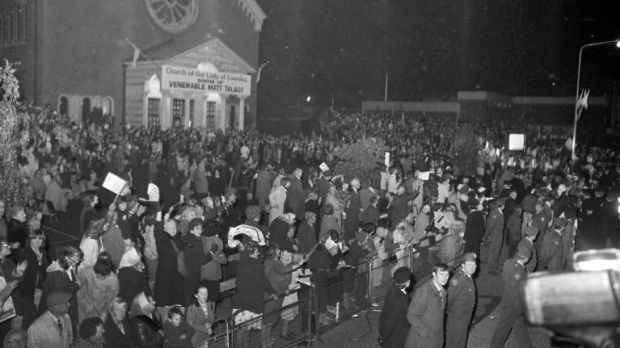
During his 1979 visit to Ireland, Pope John Paul II had planned to stop on the street to visit Matt Talbot’s tomb in Our Lady of Lourdes church. However, the Popemobile was running behind schedule and drove on, much to the disappointment of many local people. Some said afterwards joyriders did not go down Seán McDermott Street as fast.
  Crowds outside Our Lady of Lourdes, Seán McDermott Street in 1979 waiting for Pope John Paul II. Photograph: Dublin City Council photographic collection 
Crowds outside Our Lady of Lourdes, Seán McDermott Street in 1979 waiting for Pope John Paul II. 
 
“The story still persists, of course, of how people were waiting for Pope John Paul to stop,” said Fr Hugh O’Donnell at the church on Sunday. “The significance of a stop, no matter how brief, is very important. In some ways it’s a corrective, almost. The expectation was there in ’79, that he would stop,” he said.
 
Fr O’Donnell said Pope Francis’s visit, which would follow his meeting at Dublin Castle with Taoiseach Leo Varadkar and other members of the Government, was not an official stop. “He won’t be saying anything. He won’t even come into the church. So, I would say it’s more a symbolic gesture, a very reassuring gesture for the people of the area.

“Also we have the tomb of Matt Talbot here who is a real symbol of, an exemplar of, someone who dealt with addiction in a particular way. He’s well known all over the world, even more so I think than locally.”

Friday, October 28, 2016

Vatican Tightens Rules on Miracles and Money in Sainthood Cases

New rules approved by Pope Francis and released by the Vatican on 09 September 2016 are designed to make the process for approving a miracle in a sainthood cause more stringent, and also to ensure there's a clear paper trail behind who's picking up the tab and how much is being spent.
The text was approved by Italian Cardinal Pietro Parolin, the Vatican’s Secretary of State, in the name of Pope Francis in August and released on Friday
.
Italian Archbishop Marcello Bartolucci, the number two official at the Vatican’s Congregation for the Causes of Saints, presented the highlights of the new measures in a note released by the Vatican’s Press Office.

The new rules include:
  • To approve a miracle, at least 5 out of the 7 members of the body of medical experts within the congregation must approve, or 4 out of 6, depending on the size of the group, as opposed to a simple majority.
  • In case a miracle report is rejected on the first go-around, it may only be reexamined a total of three times.
  • In order to reexamine a miracle claim, new members must be named to the consulting body.
  • The president of the consulting body may only be confirmed to one additional five-year term after the original mandate expires.
  • While in the past payments to experts could be made in person by cash or check, now the experts must be paid exclusively through a bank transfer.
In general, the going rate in sainthood causes is roughly $560 for each of the two medical personnel asked to perform a preliminary review, and about $4200 in total for the seven members of the medical consulting committee.

The new rules are not retroactive, and hence they do not invalidate any beatifications or canonizations performed under earlier procedures.

Bartolucci said work on the new rules began one year ago, around the same time that leaks of confidential Vatican financial documents raised questions about financial practices in the Congregation for the Causes of Saints.

In his book “Merchants in the Temple,” Italian journalist Gianluigi Nuzzi charged the congregation was among the most reluctant Vatican offices to cooperate with new transparency measures imposed as part of Francis’s project of Vatican reform, and asserted that the average cost of a sainthood cause was about $550,000.
U.S. Catholic officials traditionally have used $250,000 as a benchmark for the cost of a cause from the initial investigation on a diocesan level, to a canonization Mass in St. Peter’s Square at the Vatican, though that cost can increase depending in part of how many people take part in the canonization ceremony and the logistics of organizing the event.

In March, Pope Francis had already approved a new set of financial procedures for the congregation, outlining procedures for handling contributions and specifying which authorities are charged with overseeing the flow of money.

Under those measures, while the postulator, or promoter, of a sainthood cause can continue to administer the funds for each cause, the bishop of the diocese or the superior general of the religious order that initiates the cause or another church authority must review financial statements and approve the budgets for each cause.

The rules approved in March also confirm a “Solidarity Fund” created by St. Pope John Paul II in 1983 to help cover the costs of causes where resources are lacking, giving the congregation discretion to transfer unused money from one case into the fund to cover the expenses of another.

Saturday, October 24, 2015

Proposed Papal Visit to Ireland Should Include Matt Talbot Shrine

The following is a Letter to the Editor of The Irish Catholic published on 15 October 2015 at http://irishcatholic.ie/article/papal-trip-ireland-should-include-matt-talbot-shrine
The Irish Catholic
The Irish Catholic

Dear Editor,
Your front page story in last week’s The Irish Catholic (08/10/2015) focused on a possible papal visit to Ireland in 2018 and the places that may be included in his itinerary. (See http://irishcatholic.ie/article/pope-hand-picked-ireland-hope-2018-visit)

Pope hand-picked Ireland in hope of 2018 visit
Francis has a ‘special affection’ for Ireland
- See more at: http://irishcatholic.ie/article/pope-hand-picked-ireland-hope-2018-visit#sthash.am4qQHWY.dpuf
If he were to come he should also visit the Shrine of Matt Talbot. This was actually included in John Paul II’s own itinerary, but due to logistic reasons, he was just driven past the church. The disappointment of the locals is still very palpable today, 36 years later. (See http://venerablematttalbotresourcecenter.blogspot.com/2015/10/pope-john-paul-ii-crowd-waiting-at-matt.html)

Though situated right in the heart of Dublin, the North inner city is a marginalised community having to endure the social stigma attached to it. However there are many positive elements to be found there which are often overlooked.

In the words of Archbishop Diarmuid Martin: “Inner city Dublin has a great history of people looking after one another, especially when times are hard. This community has shown that it has extraordinary resources of goodness and caring and courage.”

Pope Francis loves the deprived and marginalised, and would feel very much at home visiting such a community to which Matt Talbot belonged. Moreover, Matt would be very much to the heart of Pope Francis, since he is a clear “witness of the mercy and tenderness of the Lord”.

 
The Pope’s visit will highlight the World Meeting of Families; in the inner city he will surely meet many resilient families, as the archbishop himself affirms: “There are great families in this parish. There are great mothers and grandmothers, who when things went wrong kept families together.”

If the Pope were to visit Matt Talbot’s Shrine he would surely also visit his own Jesuit Community in Gardiner street, and pray at the shrine of Venerable John Sullivan. Holiness touches the lives of all people, whatever their background!

Yours etc.,
Richard Ebejer SDB,
Our Lady of Lourdes,
Sean McDermott Street, Dublin.
Site of the Matt Talbot Shrine

Pope John Paul II crowd waiting at Matt Talbot Shrine

This 1979 photograph and text is from the Dublin City Council Photographic Collection at http://www.dublincity.ie/image/libraries/030-our-lady-lourdes.


http://www.dublincity.ie/sites/default/files/styles/responsive-breakpoints_theme_dublin_city_theme_a1_wide_1x/public/galleries/030_Our_Lady_Of_Lourdes.jpg?itok=wpbt7-5U

"Our Lady of Lourdes was built in 1954 and contains the shrine of Matt Talbot (1856-1925). This photo was taken during the visit of Pope John Paul II in September 1979. 
Pope John Paul II had voiced his support for the beatification of Matt Talbot and the locals were convinced that the Pontiff would visit the shrine. 
Despite many weeks preparation, the Papal cavalcade swept past the disappointed gathering. As one local put it: 'no joyrider even came down Sean McDermott Street so fast'."


Sunday, June 1, 2014

Parish newsletter item about Venerable Matt Talbot


The following item appeared in a parish newsletter. Perhaps we can suggest that such an item about Matt Talbot be included in our parish newsletter/bulletin.


Venerable Matt Talbot

By Fr John
Newsletter for 5th June 2011- St Agnes’ Parish
Crumlin, Dublin 12


Last Sunday morning a woman who was attending Mass here in St Agnes approached me after one of morning Masses. She was from Donegal and was visiting family in the area. She asked about Matt Talbot and she expressed a wish to visit his tomb. I directed her to Sean McDermott Street.


I feel that he seems to be remembered more in other parts of the country and in the USA especially, then in his native city. On Tuesday next {7th June} we will be recalling the anniversary of his death. He died suddenly on this date in 1925 in Granby Lane on his way to Mass in Dominick St Church. Within a few short years of his death his reputation as a saintly man and especially as a patron and protector of those suffering from all forms of addiction, and their families was established.


From his early teens until the age of 28, Matt was a hard drinker. Perhaps if he was living in our age his problem would have been hard drugs. After his conversion, he led a life of prayer, devotion to the Mass and the Blessed Virgin and he gave away all he had to help the poor. He never wrote a religious book or founded a Religious Congregation. He was devoted to prayer and penance, and his little room at 18 Rutland St was his monastic cell.


Pope John Paul II had a great interest in Matt Talbot and said he would like to come to Ireland to beatify him. In a strange twist, John Paul II was himself beatified after Easter a few years after his death. However Matt Talbot, that saintly man, who died 86 years ago this week still awaits that deserved honour.

Wednesday, April 23, 2014

Canonisations of Pope John XXIII and Pope John Paul II


On April 27, 2014, which is Divine Mercy Sunday, Pope Francis will raise to the altars of the saints Blessed John Paul II and Blessed John XXIII.


In preparation for these canonisations, the Irish Catholic Bishops' Conference has created a special web feature to commemorate this historic event at
http://www.catholicbishops.ie/2014/04/08/canonisations-blesseds-john-xviii-john-paul-ii/. This link includes:
  • The Process of Becoming a Saint
  • The miracles attributed to Blessed John XXIII and Blessed John Paul II
  • Life and ministry of John XXIII and John Paul II
  • Events in Ireland
  • Details of broadcast of the ceremonies
  • Details of Irish cinemas showing the ceremonies live in 3-D
  • Special commemorative booklets from Veritas Publications  (http://www.veritasbooksonline.com/)


Both of these popes knew of Venerable Matt Talbot. See, for example,  http://venerablematttalbotresourcecenter.blogspot.com/2008/02/popw-john-paul-ii-wanted-to-beatify.html


Friday, July 19, 2013

The Gift of Self and Cooperation

“The multiplication of the loaves: Meditation during a retreat on the gift of self and cooperation.

Father Alberto Hurtado, S.J. (1901-1952)*

Introduction

Indecision, faintheartedness is the great obstacle in the plan of cooperation. We think: “I’m not worth all that much”, and from this comes discouragement: “It makes no difference whether I act or fail to act. Our powers of action are so limited. Is my unpretentious work worthwhile? Does my abstaining from this have any meaning? If I fail to sacrifice myself nothing changes. No one needs me… A mediocre vocation?” How many vocations are lost. It is the advice of the devil that is partly true. The difficulty must be faced.

The solution

5,000 men along with women and children have been hungry for three days… Food? They would need at least 200 denarii to feed them and this is the approximate yearly salary of a laborer. In the desert! “Tell them to go!” But Andrew, more observant says: “There are 5 loaves and 2 fish, but what are these among so many!” Here we have our same problem: the disproportion.

And the loaves. Made of barley, hard as rocks (the Jews used wheat). And the fish. They were from the lake, small, rather mushy in texture, carried by a young boy in a sack that had lain on the ground for 3 days in the heat… not much of a solution.

Did the Lord despise this offering? No, and with his blessing he fed all the hungry and had leftovers. Neither did he despise the leftovers: 12 baskets of the surplus were gathered, fish heads and bones, but even this he valued.

The young boy consented to give Christ his poor offering, not realizing that he would feed the multitude. He believed that he had lost his small possession but he found instead that there was even a surplus and that he had cooperated for the good of the others.

And me… like those fish (less than those loaves) bruised and perhaps decomposing but in the hands of Christ my action may have a divine scope a divine reach.

Remember Ignatius, Augustine, Camillus de Lellis, and Matt Talbot, base sinners whose lives were converted into spiritual nourishment for millions who will continue to feed on their witness.

My actions and my desires can have a divine scope and can change the face of the earth. I will not know it, the fish did not know it either. I can do a great deal if I remain in Christ; I can accomplish much if I cooperate with Christ…”


*Note:  Popularly known in Chile as Padre Hurtado,  Alberto Hurtado Cruchaga was beatified on October 16, 1994 by Pope John Paul II and canonized by Pope Benedict XVI on October 23, 2005. St. Alberto Hurtado Cruchaga was one of the first people to be elevated to sainthood during the papacy of Pope Benedict XVI; he was also the second Chilean saint, after Saint Teresa of Los Andes.

Two brief biographies include http://www.amdg.ie/2005/11/04/the-making-of-a-saint/#more-142 and  https://en.wikipedia.org/wiki/Alberto_Hurtado

To diffuse the writings (and biography) of Padre Hurtado among a wider public, A Fire that Lights other Fires: Selected pages from Father Alberto Hurtado, S.J. (2012) is available free online at http://www.clerus.org/clerus/dati/2012-07/31-13/02_A_Fire.html.

(With their canonization later this year, two additional saints who knew of Matt Talbot are Pope John Paul II and Pope John XXIII.)


Update:  The Vatican has confirmed that John XXIII and John Paul II will be canonized in the same ceremony on April 27, 2014

Tuesday, March 5, 2013

Venerable Matt Talbot on Facebook in English and Polish


While the Venerable Matt Talbot Resource Center is not on Facebook, Venerable Matt Talbot is present on this social media platform.

The newest Facebook listing for Venerable Matt Talbot can be found at http://www.facebook.com/pages/Matt-Talbot/304690079653019.  Its originator also has a Facebook page about Mateusz Talbot in Polish at https://www.facebook.com/SlugaBozyMateuszTalbot  and a website at www.mateusztalbot.pl.

Least one be surprised about a Polish interest in Matt, Blessed Pope John Paul II as a boy wrote a paper about Matt Talbot and as pope wanted to beatify Matt during his pontificate since he thought that Matt’s example could be very valuable for those addicted to alcohol and drugs.

Sunday, December 30, 2012

The "Hoped-For" Beatification That Didn't Happen

[One of the holy people that Pope John Paul II wanted to beatify during his pontificate was Matt Talbot; he thought that Matt’s example could be very valuable for those who are addicted to alcohol and drugs (http://venerablematttalbotresourcecenter.blogspot.com/2008/02/popw-john-paul-ii-wanted-to-beatify.html).

Although Pope John Paul II had visited Ireland in 1979 (http://www.rte.ie/archives/exhibitions/681-history-of-rte/705-rte-1970s/289832-papal-visit-to-ireland/?page=3), information released just this past week indicates that he was considering returning to Ireland in 1981.]

Pope John Paul II 'was considering returning for a second visit to Ireland'
By Ed Carty
Friday December 28 2012

Pope John Paul II’s "unpredictable" nature could have seen him make a return papal visit in 1981 for the beatification of Matt Talbot, state papers have revealed.

John Magee, the former bishop of Cloyne and an aide to three popes, confided in an Irish diplomat that there was a possibility the pontiff would make the extraordinary move.

In a letter to the Department of Foreign Affairs at Iveagh House, embassy officer Frank Coffey relayed the thinking in the Vatican in March 1981.

"Fr Magee thinks it is not inconceivable that if and when Matt Talbot is beatified, the Holy Father may decide to have the ceremony in Dublin," he wrote.

On a separate letter he said that such a beatification could be linked to the 90th anniversary of the 1891 Rerum Novarum, an open letter from Pope Leo XIII addressing the condition of the working classes.

"Pope John Paul has also thought that the beatification of Matt Talbot would be a particularly apposite way to mark the anniversary," he wrote.

"However, it does not appear that Matt Talbot's cause has advanced sufficiently for this to be done.

"Nonetheless, bearing in mind the present Pontiff's 'unpredictability' we cannot rule out his taking some extraordinary measures to permit beatification this year."

Talbot, known as Venerable Matt Talbot, pledged sobriety aged 28 and a life of prayer, fasting and service, never taking credit and trying to model himself on the sixth-century Irish monks.

He was a member of the Transport and General Workers Union and worked in a lumber yard in Dublin docks.

Talbot is in the second stage of becoming a saint being known as Venerable. His beatification is still pending.

The detail was contained in files on plans for the Pope's visit to Ireland under the code 2012/58/3.

Saturday, July 16, 2011

Pope John XXIII referred to Matt Talbot in a letter

In a letter sent by Pope John XXIII (IOANNES XXIII PP.) to the Most Rev. John Charles McQuaid, Archbishop of Dublin and Primate of Ireland, on the occasion of the Centenary of Holy Cross College, Clonliffe (then the Major Seminary of the Archdiocese of Dublin), he mentions Abbot Columba Marmion and Matt Talbot in the following excerpt:

“In this survey of the history of your Seminary, short though it may be, We cannot fail to mention the names of two personages whose virtues are renowned throughout the world: Abbot Columba Marmion, who was first a student and later a Professor in the College; and Matthew Talbot, who strove earnestly after great sanctity when he had been rescued from vice through the influence of one of the Professors of the College.”


On September 3, 2000 Pope John XXIII was declared “Blessed” by Pope John Paul II, who himself was declared “Blessed” in 2011.

Blessed Columba Marmion (1858-1923), beatified by Pope John Paul II on September 3, 2000, was one of the most popular and influential Catholic writers of the 20th century. Matt Talbot (1856-1925) was declared “Venerable” by Pope Paul VI on October 3, 1976.

For three references to Bl. Columba Marmion, see http://www.ignatiusinsight.com/features2006,/czehnder_bmarmion_sept06.asp
,http://www.vatican.va/news_services/liturgy/saints/ns_lit_doc_20000903_columba-marmion_en.html, and http://en.wikipedia.org/wiki/Columba_Marmion

Thursday, March 3, 2011

What makes a 'fast-track' saint?


We are occasionally asked about the seemingly “slow” pace toward official sainthood of Venerable Matt Talbot. While we do not have any “inside” information about his cause proceedings (nor any other information about Matt) beyond what is available on the web and in books, we must realize that the process has taken one or more centuries of many who become officially recognized as saints.


There are a few, however, who are on a “fast-track” toward sainthood. John Allen, a veteran Vatican correspondent for NCR, suggests in this article that most fast-tract sainthood cases share five traits.


Sunday, January 24, 2010

Native Americans support campaign for Matt Talbot


Independent Catholic News
October 2, 2000
A group of Native American Indians came to Dublin last week for a special Mass to support the beatification of Matt Talbot. Dallas Chief Eagle was among an international congregation who joined President Mary McAleese at a Mass in Our Lady of Lourdes Church, Dublin, to promote the cause of Talbot, who died in 1925. "The Pope has shown a particular interest in Matt Talbot and commended him to the bishops of Africa as a protector of those who suffer from any kind of addiction," a spokesman said. Talbot was officially declared 'Venerable' in 1973 - one of the first steps on the road to sainthood.

Born in 1856, to great poverty, Talbot began drinking at the age of 12. By his 20s he was a serious alcoholic but in 1884 he underwent a conversion experience and became a teetotaller and ascetic. Talbot gave away all his possessions and spent the rest of his life praying and fasting.

Since his death 75 years ago, a cult has grown around the world with hostels and rehab centres named after him in Poland, Australia and Scotland. There are five Talbot centres in Glasgow alone. Fr Morgan Costelloe, the vice-postulator of his cause, is going to Krakow in Poland later this year to open a new hospital for recovering alcoholics which is dedicated to his name. More than 50,000 people have joined the Matt Talbot retreat movement in Canada, the United States and Mexico.


Note: We appreciate Independent Catholic News (http://www.indcatholicnews.com/index.php)
for maintaining a link to our resource center (listed as Matt Talbot Resource Center).

Thursday, December 31, 2009

Pope John Paul II joins Matt Talbot as "Venerable"

The late Pope John Paul II, who as a boy had written a paper about Matt Talbot and had supported the cause of the Venerable Matt Talbot as the patron of alcoholics, has now himself been declared "Venerable." (JB)


" Pope Benedict XVI has signed a decree recognizing the late Pope John Paul II's life of “heroic virtue.” With his signature, Benedict XVI throws the door wide open to the beatification of the much-loved Polish Pontiff and gives him the title "Venerable."

On Saturday morning, the Congregation for the Causes of Saints led by Archbishop Angelo Amato met with Pope Benedict XVI to celebrate their 40th anniversary as a dicastery of the Holy See and to present decrees for papal approval. Pope John Paul II's name was among the Congregation's nominations for those possessing “heroic virtue.”


The next step towards canonization of John Paul II is a second decree to be signed by the Pope that attributes a miracle to him. It is thought that this miracle will be one that has already taken place but has not yet been officially recognized. The miracle involves a French nun who was cured of Parkinson´s disease through John Paul II's intercession.


Following the approval of his first miracle, Venerable Karol Woytilya would be eligible for beatification, and pending a second miracle, he could be declared a saint.


The Vatican has processed his case in record time. Since the Pontiff´s death, less than five years have passed. Five years is the normal amount of time that must go by before the Holy See can begin the investigation process. In this case, Pope Benedict made an exception just a little over a month after John Paul II's death in March of 2005."


Source: Vatican City, Dec 19, 2009 / 11:28 am (CNA)

Monday, April 28, 2008

Pope John Paul II, St. Louis de Montfort, and Matt Talbot


Not only were the writings of St. Louis de Montfort influential for Matt Talbot, Pope John Paul II noted their importance to him in his youth. This quote from Pope John Paul II may help those who are concerned that a devotion to Mary may compromise their worship of Christ.

As far as I am concerned, the reading of this book [True Devotion to the Blessed Virgin by de Montfort] was a great help to me in my youth: "I found the answer to my doubts," which were due to a fear that worship given to Mary "if developed too much, might end by compromising the primacy of the worship of Christ" (My Vocation, Gift and Mystery, pg. 42). Under the wise guidance of St. Louis Marie de Montfort, I understood that, if we live the mystery of Mary in Christ, there is no such risk. This saint's Mariological thought, in fact, "is rooted in the Mystery of the Trinity and in the truth of the Incarnation of the Word of God" (ibid.)." This quote is from the letter of Pope John Paul II referred to below ( text of this letter).

Commentary on the Letter of Pope John Paul II

SOURCE: http://www.montfort.org/English/news.htm


On 8 December 2003, Pope John Paul II wrote to the Religious of the Montfortian Congregations, a letter to commemorate the 160th anniversary of the publication in 1843 of the "Traité de la Vraie Dévotion à la Sainte Vierge" (True Devotion to the Blessed Virgin). In the letter he reflects on certain aspects of the teaching of St. Louis Marie de Montfort concerning consecration of oneself to Jesus through Mary. See the text of this letter.


St. Louis Marie Grignion de Montfort, all his life, practised and preached in his missions and retreats a form of devotion to Our Blessed Lady which he called "the most perfect devotion" to her, and which is often referred to as "the Holy Slavery". About Autumn 1712, he set down his teaching on this devotion in a book which has become, as Pope John Paul says in this letter, a classic of Marian spirituality: "True Devotion to the Blessed Virgin". After St Louis Marie's death in 1716, his followers in the Company of Mary continued to make this devotion a major part of their teaching and preaching, but, for some reason, they never thought to publish his book, although they possessed the manuscript. They did, however, value the manuscript sufficiently that, when the French Revolution brought chaos to the Vendée region where the Mother-house of the Company of Mary was, they hid it, along with other precious papers, in a field nearby. After the revolutionary fury had abated, they retrieved these papers and put them back in the library of the Mother-house, but then, it seems, forgot about them. It was only in 1842 that one of the members of the Company of Mary, doing some research in the library, came across the old manuscript and recognised the handwriting of St. Louis Marie. The manuscript was quickly authenticated, and in 1843 was published for the first time as "Traité de la Vraie Dévotion à la Sainte Vierge" (Treatise on True Devotion to the Blessed Virgin).


Some 20 years later, in 1862, Fr. Frederick William Faber, of the London Oratory, made the first English translation of the book and had it published in London. There have been a number of English editions published since that time, in the United States as well as in Gt. Britain. In 1883, Bishop Herbert Vaughan, at that time the Bishop of Salford in England, and the founder of the Mill Hill Missionaries, wrote a letter recommending St. Louis Marie's book to all the clergy of the diocese. When he was transferred to Westminster Archdiocese in 1892, he did the same for his clergy of that diocese.


St. Louis Marie's book has been an inspiration to many thousands of people throughout the 160 years since its first publication. Our present Holy Father has several times acknowledged its influence on him, as he does again in this letter. It is well known that Frank Duff, the founder of the Legion of Mary in the 1920s, made the "Holy Slavery" the basis of the Legion's spirituality. Others in the English-speaking world who have been deeply influenced by it include Matt Talbot, Mother Mary Potter (foundress of the Little Company of Mary), Eddie Doherty and Catherine de Hueck Doherty (these two the founders of the Madonna House apostolate based in Combermere, Ontario).


Friday, February 22, 2008

Pope John Paul II wanted to beatify Matt Talbot


In this 2005 homily the homilist recounts a memory of three people who Pope John Paul II said he wanted to beatify.
The key paragraph follows:

He invited the bishops to lunch, half of us one day, the other half the next. These were very relaxed and informal occasions. He told us that he would dearly love to beatify three people, Damien of Monokai, Cardinal Newman and Matt Talbot. He had written a biography of Matt in Polish in his young days. He asked us to pray for a miracle since Matt’s example could be very valuable for those who are addicted to alcohol and drugs. Damien is canonised and Newman is beatified but Matt Talbot is still awaiting a miracle.


Source: http://www.cashel-emly.ie/main/archbishop/massforpope.htm